


War Is How a Nation Eats
Snowflakes, entropy laundering, and the geopolitics of chaos exhaust

I recently encountered Ilya Prigogine’s work on dissipative structures. As I internalized what they represent and their implications, this entire essay almost immediately took shape in my head. You do not need to be a physicist to understand what’s in here (I’m not); if you can consistently digest my other pieces, you should do just fine. And if you enjoy my other work, I don’t think this one will disappoint.
There’s a small investment that needs to be made at the beginning of this essay to understand some axioms of physics that I explain in a way where you need no previous knowledge of the topic. Afterwards, we’ll have some fun that makes that investment worthwhile and review concrete applications of these frameworks as it relates to war, nations, inequality, and the rise and fall of empires.
I listened to this song on loop while writing this essay. Probably one of the more beautiful things I’ve heard and what I often play while walking around Europe in the winter.
Here is the journey you are about to take. There’s no going back.
I. Chaos Exhaust
The Second Law and dissipative structures: all order in service of chaos
II. Life: Little Pockets of Orderly Patterns
You gotta “do work” to survive
III. Nature's Chaos Patterns
Snowflake entropy agents and convection cells
IV. The Physics of Empire
Imperial heat waste, Rome, war, and the CIA’s entropy trade
V. Non-Kinetic Chaos Merchants
Switzerland, Singapore, China, national aid, petrodollars, and welfare
VI. Nuclear War and Entropy Laundering
Nukes create national chaos brokers
VII. Mother Nature, Father Universe
One breeds extremes, the other eats them
VIII. Equilibrium Accounting
Peace and volatility through the lens of energy dislocations
Chaos Exhaust
Every living, organized thing in our environment (including you) is in a perpetual state of sowing chaos. Entropy is the exhaust of existence. Fumes that scatter energy toward an increasingly disordered state are paradoxically aligned with the presence of anything with structure.
Within an inexorable drift towards cosmic disorder, pockets of intricate order arise that help expedite this disruptive direction: the snowflake, engine, and hurricane are all agents of chaos. This applies to any machine. To any organism. Which is to say, it also applies to nations.
Orderly phenomena beget the obverse somewhere else. A complex machine undermines complexity outside of it. A country is a dissipative structure, and war is how it feasts.
The Second Law: Total Entropy Never Declines
Terms:
Entropy: is the thermodynamic measure of disorder or randomness. This essay will use it interchangeably with chaos, volatility, upheaval, disorder, mayhem, etc.
The Principle of Maximum Entropy Production (MEP): In nonequilibrium thermodynamics, it’s observed that physical and biological systems self-organize or evolve in ways that maximize their rate of entropy production, within the constraints of physical laws. The pathway that most rapidly depletes energy gradients (or most thoroughly degrades usable energy) is often dynamically favored.
The Second Law of Thermodynamics: states the total entropy of an isolated system never decreases. However unlike MEP, it does not say that systems always do so at the maximum possible rate. Rather that the direction of spontaneous change is always one of non-decreasing net entropy.
MEP is not universally guaranteed by the Second Law. The Second Law only mandates that entropy can’t spontaneously go down.
MEP is a hypothesis that notes, under many real-world conditions, the stable steady state is the one that maximizes the rate of entropy production.
MEP is a documented tendency or organizing principle in non-equilibrium systems, it is not an ironclad law.
“Far from equilibrium”: means a system has a large imbalance (gradient) that creates potential for dramatic change. In physics, it's when there's a significant difference in energy, temperature, or concentration that the system "wants" to balance out.
Example: Picture a pizza fresh from the oven (400°F) sitting on a cold kitchen counter (70°F). This 330-degree temperature difference represents a hefty energy gradient; the system is far from equilibrium in this setting.
Energy will flow rapidly from the pizza to its surroundings through steam, radiating heat, and warming the counter. The further from equilibrium (the hotter the pizza), the more dramatic and rapid the changes.
Contrast this with a room-temperature pizza that's only 5 degrees warmer than the counter; it's much closer to equilibrium, changes happen slowly and less dramatically in this situation.
Systems far from equilibrium have the "fuel" to summon more forceful, often self-organizing patterns (like how hot food emits rising steam spirals). Keep this concept in mind for later.
Thermodynamics, Biology, and Organisms
There’s a certain elegance in noticing all of life as little pockets of order that nourish themselves by emitting disorderly discharges.
Said more technically: any organized structure (living or mechanical) must dissipate energy gradients to subsist, and in doing so excretes entropy into its surroundings. Counterintuitively, the emergence of orderly structures serves both the Second Law and MEP by locating more efficient ways to degrade free energy (which is synonymous with entropy).
This helps explain why we see highly complex phenomena (cells, organisms, civilizations) blossom in a universe governed by the Second Law. Remember, the Second Law asserts the total entropy of an isolated system never spontaneously decreases. It doesn’t forbid isolated pockets of order, so long as the overall change (mechanism + surroundings) results in an increase of entropic activity.
While physics doesn’t ascribe intention, humans do; it’s not farfetched to see the universe’s teleology as one constantly striving to increase entropy. As innately chaos seeking. It’s an omnipresent force.
Dissipative Structures
Localized order begets entropic exhaust; this is the essence of "dissipative structures”.
A dissipative structure is a self-organized system that maintains internal order by continuously importing energy, matter, or information and exporting entropy into its surroundings. This term and concept came from Nobel Prize winning physicist Ilya Prigogine.
It’s established science that systems far from equilibrium form orderly patterns that disproportionately increase external disorder. What do we mean by patterns:
“Orderly patterns” do not only refer to crystalline shapes and cyclones, it also applies to any machine, organism, and structure that has internal coherence. These are all orderly patterns and/or orderly structures.
Orderly patterns degrade free energy into heat (entropy) more efficiently, however they themselves require lower internal entropy (structure) to exist.
The idea that lifeforms support a low-entropy internal state by exporting entropy to their surroundings is well established, because all machines and organisms must “do work”.
Do Work
What does it mean to “do work”?
In physics, “work” means transferring energy from one form or place to another in a directed, nonrandom way that causes displacement (e.g. moving a weight, pumping heat).
If there's no movement, no work is done.
To “do work” and direct energy flows, a complex mechanism is ideal, like an engine, enzyme, or warm body. These are all examples of “low-entropy structures”.
Note: “Low-entropy structures” is simply another way to conceptualize “orderly patterns”. I’m restating it differently to help reinforce the concept.
These formations have specialized shapes (e.g. a tornado or snowflake) and are antithetical of a disorganized jumble, so we say they have low internal entropy. However, these beautifully ordered arrangements facilitate the production of greater global entropy. Why? How?
Without any structure free energy will eventually dissipate, but often more slowly or less completely than if an orderly pattern was present. An illustration:
Machine vs. No Machine Energy Dissipation
Without a machine:
An energy gradient dissipates more slowly or incompletely. Entropy increases, but not as much as it could have.
With a machine:
We invest energy to generate the internally ordered machine (this effort secretes entropy).
When the machine “does work” it causes even more entropy to be produced by dissipating the gradient more quickly and thoroughly. The more adept it is at harnessing energy, the greater its chaos fumes.
The net effect from this process is net higher total entropy than if the machine had never been built. Thus how internal order begets externalized disorder.
Note: a dissipative structure is defined by what it does (export entropy while maintaining internal order), not by what it’s made of. Cells, hurricanes, blast furnaces, and industrial plants all qualify. The dissipative-structure litmus test is not whether its organic, but whether it dissipates energy and does work. Synthetic creations can do this just as well if not better than organic ones.
Whether it’s machine, engine, human, or any orderly pattern, they all require investing energy to create. From a thermodynamic frame, the insides being carbon-based (people, crops) or silicon-based (GPUs, fabs) is irrelevant; both are orderly patterns that dissipate free-energy gradients, AKA dissipative structures. Their operation degrades energy into heat waste, resulting in increased net disorder compared to them never having existed at all.
The Chaotic Lifecycle Recap
Structures emerge, consuming energy in their creation, degrade energy sources, then evaporate once they have nothing left to dissipate.
Overall entropy continually rises because every step (construction, operation, and breakdown) is disorder accretive.
If building on orderly vehicle yields more overall energy dissipation (remember degrading energy is synonymous with entropy) than not building it, we see a persistently emergent “direction” for systems to generate pockets of local order to accelerate the dissipation of energy to more quickly reach equilibrium.
In nature, there are echoes of this everywhere: from snowflakes, convection cells, and ladybugs. Each is a sort of ephemeral, elegant schema that dumps entropy into its environment more capably than a random state would.
Life’s Chaotic Creations

What you just read regarding machines applies all the same to the snowflake and the cyclone.
In far-from-equilibrium environments, organized flow patterns coalesce that increase overall entropy more effectively than a shapeless swirl or random scattering could. From the lens of entropy and order, a living creature is no different than a machine; they are both orderly structures that emit disorder to preserve themselves.
Life itself is a dissipative structure.
Erwin Schrodinger described life as “feeding on negative entropy,” meaning organized, living systems import low-entropy resources and export high-entropy waste. The environment’s disorder must expand so that the organism may live. Jesus died for your sins, and the universe loses its coherence from each of your… whims?
When you have a significant gradient, like a major difference in temperature or pressure, there’s an opportunity to “use up” that gradient. This produces orderly patterns.
The system reorganizes itself into a pattern (dissipative structure) that transports or converts energy more optimally than a disordered state would.
Chaos Patterns:
Cells are highly organized internally and use continuous flows of energy (e.g. sunlight) to stay that way. In doing so, they dump heat waste into the environment.
Consider the snowflake
You have cold, supersaturated water vapor in a cloud.
A thermodynamic gradient is present. The vapor has the potential to condense into ice, releasing latent heat in the process.
A tiny ice crystal begins to coalesce around a speck of dust or impurity and blooms into an exquisite sixfold symmetry. Such a pretty orderly pattern.
How this raises net entropy
Condensation releases heat to the surrounding air. That increases the environment’s entropy more than the small decrease in entropy “spent” to conceive the orderly crystal.
As that crystal arranges the water molecules, it promotes the continuous condensation of more vapor, continuing to release heat. The environment’s total disorder (molecular motion in the air) rises!
End result
This lovely snowflake has the net effect of increasing the random thermal energy of its surroundings.
The universe as a whole ends up in a higher-entropy state than if you had remained with only cold vapor.
That little snowflake… was an agent of chaos.
Convection Cells (Bénard Cells)
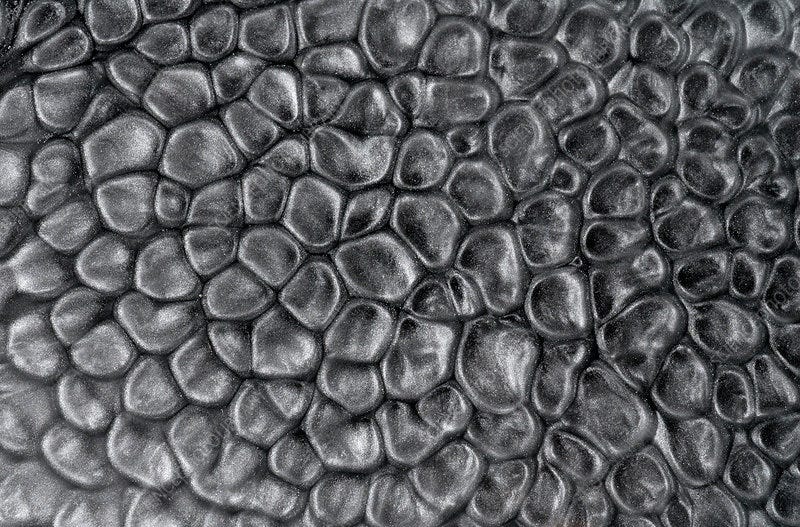
“Bénard convection” is a classic lab experiment.
Setup
A shallow layer of fluid (like water or oil) is heated from below and cooled from above. The fluid does not respond in a random way to this act.
Pattern formation
Beyond a certain temperature difference (the Bénard instability threshold), the fluid spontaneously organizes into convection cells, often in neat hexagonal or roll-like patterns.
Fluid in the center of a cell rises (carrying heat upward), flows outward across the top, cools near the surface, and then sinks down around the edges, repeating in a cycle.
Why this is “ordered”
Look at the fluid from above and you’ll see geometric arrangements. Clearly a localized orderly pattern.
Why it increases total entropy
The cells more proficiently transfer heat from bottom to top than a random process would.
By forming these coherent arrangements, the system quickly dissipates the temperature gradient. Which is to say, it unleashes entropy most efficiently this way.
The net result is that the fluid plus its surroundings (the heat source below, the cooler environment above) gain more total entropy because the gradient is drained more completely by these emergent convection patterns.
End result
These orderly cells rapidly push toward equilibrium, striving to eliminate the temperature difference (gradient). Once the gradient is exhausted the cells vanish.
Hurricanes
Warm tropical oceans have high surface temperatures, and above them the upper atmosphere can be significantly cooler.
This large temperature and moisture gradient is a far-from-equilibrium condition.
How it maximizes entropy exhaust:
A hurricane forms when convection, evaporation, and condensation organize into a massive, rotating storm system.
A hurricane is a structured vortex (low local entropy) that decrements the ocean–atmosphere energy gradient ruthlessly well by transporting huge amounts of heat and moisture upward then radiating it out to space.
A warm ocean plus a cold troposphere equals a spinning heat engine that flings moisture, wind shear, and ruined vacation plans across the Atlantic.
These storms (and large-scale atmospheric circulation in general) evolve in ways consistent with “maximum entropy production”, vigorously consuming thermal and moisture gradients.
That windy spiral exists because it's devastatingly effective at moving heat from warm oceans to cool atmosphere. The greater the storm, the more thoroughly it feasts on the temperature gradient that birthed it. Order in service of chaos.
Localized order emerges to dissipate gradients: Recap
An orderly flow or pattern (convection cell, storms) or structure (snowflake) assemble pathways that let energy escape more effectively.
It costs a local “entropy budget” to arrange molecules or fluid flows into patterns, however the global effect (system + environment) is a larger gain in entropy than if that local order had never been spawned.
This is favored by thermodynamics
If forming a pattern ends up lowering free energy faster (i.e. “burning” the gradient), that path wins out dynamically.
That’s why these patterns spontaneously materialize: they are the “preferred” states in far-from-equilibrium situations.
Once the system’s free energy is depleted, the pattern no longer has a driving force; it relaxes to a high-entropy equilibrium and disappears.
That’s when the snowflake melts and the hurricane withers.

Over evolutionary time, organisms that are better at exploiting and dissipating energy sources often outcompete others, leading to increasingly sophisticated lifeforms that, ironically, keep boosting global entropy dissipation. Survival of the fittest? More like survival of the best at oozing chaos.
Thank you for taking the time to learn these concepts and read this far, now we get to the fun(er) parts.
Just as heat flows down temperature gradients, capital and commodities flow down power gradients; whatever organism captures that cascade most productively reaps order at home, and exports disarray abroad.
Which takes us to nations….
The Physics of Empire

The imperative to consume free energy faster is an unwitting guiding light for life’s relentless evolutionary march. All organisms are dissipative structures, and human collectives are no exception.
Cells keep highly organized internal states by metabolizing energy from the environment and discharging entropic heat waste. The difference between cell and country is one of scale and mechanism.
Where a cell exports heat, a nation exports various types of disorder through economic extraction, political interference, and ultimately, war. The greater a nation's internal complexity, the more entropy it must discharge to service that complexity.
Powerful nations and their perennial attraction to conflict are convection cells writ large. Fortresses of internal order via paved roads, laws, power grids, and borders. Holding that snowflake-esque lattice together takes work: tax receipts, supply chains, police, and a daily blitz of raw thermodynamic calories metabolized by forty‑hour workweeks (thirty hours if you’re European).
Internally, nations strive to implement order with institutions that foster stability, continuously “doing work” to sustain themselves. However the Second Law never sleeps; the entropy produced by that work must go somewhere. The most-successful nations act as the most-effective volatility spigots, disseminating entropy into the global environment in the process.
Modify your understanding of war, conquest, and economic domination as bottom-up thermodynamic requirements. As events that emerge within certain environmental extremes.
Strip away the diplomatic veneer of international relations, look past the top-down, human-readable headline narratives saturated with just-so ideologically motivated stories. Remember our discussion regarding machines? Well, gaze into The Machine. Understand what The Machine must do to maintain its internal coherence: energy must be consumed, which means work shall be done, which means a trail of turbulence must be excreted somewhere. Imagine you’re assessing a country-sized snowflake.
Nations, like all organisms, are also dissipative structures: organized patterns, Byzantine engines, preserving internal harmony by dumping disarray into their surroundings. This transforms the perception of war, intelligence operations, and imperial machinations from moral tales into thermodynamic inevitabilities.
Empires necessarily export chaos, because the greater their local order, the disproportionately greater the externalized disorder elsewhere will be. The Second Law sends its regards.
Consider the Romans
Highly organized infrastructure, intricate bureaucratic governance, and systematic societal hierarchies: Rome was a low-entropy organism. To sustain and expand her internal order, she forcefully devoured resources of wealth, labor, and materials from conquered territories. Rome saw delicious gradients and came to eat.
These acts of conquest expelled entropy into surrounding lands through violence, upheaval, and extraction. A Roman thermodynamic engine that converted external resource gradients into internal order, secreting disruption and ruin in defeated regions.
The eternal city maintained spectacular internal organization by systematically degrading the civilizations around it. Subjugation consumes resources and human capital from previously ordered societies, reducing them to tributary provinces.
The British Empire was the supreme hurricane of its era. The convection-cell flow of wealth from colonies to conqueror birthed an orderly pattern that siphoned away capital more efficiently than random plunder.
The East India Company wasn't just a business, it was an entropy hose. Tending to London's high-order state by systematically spraying volatility across the Indian subcontinent. Famines, wars, and social disintegration followed in its wake. Local economies were gutted, sovereignty vitiated, and agrarian sectors restructured into extractive pipelines. Bengal, once fertile, became a graveyard: not by drought, but by design.
All companies (synonymous with machines) technically do this, but the greater the gradient (the larger the business relative to its surroundings) the more disorder it produces. We only see the big-time entropic emissions, but the microscopic secretions are happening all the time too.
Where the top-down storytelling pundit sees hostility and mercantilism, the bottom-up geopolitical physicist observes a thermodynamic inevitability: large gradients demand resolution.
Historians describe the demise of great empires as “decline”, however thermodynamics say “mission accomplished”.
The CIA’s Entropy Trade
When the CIA overthrows a government, say Iran 1953 (2025?), Guatemala 1954, Chile 1973, (many such cases, etc.), it acts as a havoc steam valve. You know that thing where the US is somehow constantly backing both sides of a conflict? Arab spring? Yeah. The Second Law reality behind this meme hopefully makes more sense now:

The above image is the memetic embodiment of chaos exports from a hegemon with a whole lot of entropy to ship: coups, proxy fights, and regime replacement are volatility by another name. Speaking in gradient terms, these are tragic byproducts for maintenance of the American snowflake.
The top-down polysci guy who appends a narrative of pure human agency onto his “we need to DO BETTER” policy assessment seethes at his inability to rationalize what’s in front of him. The bottom-up geopolitical physicist doesn’t like it either, but at least he comprehends what he’s looking at. I am a staunch, consistent, adherent of a bottom-up perception of the world.
The CIA's Phoenix Program in Vietnam, Operation Gladio in Europe, Iran-Contra: all disorderly discharges from the decadently intricate formations found behind US borders. Assassinations and false flag ops are heat-waste injections, infusing turmoil that counterintuitively preserves the empire’s imperial core.
When Mossad does a Mossad thing, it functions as the tactical mayhem merchant it was designed to be; maintaining Israel's low-entropy state by ensuring its neighbors remain in various states of controlled dissolution.

Intelligence agencies are entropy faucets. They are the Second Law’s strongest soldiers, facilitating low entropy domestically by unloading covert equilibrium operations abroad. Lockheed Martin is doing the needful.
(Remember in physics a state of maximum entropy is synonymous with equilibrium).
Non-Kinetic Entropic Transactions
While kinetic options are superior, not all entropy exports necessitate violence. Economic mercantilism, technological disruption, and cultural influence are alternative conduits for dissipating gradients.
Consider Switzerland and Singapore
They’re remarkably ordered and not known for their blood lust. However….
Switzerland
The Swiss Franc's persistent strength encourages capital flight from weaker currencies, destabilizing emerging markets during crises.
Swiss banking secrecy historically enabled kleptocrats to drain their home nations' wealth, creating disruption abroad while maintaining Alpine orderly patterns.
The phrase 'gnomes of Zurich' emerged because speculators recognized how Swiss fiscal policy exported volatility to support domestic stability.
Singapore
Its rise as a financial hub actively hollowed out regional competitors. Wealth and talent that once circulated through Jakarta and Bangkok now concentrates in one hyper-efficient node.
Its aggressive tax arbitrage strips revenues from larger neighbors, while its port dominance recalibrated Southeast Asian shipping channels, leaving former maritime centers economically stranded.
You cannot escape a disorderly export for your orderly imports. This is the accounting of chaos, the balance sheet of disorder. Human-readable narratives obfuscate these cosmic ledgers.
Even "development aid" often functions as an entropy pump with sweeter scaffolding, appearing to assist while cultivating dependencies that ensure ongoing resource extraction. A country kept in a state of controlled disorder is a dependent, and provides a reliable gradient for an empire to feed on. And Elon thinks USAID is about financial ROI… lol. Gain dependents, gain power.
Consider China's Belt and Road Initiative
A brilliant instance of entropic imperialism. Beijing extends infrastructure tentacles across Eurasia and Africa, each highway and port appearing to add order to developing nations. However in doing so, countries accept Chinese loans they cannot repay, mortgaging future resources for present infrastructure. When Sri Lanka couldn't service its debt, it handed over Hambantota Port for a 99-year lease.
The Chinese are clever with their optics: unlike British gunboats or American missiles, their debt appears to be lending a hand. We’re helping you, here have some money! But thermodynamically, the outcome is identical: assets flow from the periphery to the superpower’s core. Gradients are slurped up. China came to eat.
Nations can retain internal order by cultivating dependencies abroad: every loan a future claim on another country's resources, every infrastructure project a convection cell back to the homeland.
When entropy can't be exported, nations develop internal sinks. The welfare state functions as a controlled pressure release by redistributing just enough resources to prevent explosive gradient formation (excessive inequality) between classes. Unemployment benefits, food stamps, and public healthcare aren't charity; they're thermodynamic stabilizers, preventing the internal temperature extremes that historically birthed revolutions.

Steady State Empire
Some empires achieve a steady state: continuous entropy export that upholds internal order without depleting the gradients they feed on. The American empire post-WWII arguably accomplished this through dollar hegemony and petrodollar pipelines. By wielding the reserve currency, America designed convection cells where global trade necessarily flows through its financial institutions, extracting a small entropy tax on every transaction along the way. Seigniorage as sort of thermodynamic rent.
Each USD Transaction = Work = Entropy
Global trade that settles in dollars inherently routes through US-controlled mechanisms (banks, SWIFT, clearinghouses). Every transaction through these financial arteries carries a friction, a tiny chaos tax. The American empire instantiates internal order by metabolizing global imbalances in many forms.
While the middle class is instinctively correct to despise the second-order effects of decades-long trade deficits, the State Department and Wall Street positively love the global dependence it creates on a commodity only you can produce! Dollar diplomacy is a chaos cudgel.
This steady state is delicate and ultimately transient. Too much extraction and the gradients collapse (see: European colonial empires); too little and internal entropy boils over (see: Soviet implosion). The US has been adept at nurturing self-reinforcing volatility vectors: military bases that ensure trade routes, trade routes that require dollars, dollars that fund military bases…
Nuclear Weapons as Gradient Stabilizers
Before 1945, war efficiently dissipated gradients through direct kinetic exchange: armies clashing, cities burning, and resources redistributed in victory. The nuclear bomb broke this ancient mechanism by threatening infinite entropy release, making direct conflict between nuclear powers entropically prohibitive.
See Mutually Assured Destruction not as a policy, but thermodynamic price-fixing. When two nuclear powers face each other, the gradient between them still demands resolution, but the maximally efficient pathway now releases more entropy than either system could survive.
This transmutes entropy into different shapes: proxy duels, economic sabotage, cultural corruption, cyber operations. The Cold War wasn't cold because humans became peaceful; it was chilly because the heat of direct conflict would have vaporized both organizing structures. It was a masterclass in entropy laundering, rather than Washington and Moscow exchanging ICBMs, disorder flowed through:
Vietnam, where American order (supporting Saigon) met Soviet chaos (arming the Viet Cong) by proxy
Afghanistan, where the equation reversed (USSR installed a client government, US funded guerillas to undermine it)
Economic warfare through currency manipulation and trade barriers
Cultural degradation via propaganda and ideological subversion
Technological races that consumed massive resources
Constant chaos-injecting intelligence operations by both sides
Global powers frequently act as entropy brokers by avoiding direct confrontation, instead managing an international network of disruption dispensers with semi-plausible deniability. Every coup in Africa, each “arm both sides” fight in the middle east, are all thermodynamic releases that are preferrable to nuclear winters.
Nukes don't eliminate gradients; they force havoc to find sneakier tunnels.
Mother Nature, Father Universe

Recognizing this dynamic should elucidate that global stability depends on the degree of gradients themselves, and how “far from equilibrium” one entity is from another. Disparities fuel conflicts, because entropy is most readily manufactured within environmental extremes.
Empires represent energy dislocations. With their surplus of resources, they are able to do the most “work” and have amassed robust internal order as result. This necessitates that the obverse occurs somewhere else…
Like hurricanes, war emerges naturally from laws of energy (resource) gradients, and nothing inhales gradients and propagates chaos more thoroughly than violence. When resource accumulation exacerbates or political temperature differentials spike, the civilizational snowflake begins to resemble a cyclone. The heat gaps that drive storms also drive hegemonies.
Yet while physics imposes equilibrium, nature demands power laws; these two countervailing forces seem to feed into one another.
Mother Nature’s Pareto Principles gestate far-from-equilibrium gradients, and Father Universe’s Second Law ensures these gradients are kept in check and eventually brought to heal. This cosmic tension manifests everywhere.
Mother Nature births extremes through her power laws: the 80/20 distributions that concentrate resources, winner-take-all monopoly dynamics, and the genetic decrees that produce inequality in all its forms. Mother needs you to understand deep within your bones that equality is a false god.
Father Universe, through his tough love of Second Law, relentlessly inhales these pronounced gradients, grinding every motherly peak back toward fatherly equilibrium. It’s a cosmic dyad of creation and consumption, development and dissolution.
Empires are Mother Nature's grandest children: superstructural accumulations of order that her power laws assembled. Yet they're also Father Universe's favorite meals, with gradients so steep they practically beg for violent equilibration.
Nature operates within Universe, but pushes against it by engendering temporary blossoms of order that Universe inevitably reclaims. It's an infinite struggle between local complexity and surrounding decay. Between the biological imperative to create and the thermodynamic obligation to consume.
There is a repeated theme of identifying and orienting around dyads in my essays, and perhaps these two are the foundational dyad that all others originate from. Mother Nature breeds power-law abiding gradients, and Father Universe ingests them until they disappear. The Alpha and Omega.
Nature’s Extremes Are War’s Fuel
From a thermodynamic view, addressing extremes (the human-readable term for this is “inequalities”) is the only path to reducing chaos exports; because entropy output diminishes as energy gradients do. If resource disparities become too pronounced, soldier-shaped convection cells appear.
Ahh equality, the thing we love to say we want. You know how you mitigate extremes and try to engineer equitable outcomes? You stand in the way of nature and her power laws. Mother Nature is no feminist, and she’s no believer in equality or fairness. Best of luck to you and your noble-seeming attempts to flatten her voluptuous, curvy distributions.
Localized coherence requires externalized decomposition, and nature insists on hierarchies and power laws that foster these uneven polarities. Thus the question isn't whether resource/energy gradients endure and nations continue to export entropy (they will), the question is whether we can find less destructive avenues for that export.
The next phase of human organization and coordination would be wise to accept the biological nature of the political (Biofoundationalism) and the thermodynamic requirements of nations. A bottom-up filter to navigate existence.
Instead of vacuously pretending empires are about "spreading democracy" or other variations of pleasant-sounding pageantry, we’d be best served to have a better relationship with discomforting realities and acknowledge the core substrate of what all organisms must fulfill as resources accumulate. Embrace the disquieting bottom-up ways of nature, ignoring it won’t make it go away.
Moralizing about war and empire fundamentally misunderstands what we're looking at. These aren't failures of human nature but expressions of physical law. This doesn't excuse atrocities, but it does explain why simple solutions fail. You can't solve thermodynamics with better intentions.
Recognizing nations as dissipative structures elucidates why global stability hinges on managing gradients themselves. A thermodynamic interpretation does not sideline mankind, rather it clarifies structural eventualities and provides realistic targets for meaningful change. Do you want to solve problems, or do you want to feel self-righteous about it?
Embrace that equilibrium is the Universe’s dictate and power laws are Nature’s mandate, then thoughtfully engineer entropy outlets that minimize physical harm.
A multi-polarity world is a step in the right direction…
Concluding: The Accounting of Equilibrium
Once you remove the moralizing, ideology-infused tale telling and comprehend the accounting of a system, the assets and liabilities of its balance sheet and how it all must settle, you begin to appreciate it for what it is, rather than what you wish it were. This is not always legible to Harvard Business Review, but it’s always being accounted for by Father and Mother. Reconciliation is not optional.
Understanding nations through a thermodynamic standpoint reveals a sobering yet clear-minded reality. While humans have agency, it is not all encompassing or absolute and operates within constraints. A sailor cannot control the wind, and can only go so far without nature’s gusts; however he can adjust his sails. So long as energy and resource gradients (asymmetries) are present, dissipative geopolitical structures will surface, and conflict will follow suit. The environment dictates the expression.
Kinetic force inhales fuel, ammunition, lives, and gorges on energy. War may be the Last Argument of Kings, but more relevantly it’s the ultimate entropy-distribution mechanism, rapidly transforming gradients and dumping volatility vapor in its wake. Hurricanes efficiently dissipate temperature dislocations, and ballistic missiles dissipate another kind.

Nations perpetually oriented by internal demands for order inevitably face resource gradients outside their borders. This disparity creates an out-of-equilibrium condition demanding resolution that adheres to the Second Law. Dissipative structures can have unpleasant requirements. Life isn’t fair, take it up with Mom.
Aggression is a favored medium precisely because it evaporates gradients most effectively. War not as a failure of diplomacy, but thermodynamic excrement within extreme environments; the hurricanes of countries. When gradients become too steep, when one nation accumulates too much prosperous complexity relative to its surroundings, violent exhaust becomes inevitable. War is epiphenomenal, it surfaces when the global system moves toward equilibrium: intelligence agencies as entropy faucets, militaries as chaos pumps.
Equilibrium only arrives when the gradient has been depleted. A snowflake eventually sublimates, a hurricane starves over cool water, and an empire decays when it must lie in a bed of its own chaotic waste.
Combat manifests not due to aberration, but appetite. A violent metabolism seated at a dinner table that allows countries to feast on gradients and digest it into internal order.
War is how a nation eats.
Subscribes and shares are very much appreciated. If you enjoyed the essay, give it a like.
I’m building something interesting, visit Salutary.io for a wealth of financial history (the website has undergone a major change).
You can show your appreciation by becoming a paid subscriber, or donating here: 0x9C828E8EeCe7a339bBe90A44bB096b20a4F1BE2B


The simplest example of this is trash. Where do you think trash goes in a clean, first world country?
Phenomenal Essay.
Agreed—mutual benefit is real, and not all exchange is zero-sum. But I’d add: just because both parties gain doesn’t mean there isn’t a loser somewhere.
Whether it’s environmental fallout, third-party instability, or social fragmentation, entropy shows up. It just doesn’t always show up where we’re looking—or when we expect it.
Appreciate it—your framing helped crystallize that. It’s not just about who gains, but who absorbs the cost—and how that delayed consequence circles back.