


Touching Soul, Touching Senses: The Art You Deserve
The environment dictates the expression

This essay was written while listening to this song (a favorite of mine).
Art does not breed culture; culture breeds art. Culture does not inform an environment; an environment informs a culture. The animals at the bottom of the ocean didn’t create that pressure; that pressure created them. The environment dictates the expression.
The disposition of a people is downstream of the comfort, prosperity, and purpose they collectively possess. A society has agency in respect to shaping its environment, but it does not have agency in respect to what the environment imposes upon it while inside it. You can work to find light bulbs in a dark room so you can see; but when you’re in a dark room, you cannot see.
Sad times beget sad art, uplifting times, uplifting art. What was Picasso going through during his Blue Period? Was the art responsible for his depression, or was his depression responsible for his art? The answer to this question is not unique to him, and it scales.
It’s inverting causality to believe artistic, expressive creations from Nirvana, David Foster Wallace, and the like were responsible for the nihilistic malaise that crept in around the 90s. I’ve seen semi-frequent bemoaning of the grunge movement as responsible for the anomie and ennui-infused listlessness that the period is known for. This is misguided. Symptoms do not produce illnesses; illnesses produce symptoms.
This distinct 90s vibe shift was rooted in a national orientation that went from emphasizing eudaimonism, to hedonism. From lionizing production, to extolling consumption. A mindset that pleasure is to be maximized, in lieu of purpose. This is when it started to be cool, to be sad.
A melancholic society seeks melancholic art. A once-upbeat people become forlorn when they prioritize hedonistic sensations over eudaimonic purpose. What changed? The environment. How?
Businesses Need Product-Market Fit, So Does Art
Picture Elvis-style music being produced in the 2020s. Now imagine Nirvana-esque grunge being created in the 1950s.
Now imagine if you’d still know the names Cobain or Presley if this were the case.
I don’t think you would; I believe they would have failed miserably had they tried to sell these products in these surroundings. The essence and spirit of those decades feel like they’re in such complete contradistinction to each other we might as well be talking about different countries. The messages that Elvis and Nirvana offered had no PMF in each other’s eras. Why?
One exudes a vibrant wholesome optimism that feels borderline corny and contrived now. The other orients itself around a form of apathy that permeates everything it touches. Zoomers are the zenith of this: the less you care, the cooler you are.
The environments, despite being on the same physical soil, are basically different planets. It’s apparent in the dramatic differences in dress, speech, and even physical shape of the people then and now (we have a certain gelatinous, orb shape to us currently). Different worlds. Different environments. Different people. Different art.
The predominant creative and artistic messages of a time reflect the sentiments of its people, because otherwise they wouldn’t consume it. If you think art informs the culture and not vice versa, pick artists and messages from the 1950s and reflect honestly if they’d be successful if they came out today. Go read about Picasso’s Blue Period and assess which is the chicken and the egg.
I understand consent can be manufactured and hivemind consensus can be manipulated, but some things simply cannot be sold to a healthy person. You can massage, encourage, and influence…. but you fundamentally cannot sell depression to a healthy, viral young man who exercises and has his way with his girlfriend 5x a week. You cannot sell nihilistic art to an inspired society; and you cannot sell inspiring art to a nihilistic society.
Art is an extension of a culture. A culture is an extension of its people. A people are an extension of their environment. The environment dictates the expression.
Touching Soul, Touching Senses
When you enjoy art, you do so because it communicates something deep down you already knew, and were unable to convey in the same way. It resonates with you. If it resonates with you, that means it connects with an understanding you already had. Art reveals a belief within you.
This isn’t confined to just art. Jordan Peterson and Nassim Taleb are famous for similar reasons: peddlers of ancient truths, repackaged for modernity. They aren’t saying anything new; they’re reminding you of wisdom that humans reliably forget in 80-year+ cycles.
That’s what it means when something speaks to you: it exposes a subconscious truth to the conscious. It turns an embodied understanding into an articulated one.
Human fulfillment can be broadly placed into two categories: the kind that stimulates your soul, and the kind that stimulates your senses. You need a degree of both to lead a balanced, happy life.
Artistic stimulation is when you encounter a message that resonates with your beliefs. It speaks to you. It touches your soul.
Hedonistic stimulation is when you encounter a sensation that resonates with your flesh. It pleases you. It touches your senses.
When a society is sanguine, it values artistic stimulation; when it’s decaying, it seeks hedonistic sensations above all else.
The prevailing art of a period and the message it communicates is an extension of a civilization’s disposition; it is not the progenitor of it. Collectively, art is consumed because it captures the thoughts and spirit of your kin. Art is a concurrent or lagging indicator, not a leading one. The environment dictates the expression.
To reference a quote from a previous essay Property Rights, Toilets, and the Way of the Dog:

… and we don’t have feelings because we have art; we have art because we must express feelings.
A sort of ironic, post-modern discontent began to take hold in 1990s America, and carries on today. The grunge movement didn’t create this, it was a proxy of it. A blue message started to sell.
Symptom.
--- PAUSE ---
On an unrelated note: during the 80s and 90s the fiscal deficit began to expand, the petrodollar, eurodollar, and their network effects gave the US dollar infinity demand that made the deficit functionally not matter from an insolvency lens. US manufacturing and the middle class began to be gutted and outsourced…


China (and other chronic surplus nations) often intentionally depress domestic wages below their productivity levels; this is a substantial competitive advantage, because it makes their exports comparatively cheaper, and companies cluster accordingly. We call these supply-chain herding effects “globalism”, because the more accurately named “business gross-margin clustering effects based on surplus-nation wage manipulation” is bad economic branding.
The average Chinese worker is about 20% as productive as the American one, yet he is paid about 10-15% of the wage; similar discrepancies are found in other surplus nations. This is a massive exporting advantage, and why you uproot entire industries and eviscerate the way of life for your middle class. Margins. McKinsey medicine yields this:
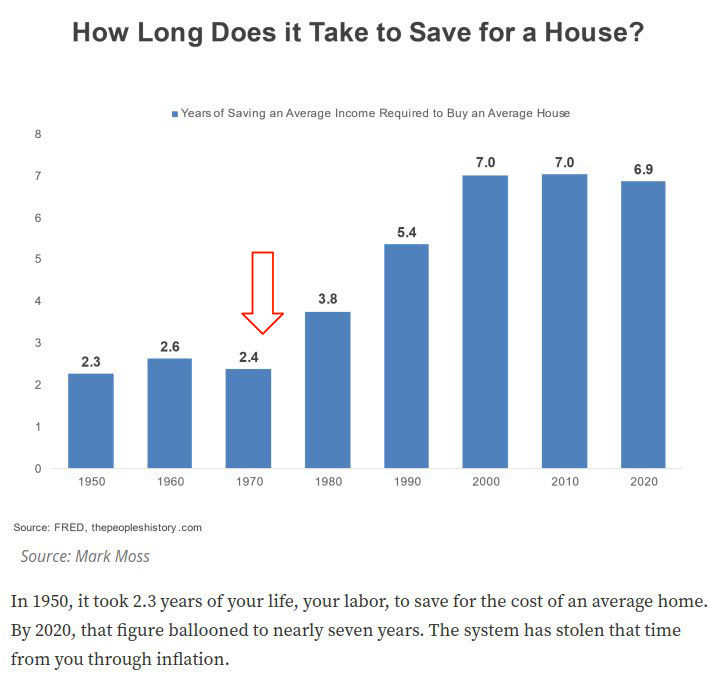
BUT, it means the trinkets became cheaper, and that means everything became way better! We know everything became better, because the spreadsheet GDP went up, and the trinkets became cheaper. That is all there is to know.
But wait, am I making money at the same rate though? Is my purchasing power increasing such that I can consume more of those trinkets without taking on debt? You know, like an actual quality-of-life increase to go along with that sweet, sweet spreadsheet growth?
If not, who cares what your spreadsheet says? Is my well-being improving alongside those iPhone gross margins? Because if not, what are these low-price trinkets doing for me….?
HUSH. The middle class are really happy about this, actually, they just don’t know it yet. Someone should tell them everything is better. You don’t need eudaimonia (because the Excel sheet can’t measure it, ugh), you only need hedonism. TRINKETS.
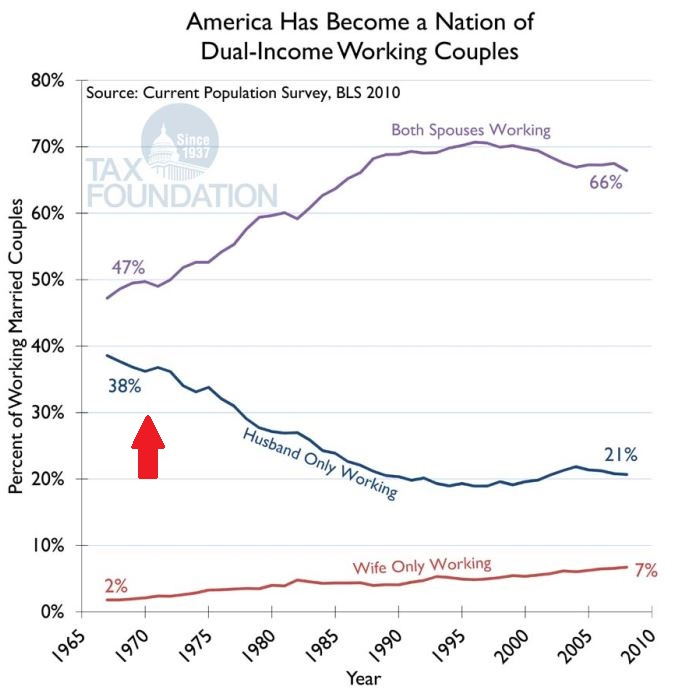
The ramifications of this take time to manifest across a nation. Their second and third-order effects accumulating as the situation persists. Sometimes when you knock over Chesterton’s Fence, it takes a while to see what you’ve done.
---- RESUME ----
David Foster Wallace critiques, Nirvana riffs, and similar despondent artistic expressions were not responsible for the societal ailment that beset the US. They were symptoms.
Just like Trump is not the cause of any strife or division, he’s merely a symptom of it. There would be no PMF for his nationalism and protectionist message if it weren't communicating something many already felt at a spinal level was needed to address an obvious problem. You will not lecture this away. Only those with spreadsheet brain disorder deny its existence.
What creates the market for a political message is a shift in setting, which creates a shift in the utility of said message, and thus how well it sells.
Political beliefs have different utility in different environments. Selling socialism in poverty is like trying to grow sunflowers with no soil; selling conservatism in prosperity is like trying to grow sunflowers in the winter; the former does not have resources to distribute to the sunflower, and the latter is trying to grow a sunflower in an environment that isn’t designed for it. No hedonism in poverty, no discipline in decadence.
This political utility function is determined by social and economic circumstance, predicated on prevailing abundance and comfort, and what they impose on people’s sense of purpose and well-being. The environment dictates the expression. And the politicians sell to their environment.
Eudaimonism vs Hedonism
I believe what gestated this market for depressive art is a slow move from eudaimonic purpose, to hedonistic consumption. A transition in emphasis from things that provide self-actualizing purpose, to things that provide fleeting pleasure.
According to McKinsey, Yale, and The Economist, middle-class men don’t derive a significant part of their identity and sense of personal worth from their jobs… because we can’t measure holistic well-being in our expected-value models. Ugh!
BUT, we can measure how many Taco Bell Doritos Locos and PlayStations you buy, so shut the fuck up. The globalism will continue until morale improves. We are GROWING, don't you want to GROW; this is the ideology of the cancer cell, and Harvard Business Review.
Consumption is the north star of globalism, because that’s the only lens through which a supply chain understands the world.
When nations are reduced to economic expected-value calculations, becoming the best GDP input you can be is how you attain happiness, you know. The highest-order value of a nation is procuring the cheapest doodads possible, you see. Good for your bottom line, corrosive to the human condition. Why did the art become sad again?
A society’s orienting force is hedonism when it sees a bigger GDP as its moral apotheosis, and cheaper trinkets as the most noble thing it could possibly attain. Structuring its industries, labor, society, purpose, and existence around the efficient production and consumption of said trinkets. You are not happy when you ACHIEVE you are happy when you CONSUME.
If the material is your sole measurement of success, then the material is what’s sold to you under a false promise of “happiness”. The economic models say you’re gleeful now, so shut the fuck up and be grateful nothing is built here anymore. Wait, why are the men getting sadder? :(
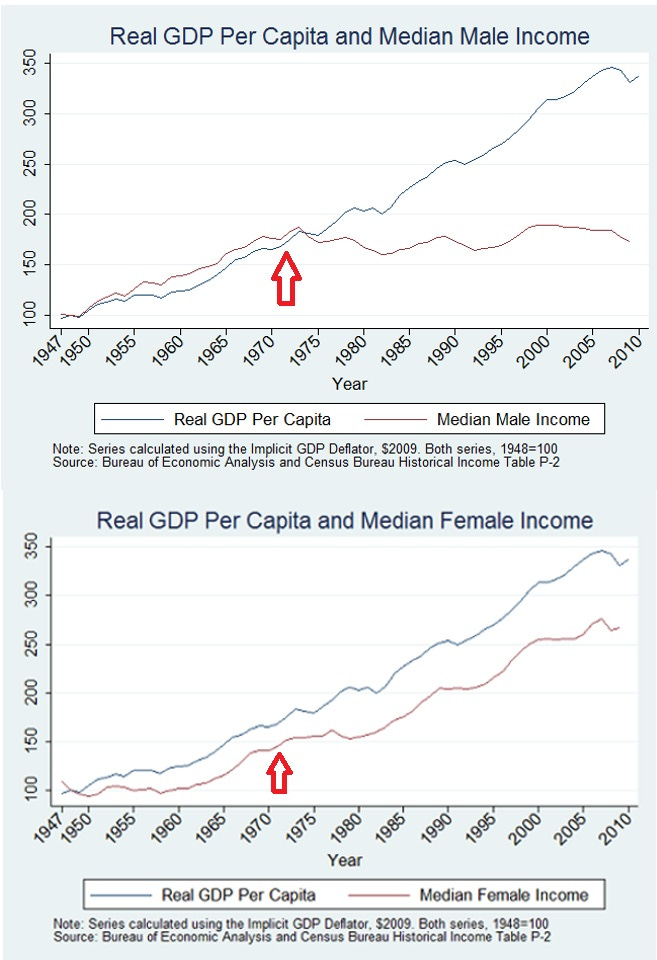
When dealing with a dyad: To destroy one is to destroy the other. To help one is to help both. To advantage one is to advantage none. Who derives their sense of eudaimonism from providing, and who derives it from nurturing? To deny the answer to this question is to deny nature. You’ll have to pay for that eventually, you know. You’re on the cusp of starting to repay it now, the stats on female happiness are degrading too…
There's no artistic message to be sold in hedonism. There's no eudaimonia for a people who exist only as a gross-margin statistic. To have the sense of purpose found in your work, the middle-class American dream stripped from you.... because China makes it cheaper. Trinket maximalism.
Trinket worship is vigorously defended by a special kind of moron who chants “free trade!” and has zero idea, none, what he’s talking about. If BOTH sides do not abide by “free trade”, then it is not free. Comparative advantage in trade is found only in the exchange of goods, not their production. Pray tell what you think a massive surplus/deficit represents? By definition, an equal exchange is not happening. What you have is a dislocation.
You’re simply subject to the policies of your counterparty if you operate with no constraints, but they do. They are dictating to you, since you have abdicated your role in the negotiation by saying “fuck it I won’t defend anything” while quoting Milton Friedman or whoever, to justify your cowardice. You’re getting hosed, and you’re too blinded by a religious precept to see it. Those Chinese, such suckers they’re known to be…
If global trade were driven by comparative advantage, persistent trade imbalances would not exist, because the reason you’d export would be to import. Exports are real costs, imports are real benefits. Why are some countries so adamantly insistent on “giving away” so many exports and getting no imports in return? It’s because they’re getting something else, and you’re losing that trade. They are exporting weak demand, and gutting your industries in the process.
You are in the domain of religion, not economic thought, if you think a strategic action is always good, and the other always bad. The real answer is always… it depends.
Closing
A society is deprived of dignity when its citizens are reduced to cog people in a calculation-maximizing supply chain. Globalism turns nations into gray expected-value optimizooors, where the only stimulation you get is that of the senses.
There is less variance, color, and purpose in this existence. The art speaks to this. You can see it in the people if you look beyond the spreadsheet.
The only thing that makes you a more sentient, enlightened being than an animal is the ability to understand and express artistic messages. To be able to achieve eudaimonic joys, and not just hedonic pleasures. All creatures do hedonism, but only one has been given the gift of eudaimonism.
When you deny human variability and become a cog-person gray-goo biomass fungibility maximalist, whose entire worldview and personality can be distilled down to “growth is growth and more is more”, with all decisions made by asking “what’s the expected value tho?”, what you worship begins to consume you. To only understand the spreadsheet is to worship the spreadsheet. You always worship something, even if it has a number sign. So be careful where you direct your genuflection.
When a society's soul withers from lack of eudaimonia, it births the hollow-eyed despondency we see today, and what the sentiments in the 90s identified. What caused the environment to transform? It certainly was not the art. Did you know Detroit used to be the fifth-largest city in America? Once a genuine economic powerhouse. Why is it called the Motor City again?
No purpose, just pleasure. Pure high-time-preference sensations. High-fructose corn syrup for the soul. What do you mean these preservatives and processed foods aren’t nourishing? Look at the nutrition facts, you're nourished! How satiated you are can be found in this number I made, you see. Fuck you.
A society gets the art it deserves, because it reaps the fruits of what it decides to worship.
"The root of 'addict' in Latin is the word 'addicere', which means religious devotion. We all worship and have a religious impulse; we can choose to an extent what we worship. But the myth that we worship nothing and give ourselves away to nothing, simply sets us up to give ourselves away to something different.” - David Foster Wallace
Subscribes and shares appreciated.
I’m building something interesting, learn more here: Salutary.io
If you’d like, you can show your appreciation by becoming a paid subscriber, or by donating here: 0x9C828E8EeCe7a339bBe90A44bB096b20a4F1BE2B
Related essays:
Midrange Jumpers for the Middle Class

This chart made me sad. It’s the inexorable result of moneyball. When every decision is maximally maximized, when every choice is an expected-value calculation.
The Insect Method: Tariffs, Labor, & Surpluses

Trump threatened to tariff Canada and Mexico recently. I understand it was nominally about fentanyl and immigration/border issues, however he’s also done it in respect to trade. This essay is specifically regarding tariffs as a trade strategy, with the intent of reducing your national deficit.
Defeating Nature

The following essays did numbers on Twitter. Marc Andreessen was a fan. I’ll link to it at the end. This essay is substantially rewritten and added to compared to the originals.
Dear Dmitry,
There is an ecosystem of artists, an unknown underground, and the successful ones that we see copied the unknowns and yes, are able to make it when the culture is ready. Elvis with bluesmen who often toiled in obscurity for decades....THEN its time has come to the culture when it's sanded down and offered to the greater culture at large. Even Elvis' hips were too much at first... until they weren't.
We used to have genius gatekeepers who knew when culture was ready, or thought they knew.
But now, yes, everything is for a paycheck which changes the dynamic, and the secret weirdos can't live cheaply and there's no more underground as we've been priced out everywhere and everywhere is for sale.
So your theory is only taking in the age of internet, which has made us all whores.
However I believe people get tired of crap culture at some point, and that's when the thinkers and artists already on the fringe become the pretty people again because we get desperate for a new idea story or way out or around. Then they'll be copied by someone more relatable palatable and famous, and it will seem that they came out of pop culture, when they were carrying other underground ideas forward that had already been discussed much earlier and tested in the underground few know about.
I'm not at the beginning level myself; I just know to look for them. The weirdos no one knows and people think are mad.
I know one or two in real life, and John Michael Greer is an online example. He's considered hella pretty now.
There's a Simpsons scene that you may like as it relates to a lot of what you're saying here. In the episode, Lisa manages Bart's little league team, implementing all the sabermetrics spreadsheet wisdom, which improves the team but which Bart deeply resents. At the end, Bart decides to steal home to win the big game while Lisa stammers about how statistically impossible this play is until she's finally overtaken by the moment, saying "it's the most exciting play in baseball" before breaking out in cheers for her brother. It's really a beautiful scene. Like you said, life (like baseball) is not a spreadsheet.