


Defeating Nature
Rationalism and false claims against the Complex


The Scripture of the Pseudo-Expert, the Weapon of the Bureaucrat
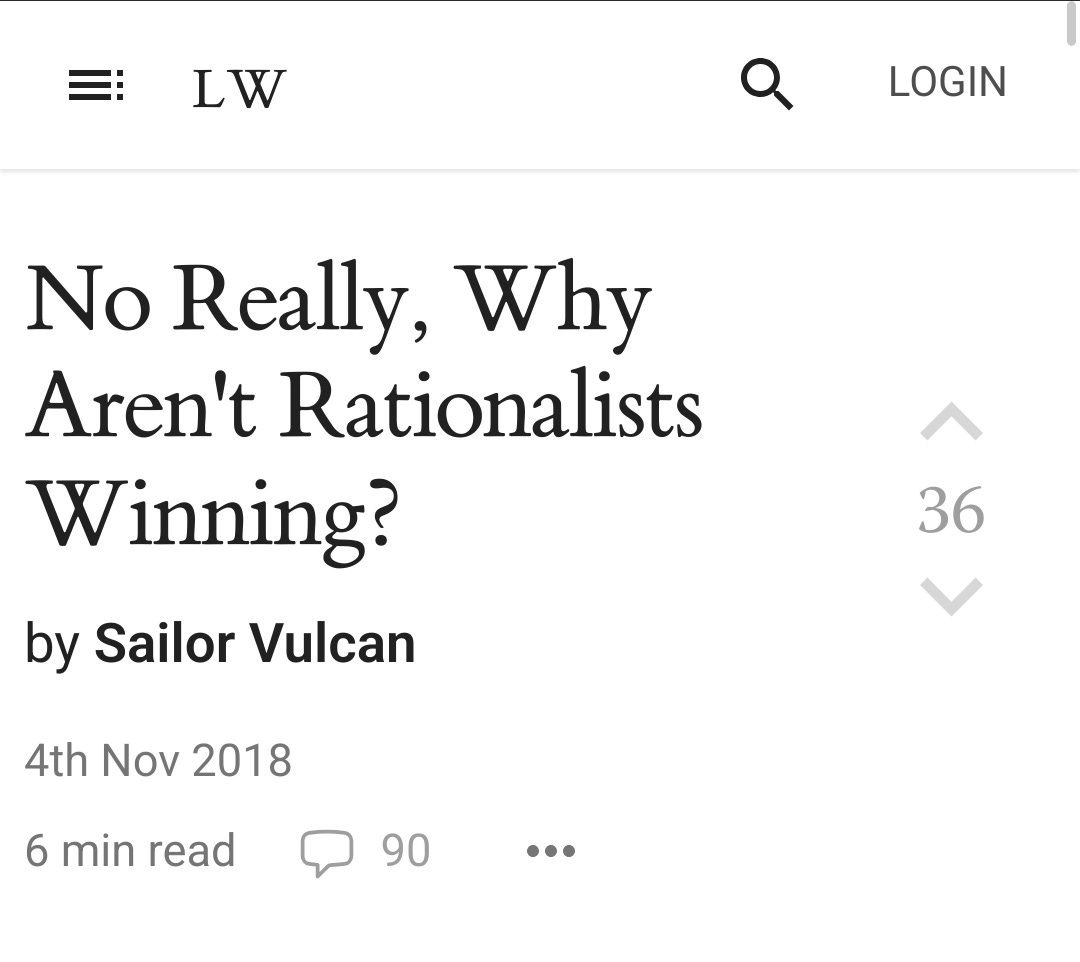
Rationalism is losing because once you come to terms with the human condition and the indomitable nature of complex adaptive systems, you realize how irrational "rationalism" is.
The left curve understands this reality on religious grounds: recognizing complex systems as under the domain of God. The right curve understands that a forest of emergent phenomena is beyond their abilities: recognizing complex systems as under the domain of nature.
The middle curve opens up their Excel sheet, says the word “peer reviewed” a couple times, and starts making false claims against the management of the Complex: they believe it is under the domain of man.
The midcurved approach is often appropriate, man does have agency in many fields he sets out to conquer; but it does not apply to the realm of the Complex. Whereas the midwit is unaware of his limits, the left and right curve understand theirs, but conceptualize it differently.
The left and right curve instinctively perceive pseudoscientific, deceptive promises as an authoritative sleight of hand; as a cudgel for an elite few to “rationalize” why they know better and thus should dictate what's best for you and society. For your safety, of course. Always for your safety.
Interestingly, these big-brain rationalist observations invariably conclude that a government or corporation should have more power and jurisdiction over your existence. Curious! Why does it never result in less? It must be because more regulations, more rules, and more bureaucrats are simply the product of sound “science”!
Rationalism pretends to predict the unpredictable and manage the unmanageable. It provides a soothing, misguided sense of command over natural systems and emergent phenomena. It's readily weaponized by those who seek to reign over others, justifying their ever-expanding purview under the fiction they can govern a complex adaptive system: a Complex realm cannot be controlled or mastered by a human mind.
We can't even predict what interest rates will be six months from now (and humans solely influence this!), yet you have a model for the weather five years from now? You are either a moron or a liar, I hope it's the former.

That you even tried to model such a patently un-modelable thing is predicated on a form of rationalism, seasoned with overwhelming arrogance. For climate proclamations specifically: you have taken a human collective-action question, rife with tradeoffs and value judgements, and lied by ascribing to it fake objectivity, with a “science says the right answer is X”. This is a manipulation. Rationalism can help us work towards a goal, but it cannot determine what the goal itself should be.
A collective-action problem is an inherently political question, it’s a values-based dialogue, not a scientific one; a rationalist has next to no ability to discern this difference. For them, all tradeoffs and value expressions can be distilled down to an expected-value-esque line of thought.
They seek to inject faux-expertise into everything they touch as a means to shut down dissent and advance their motives. Motives camouflaged as an equation, as if sprinkling in some numbers magically turns a political opinion into a “correct” value judgement. As such, they will be informing you what the “right” political outcomes and tradeoffs will be for you and your society.
Technocrats are best understood as secular priests with a God complex: instead of a Bible, they’re equipped with a model, spreadsheet, and a woefully inadequate comprehension of the multifaceted.

Feedback Mechanisms
If someone thinks he can fly, he's immediately informed he cannot. Splat.
When the rationalist thinks he can presciently navigate emergent phenomena and impose his will on the Complex... the feedback mechanism is too long and attribution too vague to emphatically illustrate he’s intellectually splatting all over the place. Unlike the immediate feedback of physical laws, the complex interplay of social and economic systems allows failed predictions to fade into obscurity while new, equally dubious forecasts take their place.
This non-definitive attribution allows him to never quite be wrong, while almost constantly failing to be right. But he falls flat on his face all the same, lecturing you the entire way with a smug aura of self-reassured confidence.
Be cognizant of unfalsifiable claims, and approach anything that exists in veracity purgatory with extreme skepticism.
Rationalism is perpetuated by people who don't grasp the boundaries of human cognition. It's intellectual vainglory, masquerading as a logic exercise. Rationalism is fundamentally a false promise against the management of the Emergent, similar to how "GDP go up forever" economics is a false promise against scarcity.
Be wary of the class of person who consistently concludes another regulation is needed and more centralized power is necessary; their motivated reasoning will often be adorned with scholarly scaffolding, alleging a “study” deems it essential. People love smuggling in their morality and value judgements under a thinly veiled disguise of pseudo-objectivity.
To its credit, rationalism is mostly fine when not applied to Complex realms. It does have its place, but unfortunately its advocates don’t know their place; they cannot distinguish between the Complex and the Linear, and treat their governance as one in the same. For fields like climate, economics, AGI safetyism, and anything with emergent phenomena and Nth-order effects, it's shit. Some things cannot be modeled; we simply form narratives that feel about right, and then append some numbers to it to post-hoc justify our desired outcomes.
“More fiction has been written in Excel than Word.”
Perhaps equipped with an AGI Monte Carlo pattern god, applied rationalism is possible for the Complex. However, it's The Machine doing the thinking, not you. A human will never be able to accomplish this. Know your limits.
Until the day comes when we summon a computer species powerful enough to calculate how nature thinks, rationalism is more appropriately understood as a mendacious means to manipulate. Many rationalists naively mean well, however the road to hell is always paved with good intentions.
This is where my antipathy stems from. This is what inspires the tone of this essay: fools and wannabe despots spreading pseudointellectual subterfuge, and a self-anointed elite leveraging deceitful assertions against nature to justify tyrannical overreach into our lives.
It's a noble endeavor to learn more about the world and our place within it; I recognize that human knowledge will always be imperfect, and pursuing information should be encouraged and praised. But the issue I have that just won't go away... is how often rationalists leverage their deeply flawed, hubristic models to advance dominion over our lives.
Learning more about the world is great; leveraging it to rule over others, is not.
And please spare me any limp “anti-science/anti-intellectual” line in a feeble attempt to condescendingly ignore the issue here. The rise of the Empiric and rejection of pseudointellectual central command isn’t "anti-science", because what you’re doing isn’t science to begin with. If it's not reproducible nor has predictive abilities, it isn't science.
This is a repudiation of an authoritarian tool. Tyranny advancing its interests under the banner of pseudoscience is a tactic all should be acutely aware of after the events of the last four years.
That's why rationalism is losing. And God/nature willing, it will continue to.
Defeating Nature
Just as a priest claims to speak to God, a rationalist claims to speak to nature. They won’t say they do, but it’s what they’re unwittingly asserting when assuming they can predict her.
Secular religions (often known as cults) are the opiate of a certain kind of masses. They’re for those who are gifted for a human, but still don’t register how woefully incapable that renders them when navigating the realm of the Complex.
You are but a man. Even a 200 IQ leaves you painfully deficient to defeat nature. You lack the synapses and raw compute power to forecast what you wish you could. You do not understand the limits placed on you by nature in your pursuit to domesticate her. You are but a man. It makes you uncomfortable to confront this; you're not at peace with your neural finitude. So you deceive yourself, then others, with your egotistic assertions against nature, claiming you can defeat her.
To defeat her is to master her.
To master her is to control her.
To control her is to predict her.
If you can be predicted, you can be controlled, and defeated.
To believe you can predict nature, is to think you can defeat her.
The hubris of these beliefs is suffocating. You have enough neurons to ask "why?", not nearly enough to answer the question, but just enough to delude yourself that you can.
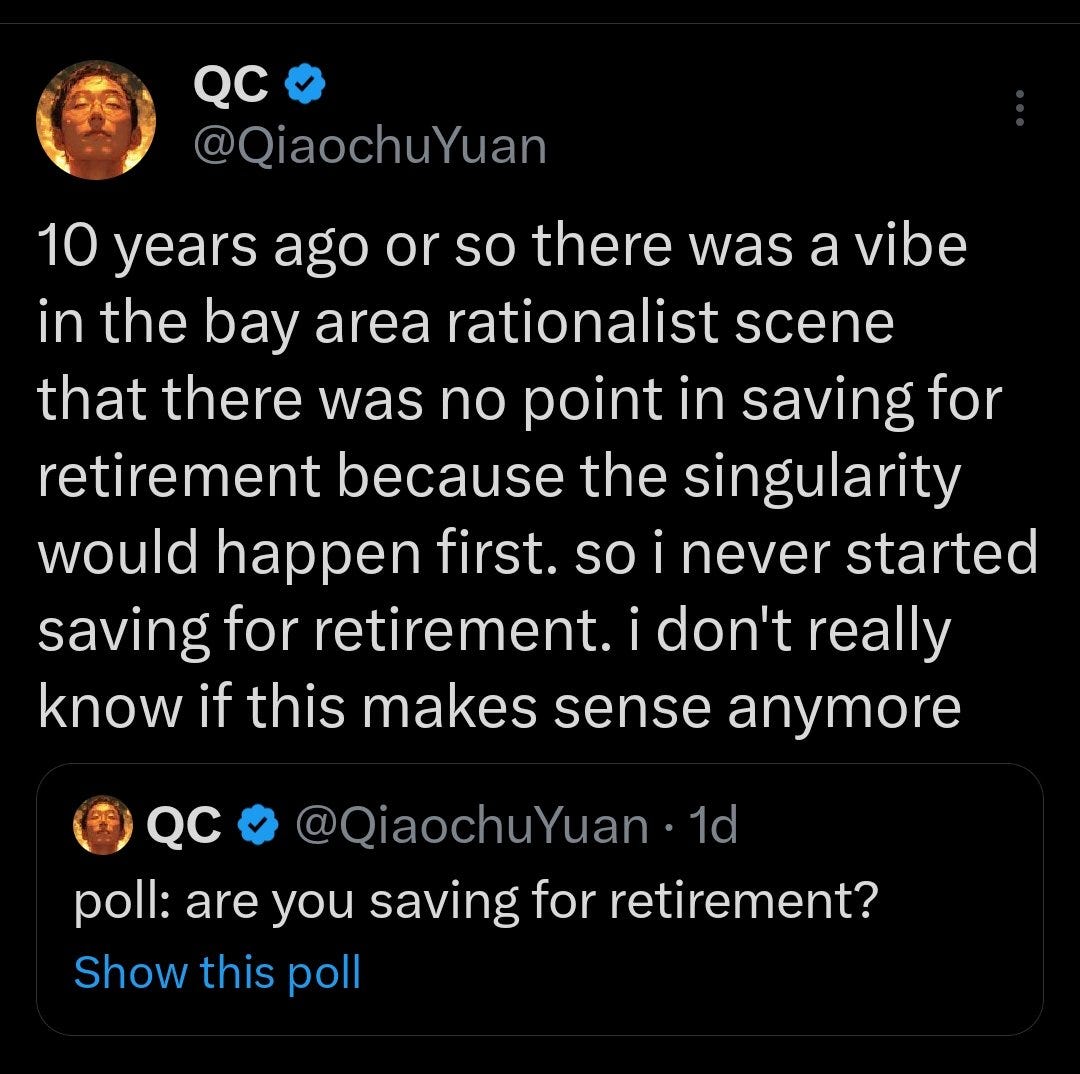
Rationalist deities are often supernatural ideals, not spirits. Their tales are rooted in religious metaphors with scientific-presenting veneers.
Eschatology:
Religion: Jesus returns. The Rapture.
Rationalist: The Singularity
Genesis origin stories:
Religion: Creation theory, man made by God
Rationalist: Simulation theory, man made by advanced civilization
God-shaped holes are always filled. Worshiping nothing just means you worship nothingness. Nihilism becomes your Mother Mary when you believe you can defeat nature.
Footnote:
I was in Stockholm recently, I got there just after I added this essay to my drafts. While at an art museum, I serendipitously encountered this exhibit:
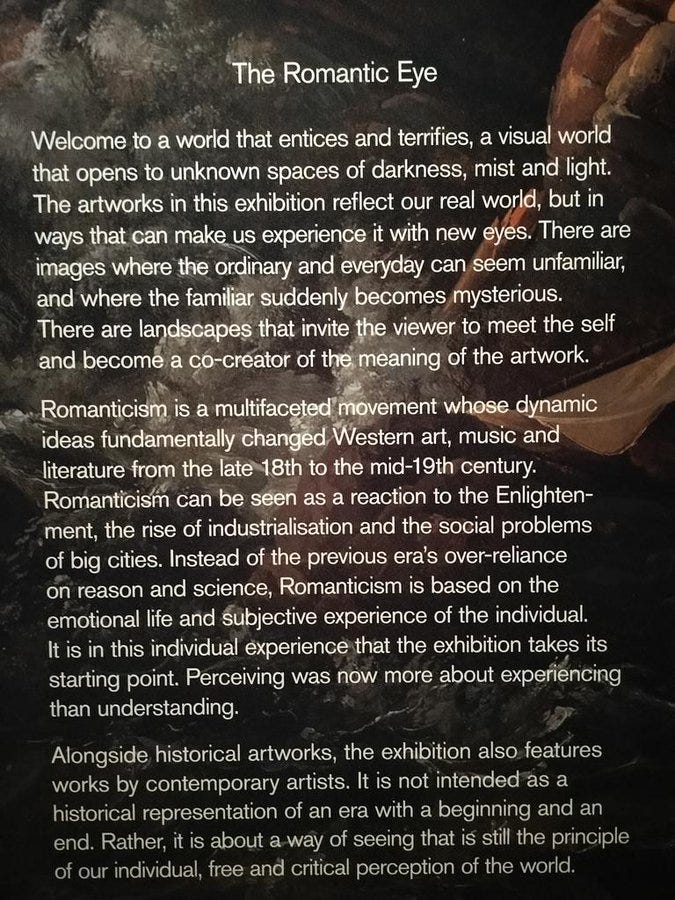
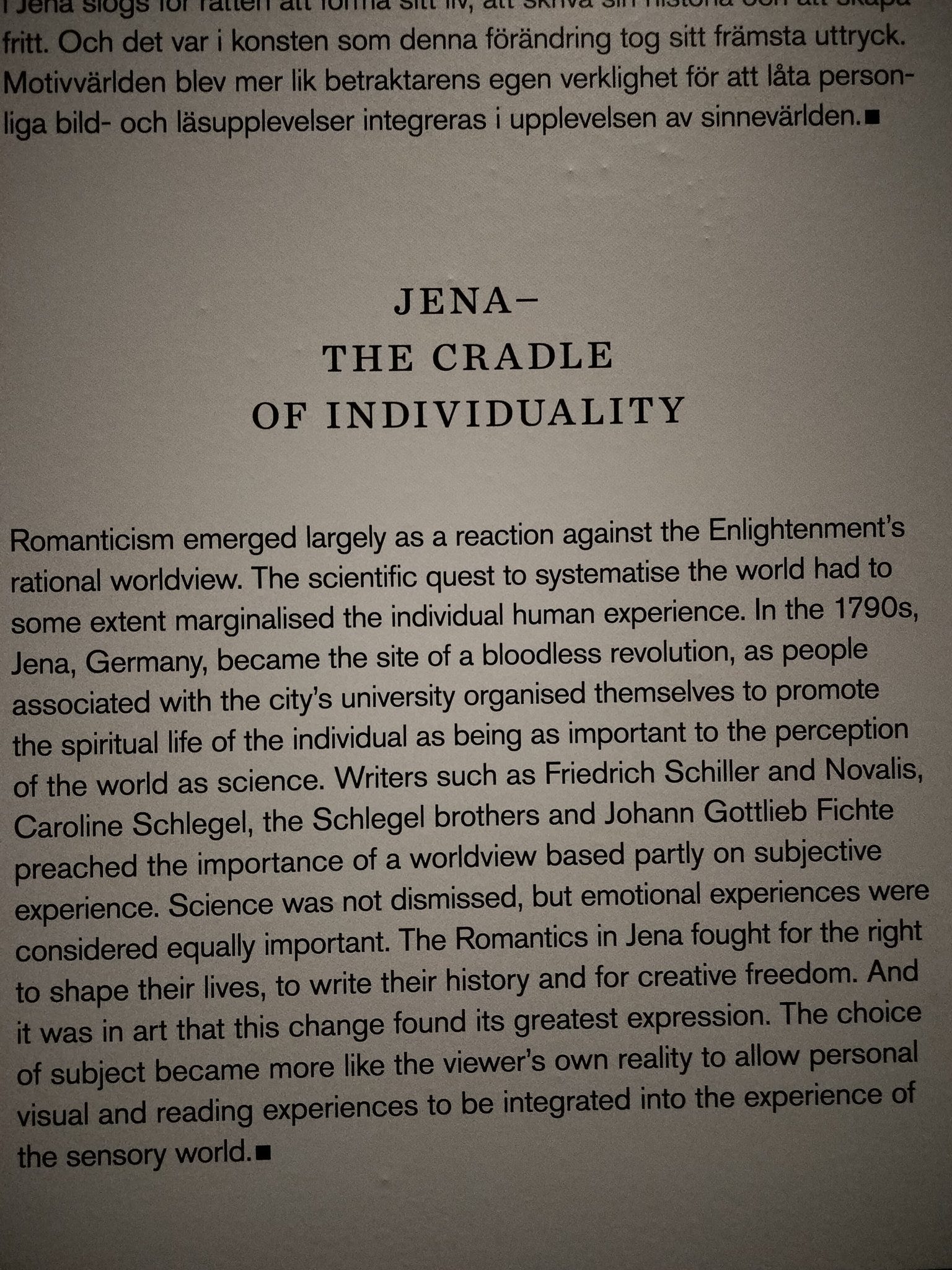
I didn’t know this period’s inspiration so closely related to the writings in here. Perhaps a new Romantic Era is on its way…. Everything we're experiencing has occurred before, the cycles will play out again.
My original essay published on Twitter can be found here.
Subscribes and shares are very much appreciated. If you enjoyed the essay, give it a like.
You can show your appreciation by becoming a paid subscriber, or by donating here: 0x9C828E8EeCe7a339bBe90A44bB096b20a4F1BE2B
I’m building something interesting, visit Salutary.io
Related essays:
The Fed, Part 6: Interest Rates & Futures for Dollars

To understand interest rates, it’s critical to see both what informs them and what they represent. Once properly appreciated as complex-adaptive-system outputs, the Fed becomes an afterthought.
AI Risk and Modeling the Un-Modelable

I’m a complex-adaptive-system respecter. This essay is about complex-adaptive-system deniers, and how they practice their craft.
Gain Dependents, Gain Power

When you're dependent on someone, they wield power over you. The more dependents you have, the more power and influence you have. They do what you say, they are more loyal, because they have no other choice. They need you. When a child is dependent on its mother, it’s a healthy dynamic; when an adult is dependent on the state, it’s an unhealthy dynamic,…
I swear, if I commit the cognitive effort to read and absorb what @Dmitry has to say, the mental jujitsu just astounds. E'ry damn time.
It's as if, assuming the Enlightenment was about separating brain, mind, and reasoning from body and elevating rational above all other types of information and knowings, then this framework is a de-enlightenment or decompartmentalizing of those cognitive faculties. Reconstituting the brain, heart, gut axis as a whole with a processing power that it's sum is far greater than its parts. Admittedly, I'm playing with Duplo blocks while he's playing with a Mechano set but even still, it's a start.
The problem with Rational Materialists is that the thing they claim they are seeking: knowledge, truth, transcend both reason and our material world. Yet they insist on searching within both.
For example, logic can't prove that logic is an accurate tool. It's also not instantiated in our material world. And yet we use this tool with the absolute assumption that it's unerring. So much so that the foundations of math and science assume it works perfectly to carry out reasoning in those respective fields. But where did logic come from, and how can we be so sure it's an airtight tool for discerning truth? No one knows, and yet our most noble goal (truth) requires its accurate use.