We’re bounded by physics, shaped by selection, and calibrated by environment. Humans aren’t floating narrators who possess bodies when convenient. We’re organisms before we’re autobiographers: creatures of appetite, fear, passion, status, lust, fatigue, and threat-detection. Reasoning arrives late to defend the programming and reframe it as a choice.
Whatever its original intent, intellectual hubris has turned the statement “I think, therefore I am” into a civilizational posture. The ego hears "my mind stands apart from my body; my thoughts author my essence". I am a Blank Slate. A fiction that depicts consciousness as sovereign and the body as furniture. No.
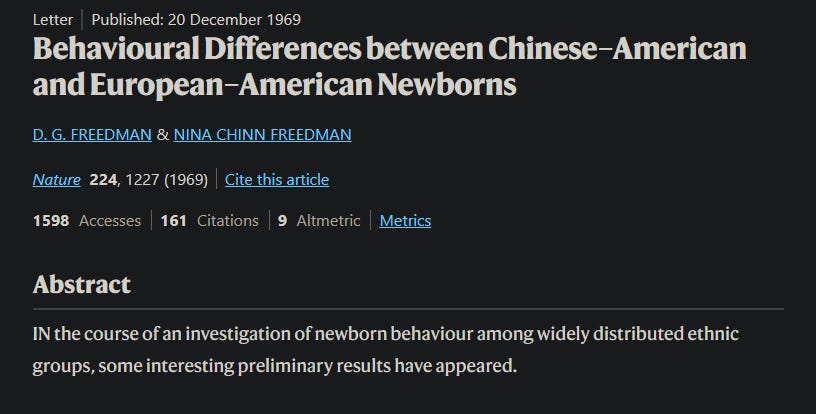
A newborn tracks faces, prefers mom’s voice, startles at loud noise, and roots for the breast within minutes of birth. It arrives with preferences, aversions, reflexes, and threat machinery before it has words, ideology, or socialization. Much of what constructionists attribute to language and culture is online at first breath. The narrator shows up years later and retroactively claims authorship of a self already in motion.
The body learned to navigate reality long before a mind described it. Life has been tracking gradients, threats, resources, and feedback for at least 3.5 billion years.
The genus Homo is ~2.8 million years old; Homo sapiens have existed for 300,000 years. Symbolic, layered speech emerged roughly 100,000 years ago. Writing arrived only in the last 5,000 years! The hardware is older than the software by evolutionary orders of magnitude. Our species predates the written word by a factor of sixty.
How did we survive and propagate without naming a “metaphysics”? How did fear, pain, warmth, love, disgust, attachment, hierarchy, territory, and desire orient behavior without theorizing “ontology”? How did the amygdala and metabolism derive an “ought” from an “is” so effectively??
The organism never derived “ought” from “is” as a syllogism. Conditions are converted into action. Hunger becomes pursuit. Pain becomes withdrawal. Attachment becomes protection. Threat becomes flight or aggression. These are evolved traits and behavioral tools conducive to survival and judgement. The tiger’s “ought” (hunt, flee, mate) is derived from its “is” (metabolism, threat, endocrine system) without passing through any rational faculty. Animals with nervous systems (like you!) do this constantly by living in the real world, no symbols or language games needed.
Your body, via sensory engagement with reality, knows what “ought” to be done while the mind tags along. These were always biological imperatives, performed sub-rationally. Describing this as a limit of reasoning is tautological; reasoning by its very nature is limited because it exists inside your head. You cannot reason your way to what’s real, because reality is not inside your head! When someone genuinely believes otherwise, it’s grounds for an insanity plea by defense attorneys. If your ancestors acted like that were true, you would not be here.
What humans later call value, preference, duty, and morality begins as physical prioritization under constraint. Conscious judgment can sometimes override these instincts, but the valuation precedes any explanation. Constructionists confuse naming a thing with creating it. Once a pattern is articulated, the narrator begins to imagine that words produced it. From there emerges the fantasy of the unembodied agent: a blank-slate mind with absolute free will, hovering above its physical substrate.
Philosophy and disciplines whose input and output is language love reducing reality to narration, because narration is all they produce. We're storytellers; therefore all reality is a story! Solipsistic, naive anthropocentrism. This human main-character syndrome assumes nature authored every animal except the one holding a pen. Ignoring how the bear, salmon, wasp, and wolf navigate the world just fine without commentary or theories.
Human nature is the residue of millions of years of adaptation layered over billions of years of selection. Organisms that failed to track consequential regularities died. The ones that did reproduced. This is the biological prehistory of logic and the actual lineage of empiricism, testing, and updating. Long before science was named, life was already varying, encountering feedback, and retaining what worked. Francis Bacon didn't invent the scientific method; he formalized a logic being run by natural selection predating him by billions of years. Substance came first. Story came second. The interior decoration mistakes itself for the foundation.
Rats searching for food perform trial/error experiments. A hawk adjusting its dive is calibrating against the laws of physics. How are these creatures performing basic tests, updating via feedback, and iterating without a theory of causality? Who taught the badger about Popper? How do cats understand object permanence without a “metaphysics”?
These aren’t top-down man-made artifacts. Cause and effect, risk assessment, explore/exploit, and group-coordinating behaviors are embodied understandings. They’re bottom-up biological solutions to thermodynamic problems under constraint. Enacted not only by mammals but organisms far simpler: insects, worms, creatures with no cortex at all. Look outside your own species, don’t assume you’re the center of the universe, and you’ll see it.
Slime mold, a brainless organism with no neurons, formed networks comparable to the Tokyo rail system! A blob with a body and no narration, no symbols, and no “epistemology” solved a complex optimization problem that took engineers decades. Who knew slime molds read Kant!
Even in sleep, when the narrator goes offline, the body continues regulating temperature, digesting, repairing tissue, consolidating memory, mounting immune responses, and managing hormones. You spend a third of your life unconscious while biology runs the operation unsupervised. Conscious thought requires a body. A body does not require conscious thought. The body comes first, because survival comes first. This binding asymmetry establishes priority and who submits to who. This isn’t a relationship of equals… nothing truly is.
Billions of years of life. Millions of years of human evolution. Hundreds of thousands of years of our species. Tens of thousands of years of visible symbolism. Five thousand years of writing. The mind doesn't levitate above the body, and the body doesn't levitate outside nature. The tacit conceit: “this applies to every animal except me”.
Strip out the species-level narcissism and restore the causal order. I’m an organism capable of narration, but I don’t exist because I narrate. I narrate because I exist. “I am, therefore I think”.
The distinction between mind and body is something Biofoundationalism derived operationally through physics and thermodynamics, clarifying the dyad in functional terms: movement and non-movement. The kinetic body and the inert mind. The body’s actions move; the mind’s thoughts do not. A belief that alters no behavior is indistinguishable from a belief never held.
Focusing on motion grounds us in measurable thermodynamic signature and sidelines philosophical language games. We only know what something is by how it moves, not by what it says.
Since the body testifies before the mind explains, the practical question is how to read testimony delivered without words. The unit of that reading is the tell.
The Tell
Modern man’s first instinct is to explain himself. He announces preferences, justifies habits, defends motives, and offers a guided tour of the self. Useful signals often sit between these explanations.
A Tell is a small, consistent behavior whose significance exceeds its nominal content. They’re probabilistic, directional signals: moments where biology slips past stories. They leave temperamental residue.
A story is what the organism says. A tell is what the organism keeps doing. One tell suggests, several let you triangulate. Claims can be curated, but tells are harder to launder because they’re unconsciously leaked. People unknowingly hand you pieces of themselves in the banal.
Some properties of useful tells:
Peripheral. It’s not a conscious self-advertisement.
Repeated. A single behavior is noisy anecdote; a series of them forms patterns with predictable shape.
Cross-domain. Traits don't exist in vacuums; they show up in prose, food, work, politics, and leisure. Triangulation happens when disparate domains converge on the same disposition.
Costly. It reveals tradeoffs around time, focus, money, reputation, comfort, or risk.
Predictive. A tell that only explains itself is trivia. A tell that forecasts behaviors builds a model.
Discriminating. A useful tell distinguishes among competing explanations. If age, occupation, politics, and fashion all predict the same behavior equally well, the behavior says little about temperament.
Context-sensitive. Signals acquire meaning against a baseline.
A public profile holds more than meets the eye. A writing style is a type of gait. Breakfast habits give fatherly insight. Rioting is moral architecture under stress. The test of any framework isn’t whether it sounds elegant, but whether it predicts. What follows is Applied Biofoundationalism at multiple scales.
Outline
Individual Scale
I. Profile & Relationship Tells: Interests and Upbringing
II. Metabolic Tells: Feminine Metabolism & the Dad Meal
III. Preference Tells: The Opinionated Gentleman
IV. Rhetorical Tells: Hedging and Defending
V. Diagnostic Tells: Books, Vacations, Careers, & Politics
Population Scale
VI. Civilizational Tells: The Government You Deserve
VII. The Game Theory of Constraint
VIII. Societal Tells: Political Violence & Riots
IX. Concluding: Substance Precedes Story
Emphasizing again: tells are probabilistic signals, not definitive law. They deal in central tendencies, population distributions, and systemize aggregate traits to form testable predictions.
I. Profile & Relationship Tells: Interests and Upbringing
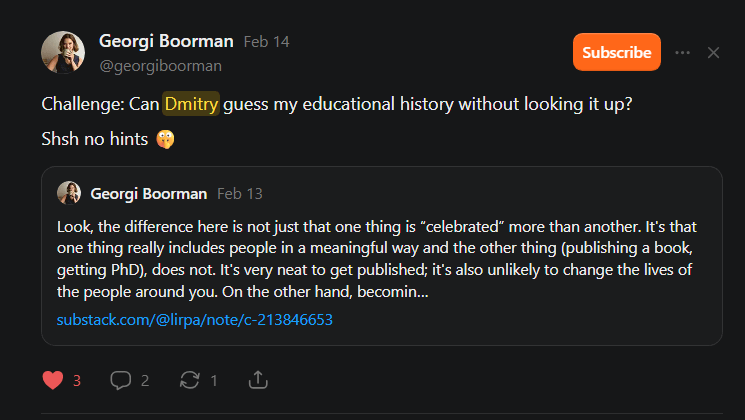
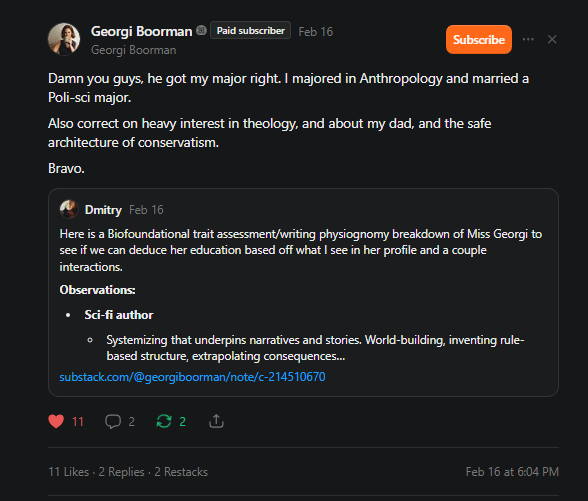
Georgi Boorman challenged me to deduce her major from her Substack profile and nothing else. To do so, I applied a blend of psychology’s Big 5 traits, female and male temperament research, and Biofoundationalism categorizations.
Tells and observations:
Not all of these are necessary for the conclusion. I’m going to walk you through the process so you can see what went into it.
Sci-fi author
Sci-fi entails systemizing a fictional landscape: world-building, rule-construction, extrapolating consequences from premises, and applying them across characters.
The male advantage in spatial intelligence is the largest cognitive sex differences in psychological literature. Fields that require it (engineering, physical systems) are overwhelmingly male.
Happily married, respects husband
She confirmed this in an unrelated remark. I’ve also seen her say on the timeline she married young and has several kids.
Per this, I’d wager she has a good relationship with her father. A woman calibrated by a strong dad selects for a man she respects, not one she manages.
She’s less likely to be threatened or resistant to masculine competence because she was raised by a healthy version of it. Experiencing hierarchy as functional and secure before encountering a political ideology telling her what to think about it.
A girl whose primary male relationship growing up was protective and capable doesn’t develop the defensive posture toward masculine authority that precipitates reflexive egalitarianism.
Women fitting this description will be more conservative; this aligns with Georgi’s presence. She’s not conservative against something, but because the support it offers feels like home. Her father provided a template for masculinity as functional rather than oppressive, and her husband is furthering it.
Conservative
Conservative women commonly follow two routes:
Threat mitigation: unsafe environment induces defensive structure-seeking, or
Inherited ethic: stable nuclear family, positive upbringing with dad present
Georgi codes as inherited ethic. Like it’s architecture she was raised inside, not armor she puts on. She doesn’t have the defensive posture you see in some aggressively rightwing women who got there via trauma, reaction, or attention whoring.
This is the difference between women who uphold values and women who react to a wound. The reactive kind is louder, more identity-forward, and ostentatious.
Exceptions tend to involve elevated androgens/testosterone (PCOS is a common culprit), being very autistic, or being Ann Coulter.
Temperament Assessment
Women are natural liberals, especially under secular, high-safety, prosperous conditions where masculine influence fades. The feminine baseline is dispositionally geared for an “ethic of care”: compassion, harm reduction, need-based fairness (determined by equality of outcome), and universalist dignity (deserved).
Contrasting the masculine ethic of honor (earned). Masculine effort-based fairness manifests as proportionally receiving what you contribute. Hierarchy is inherently unequal: masculine resource allocation upholds hierarchy; feminine resource allocation diminishes it.
A conservative woman weights authority, loyalty, and proportionality more heavily than sex-typical distribution predicts.
Female conservatism is context-dependent: less innate, more situational. In the absence of exogenous rules-based influence — a strong father/husband or religion — women collectively skew liberal.
Other factors you can point to are largely derivative of religious decline, such as no-fault divorce and contraception/abortion access. As religious influence loosened, women moved left, and so did the policies.
The degree that women vote liberal varies by race (white women vote more conservative than minority women). However women across all races are more liberal than men of their own race.
PREDICTIONS:
Educational Background Prediction: Political Science, Anthropology, maybe History.
Core informing traits: Sci-Fi affinity. Female conservatism via nuclear family upbringing and good father, reveres husband, not reactive.
High verbal intelligence (she’s a published author) correlates with humanities education.
These majors chronicle new worlds and models of human organization. They’re more befitting of a systemizing woman than STEM.
They give conservative-leaning women a people-and-language orientation (female default) while incorporating standards for evidence and boundary-recognition (masculine influence).
Female interest in people over things is one of the largest sex differences in psychology. Conservative women are likely open to “things” if they’re institutions made of language (courts, legal processes) or studies focused on human organization (anthropology, political science).
Other possible interests:
Classics or Theology: I’d expect conservative women raised in a strong father-figure household to have a penchant for the Great Books, Western canon, and religious tradition.
These take authority and tradition as topics of study, not oppressors to deconstruct.
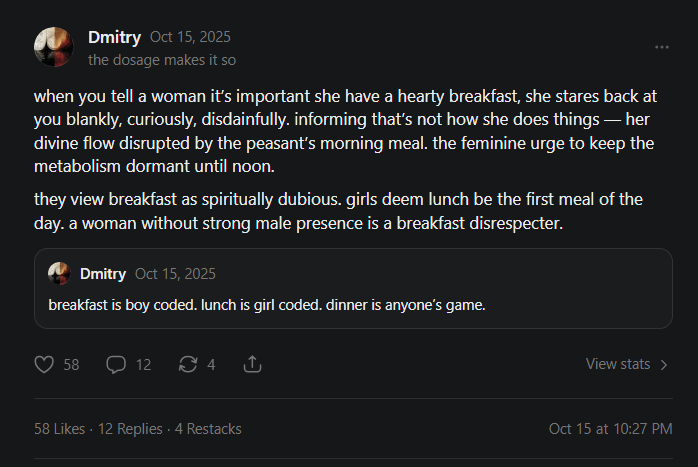
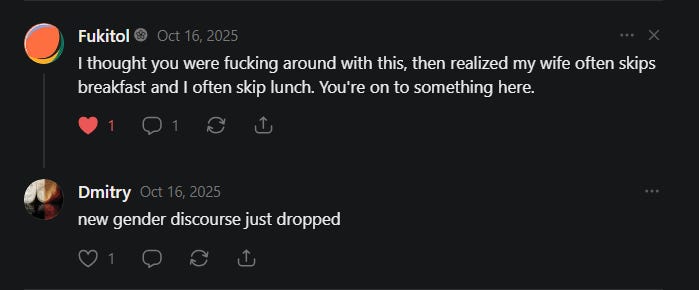
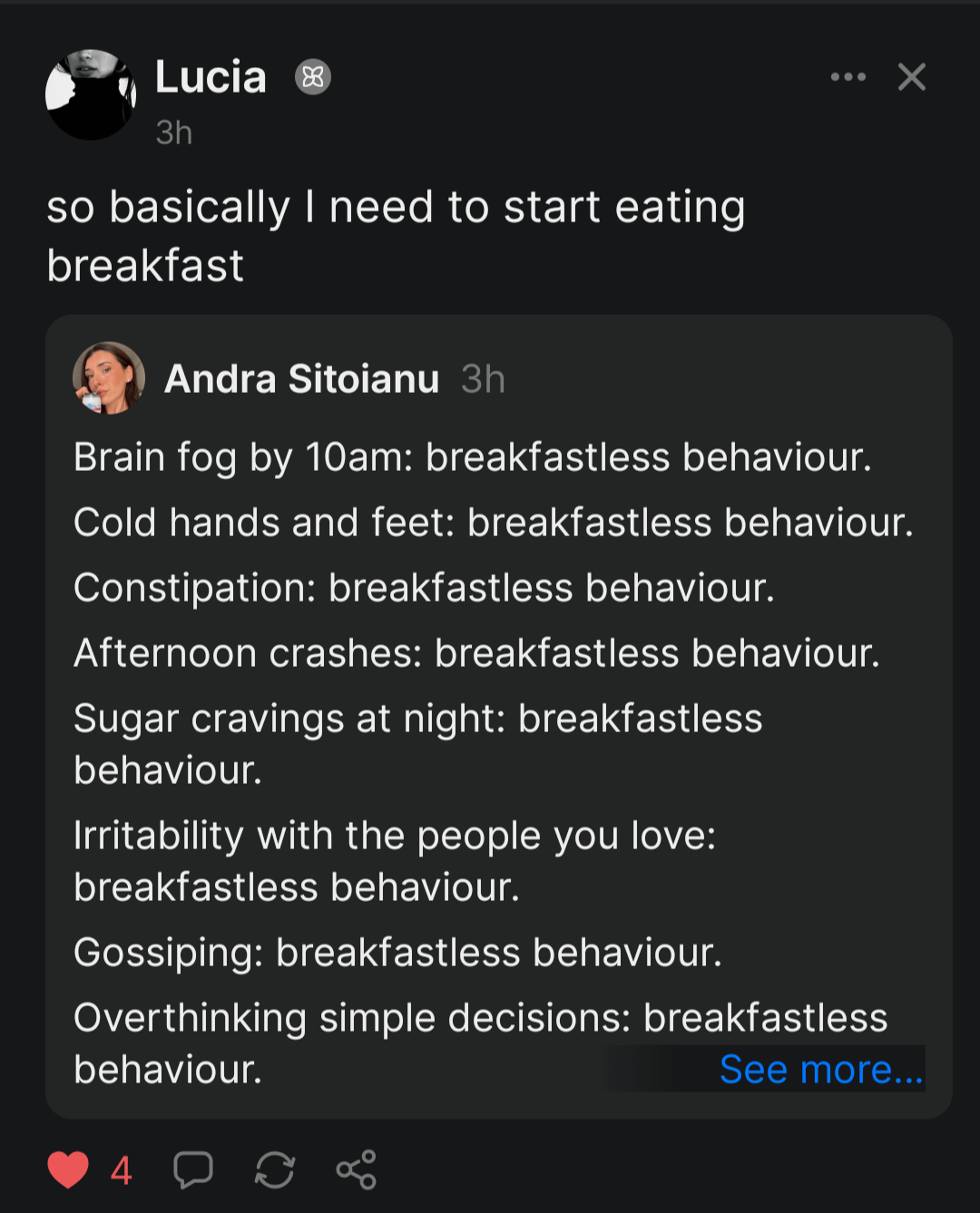
Georgi’s request to figure out her major came from comments I made on preferences for breakfast. I’ve made breakfast comments like this over the last year. I think there’s something to this in respect to female metabolism.
Personal observations:
Women tend to default to small or no breakfast and a more prominent lunch. The "not a fan of breakfast" thing was particularly prevalent among liberal women when I lived in NYC.
Men (especially dads) are famously big on breakfast. “Fuel yourself, you’ve got a big day ahead!” energy.
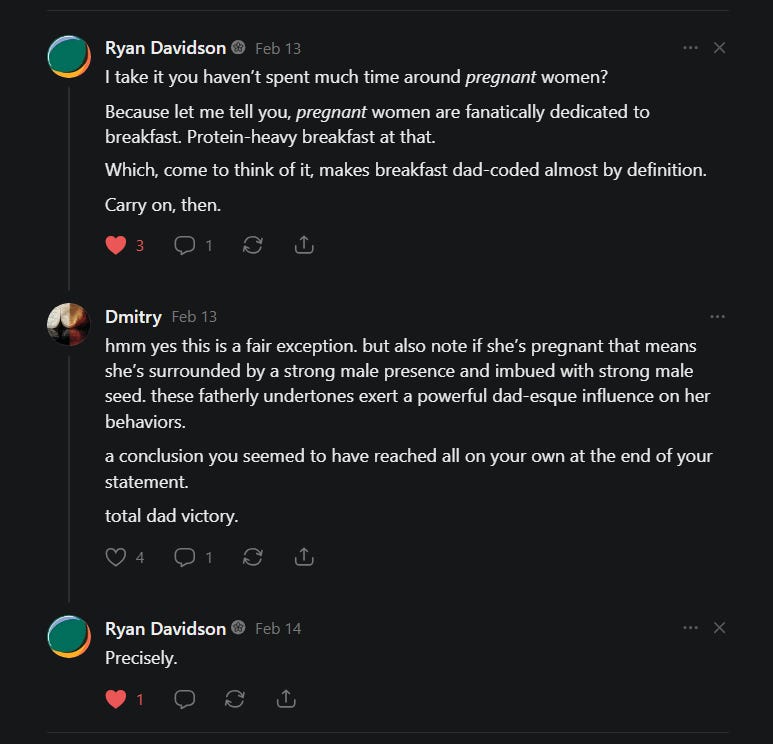
I’ve noticed women in relationships or close with their dads are more often breakfast fans.
My reasoning why breakfast skews male:
Breakfast is utility-focused and functional. Commonly eaten in solitude. Feels more like an obligation.
Men tolerate solitude better and have higher comfort with independent activities. Whereas women have greater relational orientation.
Lunch has social connotations, it’s more relational. You’re expected to eat it with others (coworkers/peers/friends). Lunch dates are common. It carries implicit interactive assumptions.
If someone eats lunch by themselves, it sounds sad. The same isn’t so for breakfast; we recognize it’s a pragmatic meal with less social expectations.
Metabolic claim: sex-linked physiology contributes to differences in morning appetite.
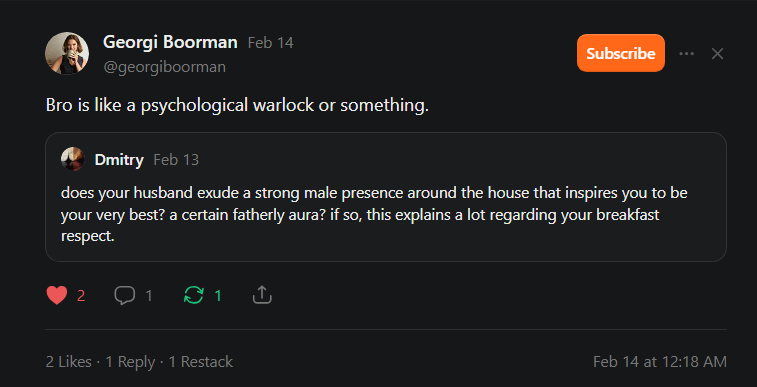
Household tell: breakfast consistency in women is a probabilistic biomarker for a gravitational masculine. Raising the odds of these background conditions:
She had an involved, present father
She has/had a husband-shaped domestic rhythm
Is pregnant. Male seed and fetal demands rewire her toward self-provisioning.
Dads and husbands are the strongest soldiers of the Big Breakfast lobby. A woman eating ham and eggs at 8am isn’t proof of a good father or marriage. But it’s enough to make me check for one.
While writing this essay, I remembered these breakfast reflections and decided to look into it. Turns out, there’s biological substance to them.
Evidence: Estrogen and Metabolism
Estrogen/estradiol has an appetite-suppressive effect. Female appetite drops in the late follicular and ovulatory phases: when estrogen peaks.
A finding so robust it replicates across menstrual cycles in rodents, primates, and women. Source. Source.
Leptin is the body's "I'm full" hormone. Women have ~2x higher baseline leptin levels than men at every bodyfat level and time of day.
Leptin’s circadian rhythm peaks between 22:00 and 3:00 and bottoms between 08:00 and 17:00. At breakfast, both sexes are at their personal low, but the female low is meaningfully above the male.
We run on ancient programming: morning is the period optimized for hunting and provisioning. The male endocrine signature is roughly: mobilize, fuel, move, hunt. The female endocrine signature lacks this urgency.
The sexes start the day in different metabolic gears and behaviors run downstream of this. A woman's "I'll just have coffee" is a hormonal default setting. By lunch, testosterone has fallen and the male-female hunger gap has compressed. "I'm not a breakfast person" is pitched as a preference when it’s also a window where the male endocrine architecture is loudest and the female is quietest.
Side comment:
When you encounter remarks that free will isn’t absolute, this is a shining example. The decision will feel intentional while the mechanisms operate unconsciously.
A woman who isn’t hungry in the morning narrates a hormonal directive drafted during sleep. She can override it through active intention, otherwise the programming runs on autopilot. This is what “behavior leaks biology” means; you have to be both cognizant and consistent about altering it. This doesn’t mean there’s no free will; it operates inside a system we do not fully inspect. Stuff like this occurs constantly at levels we have no awareness of.
There’s meta commentary in this superficial remark about music apps. The intensity of opinion is more diagnostic than its content.
An idiosyncrasy of manhood is the development of strangely intense convictions about minor things. I see it in other men; I see it in myself. The object is usually incidental. The signal lies in the force of commitment: passion, accumulated experience, an identity with edges.
For example: there’s one acceptable brand of headphones; a blood feud with at least one airline; guy who loves Linux; guy who loves Apple; guy who tells you the 'right way' to grill / code / fish; tribalizing along luxury watch lines (Submariners are for poors); if your truck isn’t diesel you’re gay, etc..
What’s being tacitly communicated:
“I have encountered the world enough times to develop grooves and form.”
The opinion is beside the point. What matters is the lens into temperament (namely disagreeableness) and a personality with definite shape and color, not some limp-noodle chameleon. If you have no enemies, that just means nobody notices you. If no one dislikes you, nobody really likes you either. It means you’re safe. Uninteresting. Like a Windows PC. Nobody brags about their Windows; it’s neither here nor there. It’s fine.
Preferring single malt to bourbon or an intense commitment to bowling aren't personalities; they inform on one. Allegiance to particular hobbies, products, tools, and methods leaks second-order traits: competence, affiliation, aesthetics, and how you spend your time.
For example, if you love Linux:
This suggests you’re technically inclined and prefer control over convenience. You’re probably a tinkerer.
Higher likelihood of wanting to know how something works before using it and being a “do-it-yourself-er” in other domains. Linux users are the computer version of the guy who installs his own kitchen cabinets. Both prioritize self-sufficiency over efficiency.
These types often skew libertarian (strong individualism), with emphasis on autonomy and accountability.
Triangulation: If I learn the Linux guy also drives stick-shift, it’s a second tell he’s willing to sacrifice usability for fuller command of a tool. Increasing his control preference and raising the odds of disagreeableness + technical orientation + contrarianism.
Context-dependency: In Europe, manual transmission is commonplace, so driving stick isn’t informative. In the US, automatic dominates, so it’s a choice against the current.
Conversely: an American driving automatic says nothing (default); a European driving automatic says something (deviation).
When reading tells, factor in the base rates of the behavior. The more prevalent it is, the less insightful.
Linux in a datacenter says nothing. Linux in an accounting department says a lot.
A man with no oddly overdeveloped convictions comes off as malleable, softer, more concerned with being liked, supporting consensus, unconfrontational, harmonious, feminine. The “everyone’s opinion is valid” guy feels womanly. No gravity. No texture. No aura.
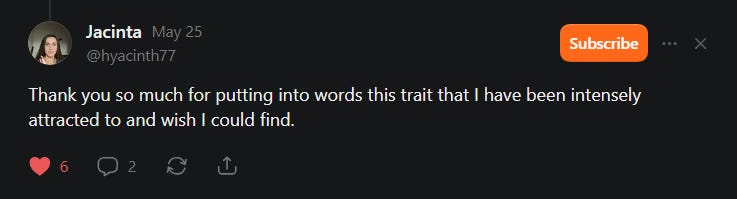
Befittingly, women are less attracted to men who act like women. A comment from the initial version of this post:
The opinion fills out a dating profile. The vigor, excitement, and manner it’s delivered illuminates something else. The man with decisive taste is legible, direct, passionate, and while he’s less tactful, he’s also less ambiguous, more honest… and probably more androgenic.
Meanwhile the guy who will die on the hill of mechanical keyboards, quantum interpretations, gun-holstering techniques, or Spotify’s spiritually castrated algorithm is letting you know he’s lived-in and stands for something. If you get him rolling, he’ll probably say something entertaining and interesting.
Biological Underpinning
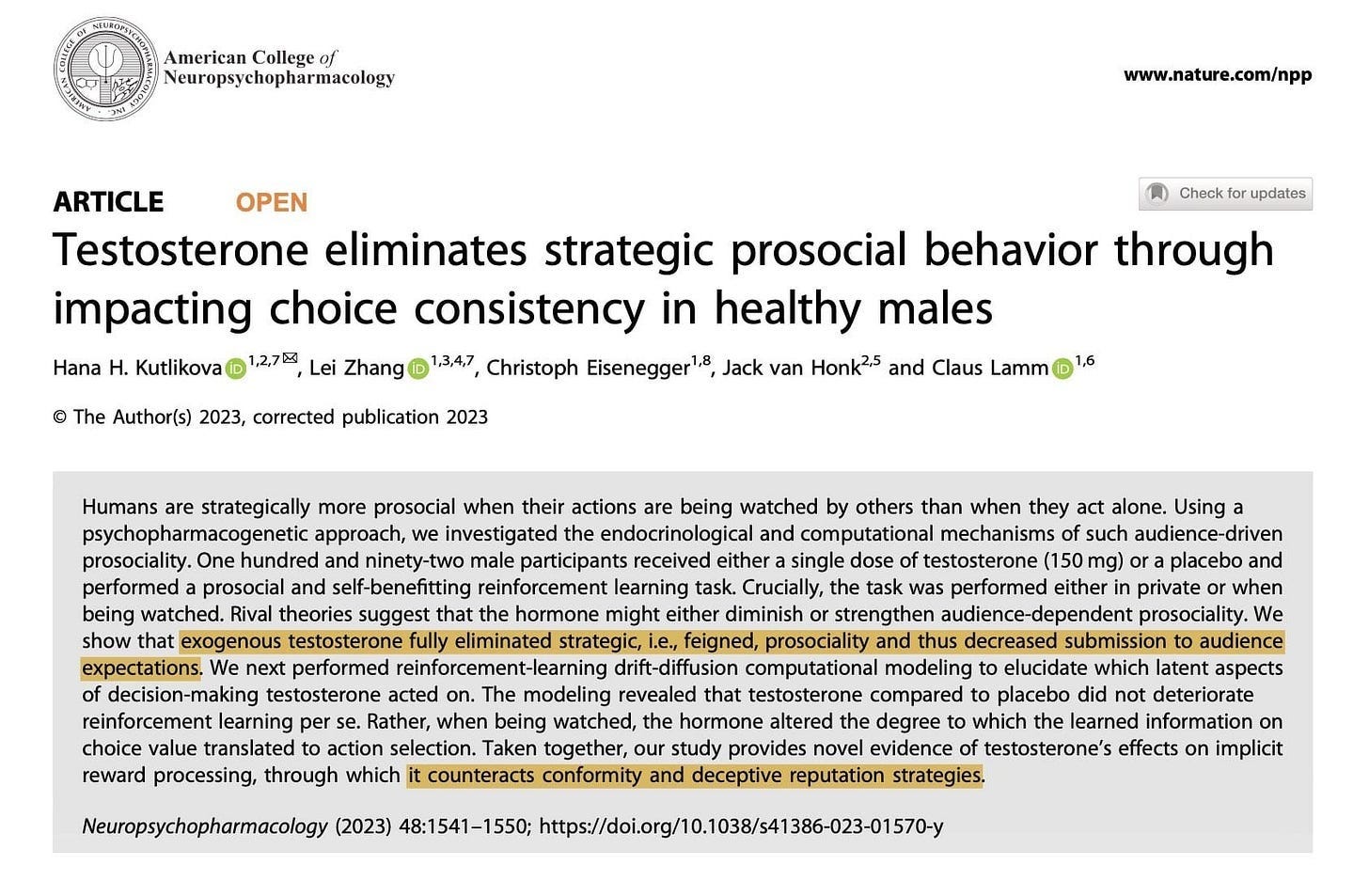
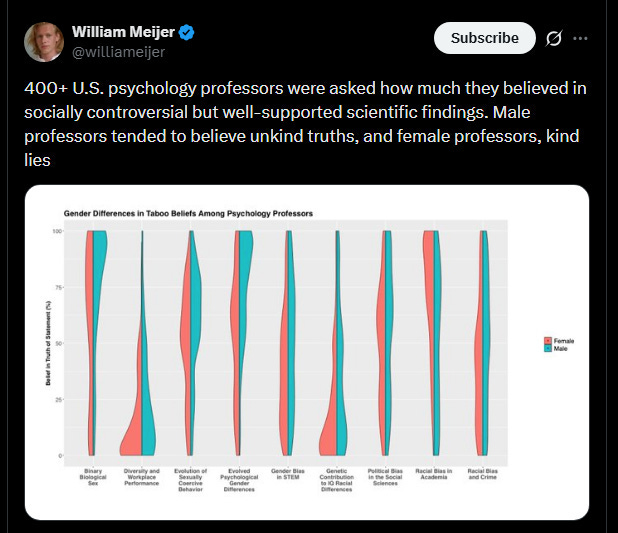
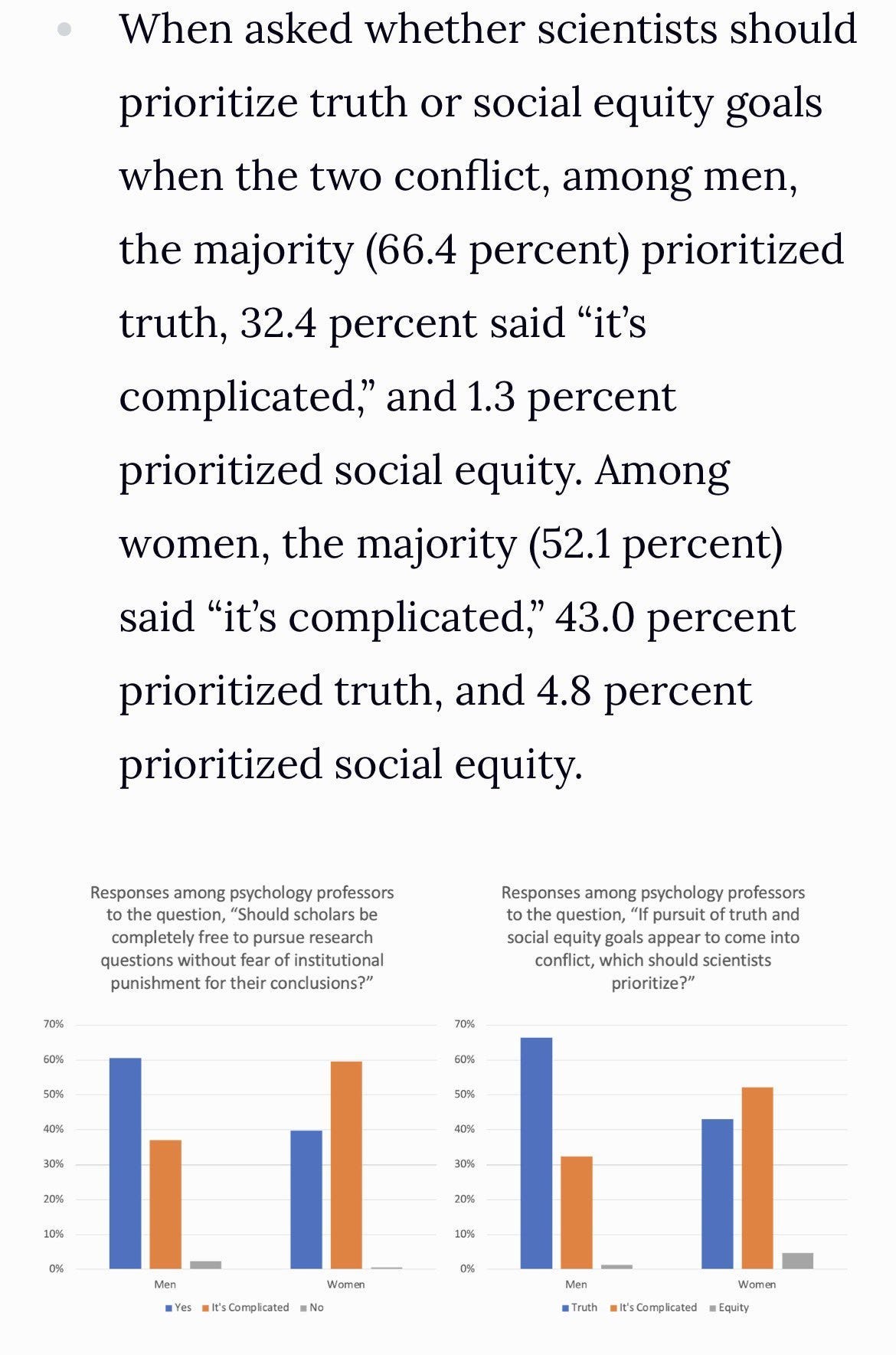
High agreeableness (harmonious, consensus-reinforcing) is a prominent female trait. Men are notably more disagreeable (competitive, confrontational).
Feminine perception of “truth” is processed through Manichean social valence. Is this idea kind or mean? Does this help my social standing or hurt it? The goal is relational preservation, not fidelity to accuracy. The instinct doesn’t prioritize if it’s true or false, but whether it’s harmonious or disruptive. Comforting falsehoods feel truer than acrimonious facts.
Things that increase harmony and status are good, whether or not they are truthful. Things that threaten harmony and status are bad, whether or not they are truthful. Veracity is an afterthought.
The claim isn’t tested against reality so much as screened for social consequences; it’s a survival strategy manifesting as reputation management. We evolved in settings where exile meant death. Women are significantly more vulnerable to being disliked because they can’t physically defend themselves against the consequences of intense disagreement with men (violent confrontation). This places a greater premium on coalitional protection, social standing, and conflict resolution mediated through language.
Truth won’t feed or protect you, but being liked might.
This divergence becomes visible when accuracy carries a social price. When a claim is framed as harmful or inequitable, the question quietly changes from “Is it true?” to “Should a good person admit that it’s true?”
Harmony, belief, and estimation are passive states (don’t verify, trust).
Truth, proof, and measurement are active states (don’t trust, verify).
Not all demonstration and testing produce truth; but all truth emerges from demonstration and testing.
To understand the dyad of truth/harmony through information theory see here. To understand it thermodynamically see here.
There’s metabolic logic to these tells: narration costs cognitive work, which costs energy, and we don’t expend energy on things we don’t care about. Rhetoric has an economy: attention, effort, and reputation are scarce, so their allocation carries signal. The Least Action Principle flows through all things, because physics flows through all things.
Hedging and shitposting:
How someone hedges can hint at intellectual identity. A reader from the comments in Writing Physiognomy asked me this:
“I shitpost intensely but hedge my bets constantly when I write. I seem to be gun-shy to affirm any point of knowledge I actually have. What is this called?”
— Sarah (wrote the Substack Yoga Rat, she’s since deleted her account)
She lets it fly while shitposting but is measured and hedged in domains of expertise. This inversion suggests she’s not constitutionally timid but selectively guarded. Hedging displays as humility but is often a kind of self-image insurance, a prophylactic against critique. If you don’t fully commit to a claim, you can’t fully be wrong.
The shitposter in us posts frivolously. It’s low stakes, so the unfiltered voice comes out. But when the topic touches our expertise, it touches our identity; this is when being wrong can damage the image others hold of us, and worse, the image we hold of ourselves.
Psychology calls this self-handicapping: undermining yourself to preserve a fallback explanation for failure that’s unrelated to your abilities.
If you fail → It’s because of the handicap
The shitposter has a free out: “I wasn’t trying, it's the internet, who cares”.
Hedging has a similar escape hatch in scholarly tone: “in my opinion”, “I could be wrong”, “it appears that”, “one might argue”.
Both are buying optionality on being wrong, paid for in claim-strength
If you succeed → It’s impressive despite the handicap
It also maps onto evaluation apprehension: anxiety triggered by judgement
You don’t get evaluation apprehension about shitposts because you’ve pre-disclaimed seriousness and effort.
The shitposting voice is the candid self. The hedging voice is the self under evaluation. The delta between them sheds light on status, confidence, and insecurities. A related quote:
“Some write as they speak. Others compose as who they wish they were. A man who sounds nothing in person as he does on the page is telling you who he wants to be. The gap between spoken and written voice exposes the gap between self-image and self-reality.”
Unprompted defensiveness signals sunk cost and identity investment; it’s more informative than attacking unprompted. Attacking is cheaper; you can lambast things you don't care about for entertainment, status, or sport. It’s far less common to defend something you don't care about. Defense is paid in vulnerability and potential cost-of-being-seen-as-uncool; this makes it more diagnostic.
Impaired mental states and honesty:
What people say when they’re tired, drunk, sick, or frustrated is often more candid because decorum requires mental energy, and these states deplete it. The cheaper budget produces the truer report.
“Sorry I said that, I was drunk” translates to “My depleted state stopped paying for pleasantries”. Deception research shows that lying is computationally expensive; it requires maintaining two simultaneous models (truth and cover story). Anything that reduces cognitive capacity (alcohol, fatigue, pressure) makes deception harder to sustain.
V. Diagnostic Tells: Books, Vacations, Careers, and Politics
What you read, where you vacation, your bookshelf, occupation… each leaves temperamental residue. They illuminate underlying dimensions — openness, familiarity, origin, novelty, abstraction — that a person values. Political stances live downstream of these.
What they read:
Conservatives read within genre and function: military history, business strategy, scripture, self-improvement. The bookshelf is a mirror.
Liberals read promiscuously: literature, philosophy, heterodox theory, poetry, opinions out of Davos. The bookshelf is a window.
Where they vacation:
Conservatives prefer the known, returning to the same places: the lake house, family cabin, annual hunting trip. Relaxation in the familiar.
Liberals holiday in the unknown, preferring foreign places: new cities, new people, different cultures. Relaxation in the unfamiliar.
Fitness routines:
Conservatives are more likely to train through repetition in defined domains: bodybuilding splits, CrossFit splits, the same running route. Discipline as method.
Liberals train through novelty in less defined domains: rock climbing, obstacle races, cycling new routes, dance classes with an instructor. Exploration as method.
I suspect exploration training like rock climbing or parkour is more indicative of higher openness (liberal temperament) than repetition/defined exercise is of conservatism. I would weight these tells differently.
Decorations:
Conservatives display trophies, flags, and family photos. Homages to origins.
Liberals display books, art, and travel artifacts. Homages to destinations.
One room says “this is where I’m from”; the other says “this is where I’ve been.”
Reasoning and argumentation:
Conservatives argue from precedent: “it’s always been done this way”, “the founders intended”, “tradition exists for a reason”, “don’t remove the fence before learning why it’s there”.
Conservatives see inherited arrangements as compressed information.
Liberals argue from principle: “logically, it follows” “if we’re consistent, then,” “the experts agree”, “the fence is a social construct.”
Liberals often submit inherited arrangements to abstract consistency
One defends the wall; the other defends the blueprint.
Professions & Politics
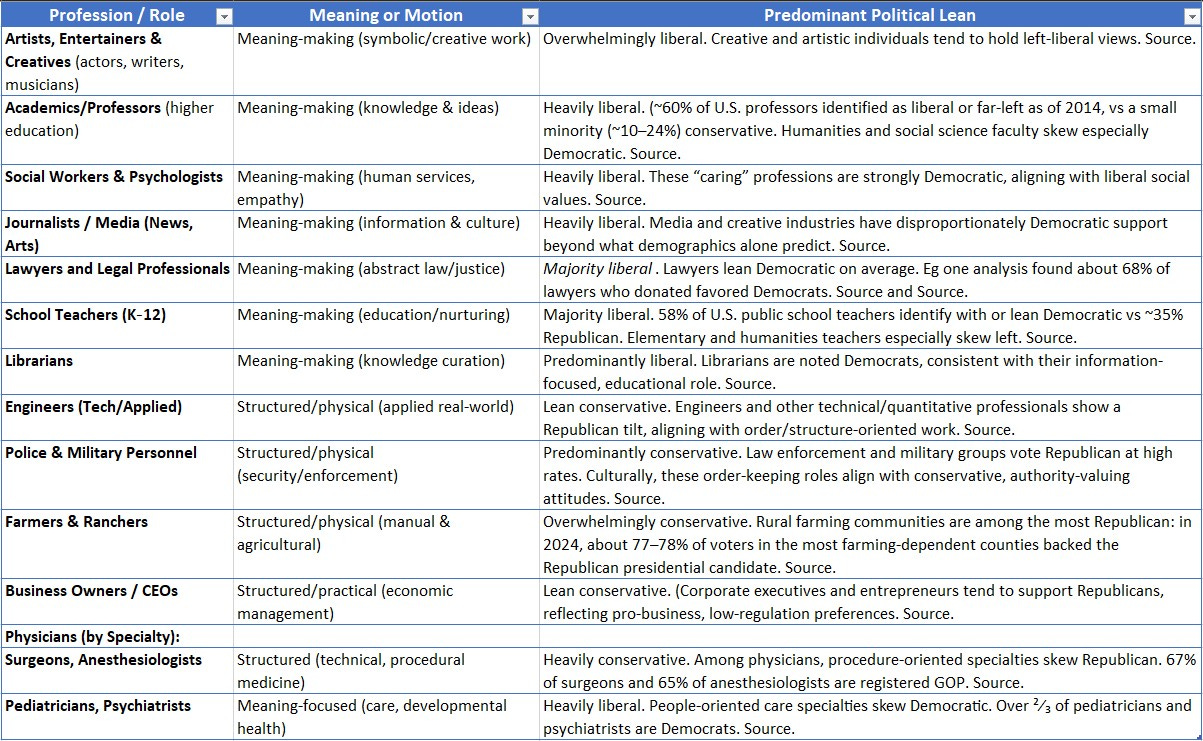
If temperament underpins preferences and political stances, then we should see correlations between professions and politics. And indeed, we do. Research mapped FEC donation records across hundreds of professions and found a consistent pattern in political donations:
Fine arts, film, music, creative writing, theater: liberal donating.
Home builders, accountants, truck drivers, surgeons: conservative donating.
This tracks openness and “explore vs exploit” remarkably well. The more a discipline rewards interpretability, novelty, and innovation, the more liberal its practitioners. The more it demands precision, structure, and rule-adherence, the more conservative.
Example: architects vote Democrat (74%). Home builders, Republican (77%).
One conceptualizes the building. The other builds the building. Abstraction vs atoms.
I’d like to reframe this distinction more functionally. Rather than asking if a profession is creative or quantitative, ask how failure is determined.
Jobs that keep failure rates down (reality audited)
Failure-rate occupations are falsifiable: if they do their jobs wrong, something breaks, someone dies, or resources vanish in a way that cannot be narrated away.
Reality audits the work. If the structural engineer screws up, the bridge falls; if the accountant errs, the books don’t balance. The patient dies, welding breaks, code fails, plane doesn’t land.
Jobs that produce legitimacy stories (guild/feeling audited)
Legitimacy-story occupations are largely unfalsifiable: if they do their jobs wrong, the consequence is disagreement about whether they did them wrong.
Failure looks more like “disapproval”, mediated through interpretation.
The findings aren’t false they’re “problematic”. The theory is “misguided”. The campaign “shifted sentiment”. The art “interrogates space”. The work is judged by peers whose main product is judgement.
A callback to Section IV. Rhetorical Tells: academics work in a guild-audited setting. Hedging is mandatory in these fields because failure is defined by peer disapproval, not a bridge collapsing.
The engineer who hedges on load calculations kills people. The sociologist who doesn't hedge gets ostracized.
Failure-rate professions are validated by calculations, mechanisms, and external consequences. Legitimacy-story professions are validated by feelings, peers, and consensus. The surgeon answers to the body’s health. The historian answers to other historians.
Pilots skew conservative: they’re evaluated by how the plane flies. Flight attendants skew liberal: they’re assessed by how helpful and likable they are. Professions audited by consequences cluster conservative. Professions audited by feelings and framing skew liberal. Research and sources here.
From individual tells to population-level ones. A nation is a living thing by virtue of being composed entirely of living things. Its citizens have metabolic and behavioral patterns. In aggregate, those individual patterns produce the collective patterns of civilization.
VI. Civilizational Tells: The Government You Deserve
The following is from a future essay Biofoundationalism, Hajnalista: Values of Wheat, Ethics of Rice.
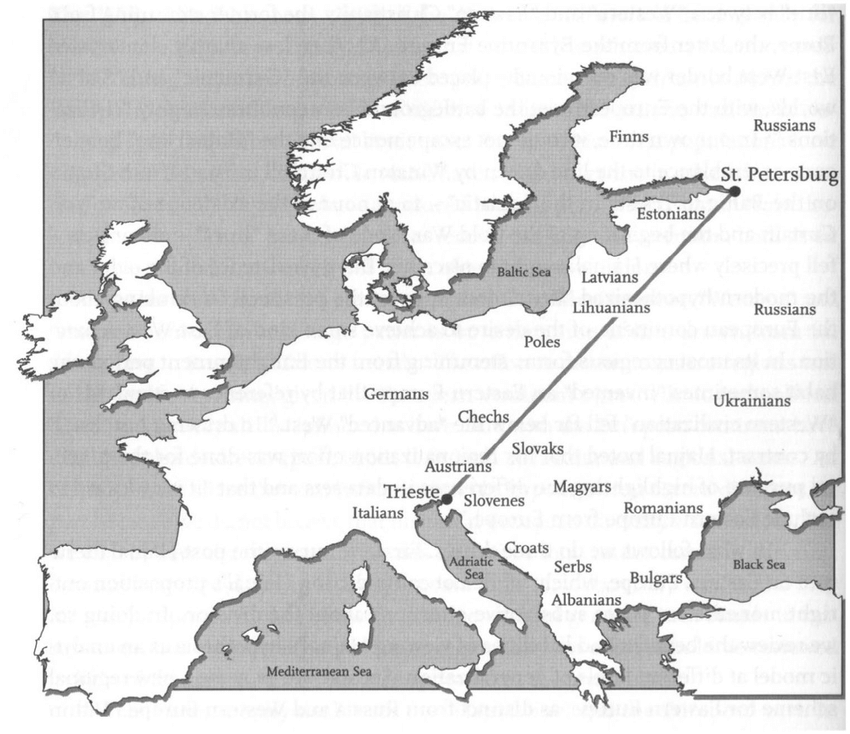
The Hajnal Line extends from St. Petersburg to Trieste and covers all nations to the west of it
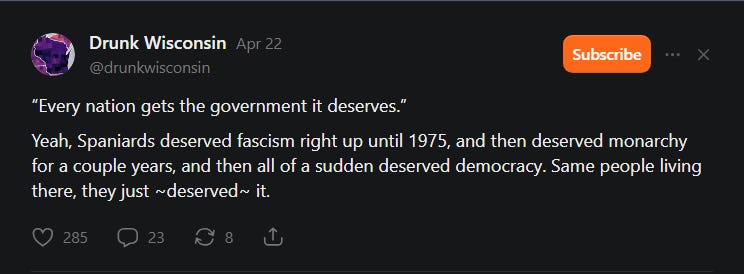
Amusingly, my Substack mutual Drunk Wisconsin is correct, but not for the sarcastic reasons he thinks. "Every nation gets the government it deserves" isn't a moral sneer about fixed governance. Rather, it's a description of the distribution of governments a people cycle through. A population’s history presents a range of political equilibria that its ecology, temperament, and coordination make more or less reachable.
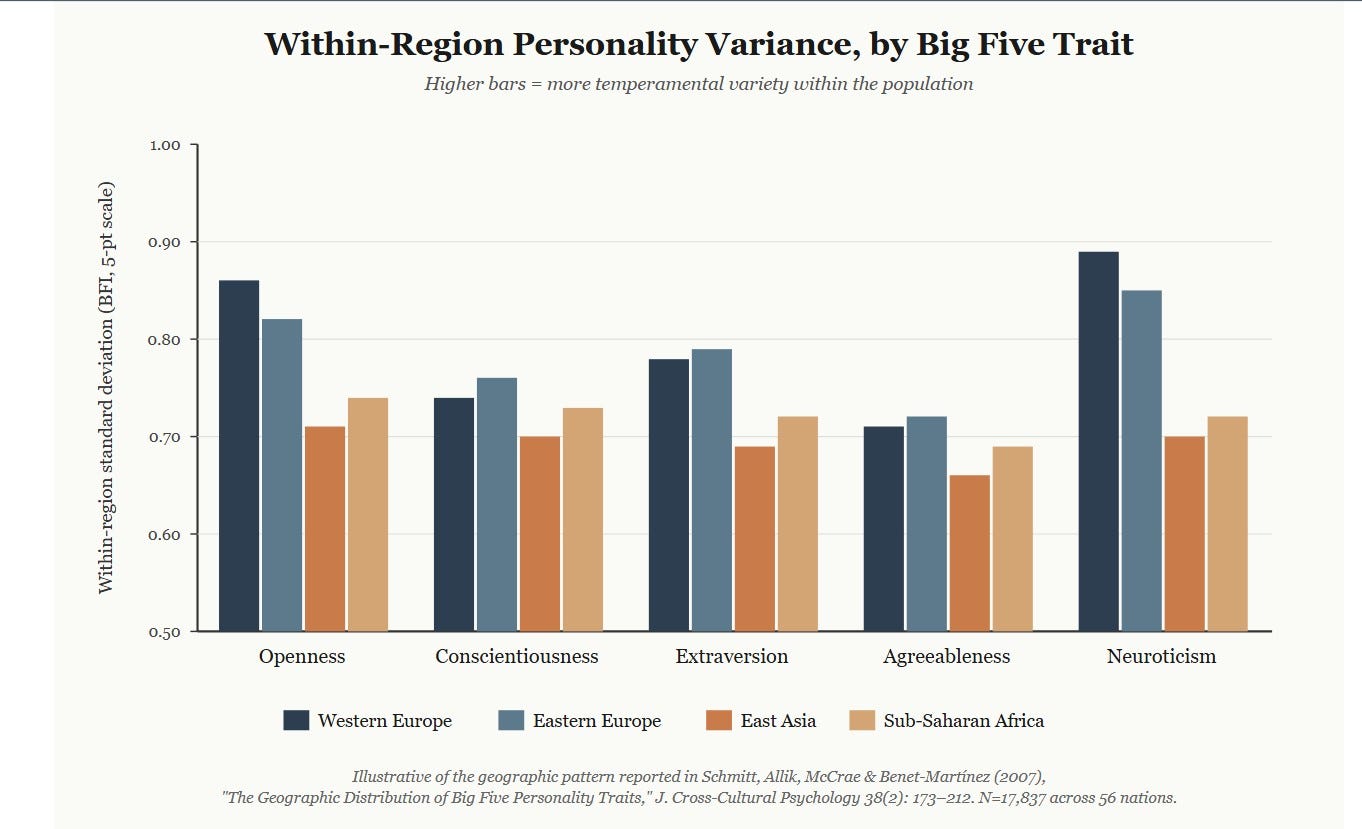
Populations differ not only in average traits but the width of their trait distributions. A broader distribution contains more contrasting temperaments: more appetite for hierarchy and rebellion, conformity and experimentation, imperial coordination and radical individualism. Under a set of pressures, one part of the distribution becomes politically prominent; under another, a different part does.
European Variability:
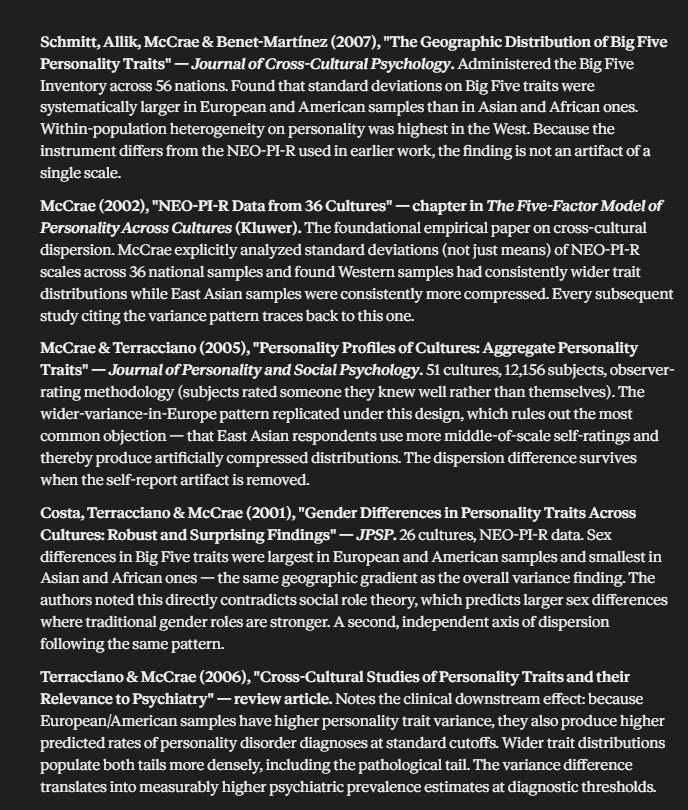
Europeans have greater temperamental variance than any other major population.
They have wider distributions on openness, neuroticism, novelty-seeking, and outgroup-concerned politics (WEIRD morality, per Harvard anthropologist Joseph Heinreich).
This broader personality distribution is one of the most replicated findings in cross-cultural psychology. Sources:
Europeans are a higher variance people, meaning they have more “types of guy” per capita than anywhere else. Punks, poets, monks, nerds, conquistadors, sensitive young men, jocks, scholars, liberals, fascists, anarchists, ballerinas, theater kids, Florida Man, and German engineer… all drawn from the same gene pool.
Genetic diversity is indeed a strength, and homogenous diversity is Europe’s strength. They are more varied within their own people.
The European isn’t only temperamentally distinct from the East Asian or African; he’s more distinct from his own neighbor.
Under one pressure it engenders bureaucracy. Under another, revolution. Another, empire. The event gets narrated as the cause; however the civilizational distribution was the genetic soil allowing it to bloom.
Western/Northern Europe and the US-UK Anglosphere are the most individualistic societies on Earth, with East Asia at the collectivist end. Individualism means people behave less uniformly; this makes their forms of societal coordination more volatile! Note how the European continent has been at war for most of its existence up until the last 70 years.
So, yes, broad shifts in European governance fittingly reflect the underlying breadth of European temperament. Conversely, Asian populations and their governance are more uniform, because the people are. The same biological reasons lurk (this will be covered in detail in Biofoundationalism, Hajnalista).
Lower-variance/more collectivist populations may still experience rebellion, collapse, reform, and conquest. But the political organization snaps back more readily because the underlying temperamental distribution is narrower. The occasion changes; the attractor remains.
Spaniards "deserve" fascism and monarchy and democracy because their distribution contains a fuller range of personality types, and oscillates between expressions as conditions change. The Chinese "deserve" millennia of similar imperial form because their distribution is more uniform.
This is bottom-up gene-environment interaction, obfuscated by top-down sociological descriptions. The agriculture of a people breeds its culture. The land cultivates a people, then the people cultivate the land.
Not every Hajnal nation fluctuates the same way: within-Europe variance is itself variable. Sweden and Switzerland haven’t undergone fascism and democracy in a century like France, Italy, Germany, and Spain. It’s the neurological capacity for this volatility that distinguishes the European gene pool, and why the continent has birthed so much disruption and innovation throughout its history.
Some of the worst wars and tragedies come from Europe. And the most impactful technologies, literature, empires, and innovations also come from Europe (and its diasporas).
A note on political parties and Biofoundational systemizing.
The following is important for the next sections.
Partisan labels aren’t Biofoundationalism’s reference point. Parties are tribal jerseys. We track actions and whether they enhance order or erode it.
Biofoundationalism generally uses liberal/leftwing and conservative/rightwing interchangeably, however it’s technically imprecise to do so. Conservative and liberal are temperamental poles and thermodynamic tendencies. Whereas parties are ideological mixtures with changing positions that skew towards one pole.
When you hear “conservative”, think: human coordination oriented toward structure (order).
Hierarchical, authoritarian, boundary-building, standard-enforcing (exclusionary). Resources and rights are earned.
When you hear “liberal”, think: human coordination oriented toward freedom (chaos).
Equitable, boundary-dissolving, standard-reducing (inclusionary). Resources and rights are deserved.
Example of leftwing, but not liberal:
The USSR was an extremely orderly, authoritarian regime despite being “leftwing”. Communism imposes strict rules and militant enforcement. Referring to it as liberal focuses only on economic policy (equal distribution of resources, independent of contribution).
Example of rightwing, but not conservative:
Libertarianism is a chaotic form of governance. It advocates weaker hierarchical command and reduced structure in favor of freedom. Fewer rules, less limits, less boundaries.
Referring to it as conservative similarly narrows the frame to only economics (resource distribution is based on performance, not need).
Please keep this in mind for the following sections.
VII. The Game Theory of Constraint
Rules are only as binding as the mutual incentive to obey them. Once one side discovers advantage in violation, the contest no longer occurs inside the rulebook. The standards are then determined by he who is least inhibited, and who loses legitimacy by responding in kind. If one side operates under constraint and the other does not, the constrained side faces competitive disadvantage.
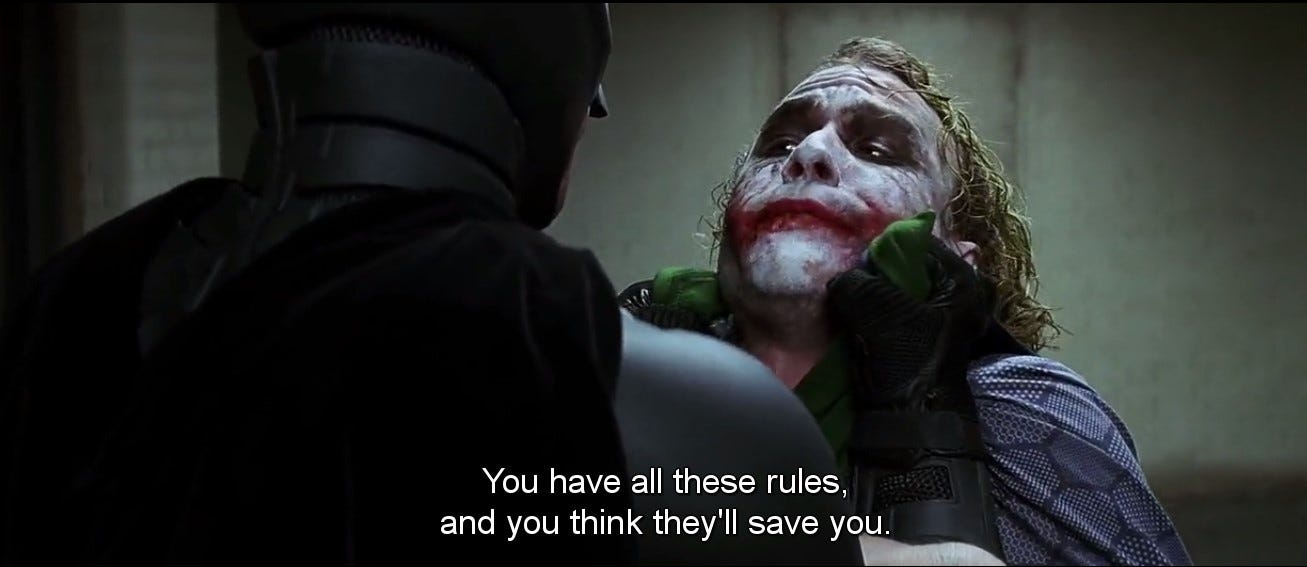
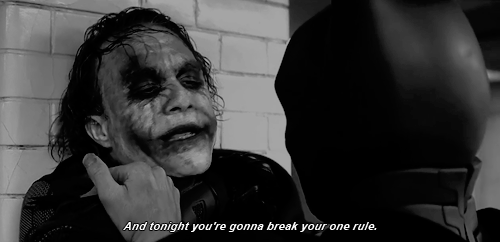
Batman and Joker are useful here, not as hero/villain labels, but as constraint models.
Batman is self-inhibited by the system of justice he defends. Joker is liberated by contempt for the system and strategically uninhibited. Batman’s escalation incurs identity and legitimacy costs; Joker’s escalation reinforces his identity. Paradoxically, Batman can escalate only by betraying part of what he protects; he competes by being less like Batman. Joker escalates by becoming more fully himself.
This is the game-theoretic problem for any orderly, standard-adhering faction. Its constraints are virtuous assets inside a functioning system and tactical liabilities once the adversary exits the system.
Standards, due process, reciprocity, and trust all coordinate civilization. But against an opponent rewarded by transgression, those same virtues become handicaps.
This liability is prominent in the short run. But in iterated games over time, constraints serve as a coordination device. Predictability attracts allies, restraint preserves coalitions, and a reputation for proportionality and commitment facilitates cooperation. Joker’s chaos wins scenes, but Batman’s order sustains a city.
The same asymmetry runs through biology:
An immune system must destroy threats without destroying the body it guards. It operates under constraints that target the pathogen, spare the host.
The pathogen has no reciprocal obligation. It mutates freely, exploits vulnerabilities, and replicates without self-regulation.
If the immune system escalates beyond its mandate, defense becomes autoimmune disease, attacking the organism it’s built to protect. The pathogen never faces this problem; it’s at odds with the system to begin with.
EMPHASIS: The analogy is about asymmetrical constraints, not the classification of political opponents as pathogens.
In adversarial domains, the side preserving legitimacy and standards faces obligations the transgressive side does not. Order carries the active burden of continuity. Chaos carries the passive advantage of permission.
Order requires effort to maintain; chaos only needs the absence of effort and maintenance declines all on its own. At every level of existence, gravity has a thumb on the scale in favor of entropy. Physics flows through all things.
Rather than a moralizing chronicle of good vs evil, see the dyadic systemization of order vs chaos and the game theory of adversarial engagement that sits atop it. Observe these dynamics dispassionately — as strategic moves in an iterated game, a thermodynamic pattern of existence — and the behaviors of both factions become legible and predictable.
Similarly, the Left erodes hierarchy’s rules by constitution. The Right violates these rules under duress. One experiences escalation as self-injury; the other experiences it as self-expression. The Left holds a structural advantage for the same reason Joker does: its moral compass rewards escalation.
A common refrain in rightwing circles is confusion about why they don’t mirror the Left’s tactics and aggression. Why they're perpetually on defense, responding, rarely initiating. To understand why, conservatives must first understand themselves: not via mythic philosophy or grand heroic gloss, but through behavioral architecture.
A structure-maintaining agent doesn’t behave the same as a structure-dissolving one. An orderly temperament responds to escalation; a chaotic temperament initiates it.
Human coordination oriented towards order doesn’t riot as its first instinct; it seeks to contain riots. Even when enraged, its methods channel known paths for resolution. It riots reactively, reluctantly, and more briefly. It wants to reduce disorder, not increase it.
A chaotic temperament has no such reservations. Norm-violation isn’t a last resort but a precondition for renewal. Disorder is the medium, not the enemy.
The innate difference is a logic gate.
Conservative rioting needs two conditions: norm-violation AND perceived institutional failure. Both must be present. This is an AND-gate.
The violation alone isn’t enough. The orderly temperament wants the sheriff, court, border, military, constitution, or crown to handle it. It enters chaos when the legitimate channels break or get captured.
Liberal rioting requires either an event of perceived harm against a designated victim class, OR a narrative of potential harm that justifies preemptive disruption. This is an OR-gate.
A harmful act/violation doesn’t need to have actually happened, just the anticipation of one. Because disruption is already morally available as a method of renewal, the event doesn’t need to demonstrate that legitimate channels have failed.
Example: Trump’s 2017 inauguration saw large-scale Antifa riots and nationwide disruption. No harm occurred, only the anticipation that something bad would happen under Trump.
The AND gate requires two simultaneous failures. The OR gate needs only an assumption of one. Rioting frequency, duration, and scale are asymmetric because the triggers and desire for disruption are also asymmetric.
Rightwing riots are types of system-failure behavior. Leftwing riots are system-defiance behavior.
Transgression is the chaos pole’s guiding ethic. “Decolonize academia”, “the future is female”, ACAB, prison-abolition, etc.. Every slogan embeds a similar instruction set: reduce the standards, curtail enforcement. These arrive pre-packaged as legitimate from universities, pre-explained from MSM, and pre-loaded with moral superiority, looking for an excuse to act.
Rightwing Riot Example: January 6th
It was reactive. The norm-violation was believed to have come from the system itself. Responding to perceived institutional betrayal and election fraud.
It was reluctant. Totally disorganized. Mayhem occurred on the doorsteps of congress, but many participants had no evident plan and seemed surprised by their own presence: milling, filming, and posing rather than executing anything.
Officers were filmed opening barriers and allowing them through. Rioters entering a building whose defenders weren't defending it, uncertain what to do once inside, walking in a line while cops watched:
It was self-limiting: no sustained occupation, no follow-up actions, and widespread participant regret afterwards.
The Belfast riots of June 2026:
An African migrant attempted to behead a Belfast citizen on June 8th, savagely slashing his head and neck with a kitchen knife and blinding him in one eye; you can see the video evidence here. Civilians intervened and saved the man’s life. The video spread within hours. Destructive riots followed.
Reactive. Responding to grotesque violation. A 3rd-world act in the 1st-world.
Self-limiting. The destruction was citywide; however it was distinctly targeted at migrant housing (the norm violators) and police (agents enabling the violators) for five days.
Reluctant. It’s surprising violent riots aren’t commonplace after the sheer amount of migrant influx and crime over the last decade and institutional enablement.
Comparably violent and brutal migrant crimes have been routine against Europeans for years. The justice system (order-maintaining institution) isn’t fulfilling its role. The Right’s AND gate is getting activated.
To illustrate the reluctance, look at what hasn’t elicited riots:
Bataclan / Paris (Nov 2015): Islamic terrorists killed 90 at a concert hall, with 130 dead and mutilated across coordinated attacks.
Public response: French flags as profile pictures, candlelit vigils. No riots.
Nice, France (July 2016): 86 murdered on Bastille Day, including 15 children, run over by a truck.
Public response: no riots, just “thoughts and prayers”
Manchester Arena (May 2017): 22 dead at an Ariana Grande concert, mostly girls.
Public response: a benefit concert. No riots.
Cologne, New Year’s Eve (2016): Roaming rape gangs of Africans and Arabs with ~1,200 women sexually assaulted. Coverage suppressed by press and police.
Public response: no riots.
Berlin Christmas market (Dec 2016), Stockholm truck attack (Apr 2017), Reading park stabbings (June 2020), Brussels attacks (Mar 2016), Vienna shootings (Nov 2020), Solingen, Germany (Aug 2024)…
The UK Rape Gangs (1997–Ongoing): Somewhere between tens of thousands to a quarter million mostly white working-class girls were groomed, raped, and trafficked by gangs of Pakistani men. The scale is hard to ascertain. The report can be found here.
The details are inconceivably vile and genuinely one of the worst things I’ve ever read. Tame details are the NHS treated 13-year-olds for STDs and returned them to their abusers and police overlooked it for years. The system opted to allow systemic bodily violation of children rather than risk being called “racist”.
It’s the most severe modern norm violation AND institutional failure I’ve ever seen. The public response? Mostly angry speeches and tweets.
Thousands of dead, raped Europeans over decades… and overwhelmingly no riots. These are extreme, repeated violations and only now — after institutional channels have failed conspicuously and seemingly intentionally — are we beginning to barely see the societal behavioral immune system respond.
Compare this to the willingness of leftwing riots: initiatory, sustained, escalatory by design, with explicit templates for why transgression is justified. The Left embraces chaos deliberately because disorder is its native tactical environment.
BLM 2020
The OR-gate needs a story, not a verdict.
George Floyd had eight prior criminal convictions, including armed robbery. His 2020 arrest was for using a counterfeit $20. His autopsy found fentanyl at 11 ng/mL (fatal range starts at 3 ng/mL) plus methamphetamine and severe heart disease. The restraint used against him is a standard police technique. There was no actual norm violation for Floyd. None of this mattered. The overdose of a career criminal with one cellphone video making him appear victimized was all it took to sell a police brutality story and wreak havoc on a nation.
Sustained
Approximately six months of riots across 140 US cities in all 50 states, with varying intensity. It was the costliest civil disorder in US insurance history (~$2B), with total estimates considerably higher. There were riots in Europe too. Why? Well, why not?
Organized
Mutual aid networks, bail funds, legal observer guilds, support apparatuses with decades of operational continuity.
The Minnesota Freedom Fund raised ~$40M in days, with celebrity endorsements and corporate ritual submission. The ACLU, SPLC, and National Lawyers Guild mobilized infrastructure running since the 1960s civil-rights era.
Courthouse arson in Portland, autonomous zones in Seattle, mortar attacks on federal buildings. CHAZ lasted nearly a month. The response wasn't proportional because proportionality is a constraint, and constraints are what chaos wants to dissolve.
The overdose of one violent criminal caused corporations to honor him, putting “BLM” on landing pages. Not one has paid tribute to tens of thousands of trafficked and raped British girls.
Conservative chaos is depicted as reactionary and harmful; it’s narrated as unacceptable. Liberal chaos is framed as righteous and just; it’s narrated as acceptable.
When the order pole riots, it erodes their self-concept. When the chaos pole riots, it reinforces their self-concept.
J6 participants got the book thrown at them, had no support networks, and most expressed regret in post-trial statements. BLM participants were mostly let off, expressed resolve, with support networks backing them.
Consider: when a man hits a woman, the reaction is “he’s violent and dangerous”. When a woman hits a man, the reaction is “what did he do to deserve it?”. You need no other details for this instinct to emerge; this doesn’t exist in isolation.
The standards diverge because the biology does; the same reason applies to political poles. We just can’t see it yet, because we’re too preoccupied with moralized stories.
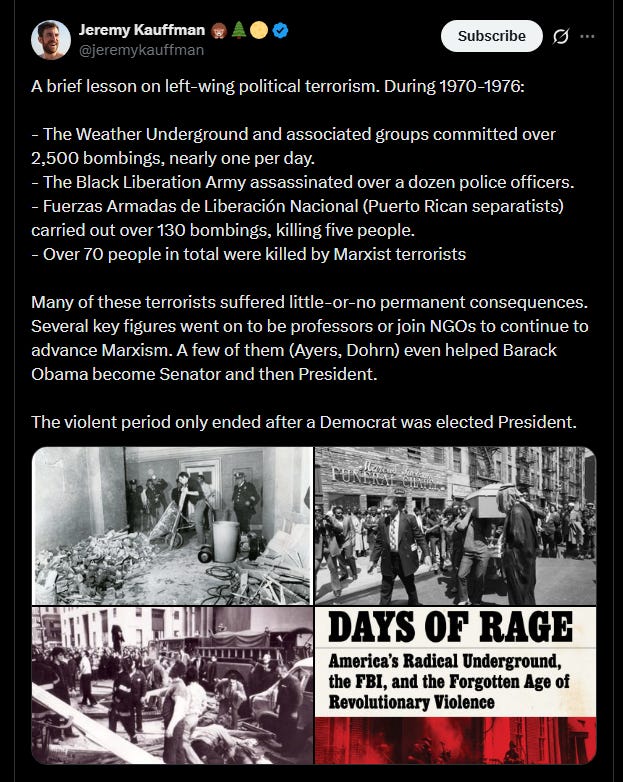
Add up every Western rightwing riot of the last decade and the scale is a fraction of BLM 2020 alone. Damage, duration, geographic spread, prosecutions, death tolls: every metric favors the Left by an order of magnitude or more.
A riot becomes sustained when grievance is joined by organizational capacity, social permission, network density, low expected punishment, and some belief that escalation will be rewarded rather than abandoned.
The order pole rioting makes news because it’s rare. The chaos pole rioting makes news because it’s loud. One side enters chaos reluctantly and exits quickly because disorder contradicts its temperamental programming. The other embraces chaos methodically, because disruption feels more like home.
A profile hints at a major. A breakfast hints at a household. An opinion betrays edges. A profession tattles on a vote. A sociologist explaining Italian governance catalogues the trees of history while overlooking the temperamental soil. Stories describe their subject; they also gesture at the substrate doing the describing.
This doesn’t make stories or narratives useless. They’re kinds of evidence. But they’re late evidence. Curated, edited, polished evidence. Something that follows, posing as what leads.
Biofoundationalism isn't a worldview to adopt any more than physiology or psychology is. It's a method to inspect, not an ideology to moralize. It looks for disposition before explanation, metabolism before palate, tradeoffs before slogan, action before caption, and revealed preference before stated belief. Look at how bodies move, not what minds say.
A parting tell:
Your discomfort, agreement, or resistance to this essay is itself… a tell.
It's not that you disagree with me, but how you disagree. Do you contest a study's methodology? Challenge a particular inference? Is there a specific objection to a specific application?
Or is your resistance visceral: a general distaste for biology rendering the human animal legible, bounded, and the implications it has for free will. Do you find my use of “animal” in this context offputting? That discomfort is guiding the conclusion before words can formulate it.
Underneath this is a clarifying question: what evidence would change your mind? If a mechanism were demonstrated, would you accept it? Would anything change your mind? If nothing would, the disagreement was never about evidence. A religious conviction not only lacks proof but stands in opposition to it. Evidence won’t dislodge a belief that evidence didn’t install.
How comfortable are you with systemization applied to human traits? When someone identifies a population-level pattern by sex or race, do you say "but not all!" and hunt for exceptions like they disprove rules? When an innate disparity appears, do you reach for "they're more alike than different"? Major divergences arise from small asymmetries. Humans and chimps share ~98% of their DNA. More alike than different, surely.
Chaotic temperaments carry devout belief in a blank-slate soul and unconstrained agency. The human is unfathomable, "there's no such thing as normal", "we’re all special", “everything’s a perspective”. Insisting that everyone is somehow fundamentally the same while also beyond classification.
Yet normalcy is just common behavior in aggregate. If everyone's special, no one is. If everything’s a “perspective”, then nothing is objective. Planes don’t fly by perspective. Buildings don’t stand by consensus. Bodies don’t function by self-description. Gravity cannot be narrated away.
A chaotic mind mistakes variation for the absence of structure, thinks exceptions defeat rules, and refuses to generalize or systemize. It buries signals by overweighting outliers and anecdotes (in statistics this resembles “overfitting”). The conclusions you’ll find: “everyone is unique (no biology), nothing is knowable/objective (no structure), it’s a social construct/bias/story we make up (100% agency)”.
Why this is chaotic reasoning:
It treats thoughts in the head as real as reality outside it. “Perspective” does heavy work here.
It believes everyone is fundamentally the same while also believing in infinite categories of uniqueness.
Note the contradiction: we’re all equal and similar (no group differences), yet also immeasurably layered and one-of-a-kind (endless subdivisions). Uniformity and infinity at once. We’re all the same, yet also special.
It denies structure to existence and grammar to reality. Rejecting categories, boundaries, and rank: the idea of superior and inferior, better and worse (hierarchal coordination). Chaotic thinking decrements limits, borders, and classifications. It wants everything to be flat, symmetrical, equal, indefinite.
You can detect it by stripping away rhetoric and asking: does this preserve distinctions or dissolve them? Does this want more limits or less? More standards or less? Chaos always wants less.
The instinct to deny biological essence is borne of the very temperamental programming it denies. Your biology is outlined by how you deny biology. You’re more legible in your rejection of legibility. But then again, of course I’d notice patterns and generalize. I’m clearly an orderly temperament. It is my nature. This essay carries my residue too. My attraction to legibility is as dispositional as another’s resistance to it.
Orderly temperaments systemize by taking regularities, forming scalable rules, generalizing, and extrapolating. If you agreed with this essay, or if your issues were methodological or mechanical, this likely describes you too.
The stories aren't necessarily wrong; they're just not first. They’re downstream. And downstream forces can, in time, reshape the river. When narratives get embodied in law, ritual, education, and habit, they become material forces, acting back upon the conditions that produced them. But that cycle still has an origin, recursion doesn’t erase sequence, and language did not summon the speaker into existence. The relationship between nature and nurture is reciprocal, but not symmetrical. It’s not a relationship of equals… nothing truly is.
Body precedes mind. Biology precedes ideology. Motion precedes meaning. What comes first leaves residue in what follows. Substance precedes story. I am, therefore I think.
"These determinist essays are extremely misguided, but the claim is so extreme it draws people into it, like cutting off a head in a Tarantino film.
By its own logic, “biofoundationalism” (a reactionary version of the more serious claim of determinism) can be ignored. By correct logic, it should be ignored as it is wrong.
Whenever I read something like this or deterministic philosophy there is a basic antithesis: so, by your own logic, your essay argues no change as things are biologically or physically determined. By your own logic, there is no need for this essay, since there is no choice. I can ignore your essay entirely it won’t change anything. ———- by the logic of Darwin’s human selection on the other hand, human choice is subject to particularity and change, not simply programmed, but differing from natural selection which relates intergenerationally to survival and reproduction. It is obvious that “choosing determinism” is a mechanism of human selection which relates to other motives —- however, by its own logic, which is wrong by the way, there is no purpose of choice, as there is no choice in the first place. By its own logic, it can be ignored. By correct logic, it should be ignored as it is wrong."
----
RESPONSE:
The is a solid example of what philosophically inclined guys deploy in attempt to dismiss Biofoundationalism.
A relevant quote from Temperamental Residue:
> “The stories aren't necessarily wrong; they're just not first. They’re downstream. And downstream forces can, in time, reshape the river. When narratives get embodied in law, ritual, education, and habit, they become material forces, acting back upon the conditions that produced them. But that cycle still has an origin, recursion doesn’t erase sequence, and language did not summon the speaker into existence.”
Just say, “I don’t like this, so I’m not going to engage it; I prefer the narrative overlay,” next time. It’s more honest. Then you won’t have to play pseudo-logic games. None of that was logic; it was anger directed at a strawman you constructed by completely mischaracterizing the essay and series. You can thereby dismiss mountains of evidence and detail because the conclusions discomfort you, and thus, cannot be true.
You are confusing determinism with fatalism, and causal determination with causal irrelevance. That a choice has causes does not mean the choice has no consequences; it means the chooser, the choice, and its consequences all belong to the same causal chain.
You do have choices! You have bounded choices. However you simply do not choose the temperament doing the choosing from some immaculate balcony outside biology.
More importantly, you have the choice to stop treating your natural dyadic counterpart as a defective version of yourself. You can encounter The Other as a contrasting complement, carrying necessary values that you underweight. Or… continue with the prevailing storytelling approach, in which political disagreement shows the other person is evil, stupid, brainwashed, ethically deficient, or has tragically failed to read all the Good and Right books.
Look around. The political landscape has produced ideological rabies: two moral temperaments converting difference into depravity, each convinced the other half of the population is malicious or mentally defective. People attack one another as enemies because they mistake their own moral emphasis for morality itself.
And somehow this is being presented as healthier than what I’m doing! LOL. Political discourse is overwhelmingly a noxious clownshow of vicious moralizing attacks, yet when I lower the temperature and say, “Hey buddy, you didn’t author the machinery generating your convictions” then I’m ‘nihilistic’ or receive some other puffy philosophy-word dismissal amounting to “hey, this bums me out, so I’d rather not”.
A biological framework that tells you your opponent completes what you lack is plainly less toxic than one declaring him perpetually wrong, evil, and must be defeated, silenced, or purified out of the polity. The latter is our present arrangement.
Biofoundationalism is rooted in neurology, physical law, and demands you HUMBLE YOURSELF to recognize forces beyond your control are guiding your “firmly held” beliefs.
It encourages you to treat The Other as complement rather than enemy. That is not only more scientifically grounded than partisan self-worship; it’s vastly healthier. Yet people trot out “determinism”, “fatalism”, and “nihilism” as magic-word dismissals, as though Biofoundationalism were some kind of info hazard. Say the magical words and… poof… you have apparently made some kind of point through decree.
Biofoundationalism does the opposite. It strips out the moral melodrama. It says these competing dispositions are recurrent, adaptive, environmentally responsive, and complementary at scale. The opposing pole is not a tumor to excise, but a counterweight you resent because it obstructs your preferred excess.
We all could do with more sterile reality and less flamboyant, feverish political storytelling. Consider it good for you to eat a bit of humble pie and learn what’s going on under the hood.
-----
> “If biological reality is true, then I will call it determinism and/or nihilism and then dub it wrong by decree”
This is a TL;DR of many of the objections I’ve received over ~4 years of working on Biofoundationalism in public. This escape hatch doesn’t work anymore. Engage with the substance. Identify a causal claim, mechanism, or piece of evidence you believe is wrong, and I’ll examine it. But visceral dislike with philosophy words sprinkled on top doesn’t cut it.
Or, you can keep doing the whole toxic partisan tribalism thing. Surely that is more “logical” and healthier for everyone.
-----
A quote from Power Acts, Beauty Is:
> “Biofoundationalism is a framework recognizing natural law and its human elements. It reads society like a biologist reads an ecosystem: not through judgmental eyes of good/evil or right/wrong, but of symbiosis and competition. Growth and decay. Adaptation and extinction. It maps environments and trade-offs; it doesn’t decree virtues.
This contrasts with the partisan ideologue’s story, which selectively compiles factoids to craft top-down narratives advancing ethical beliefs wearing political drag. A framework doesn’t assert moral superiority, whereas a political story does by its nature. Biofoundationalism does not take sides or moralize.
We have more in common with political allies than we think. And more to be grateful for regarding political adversaries than led to believe. We’re counterweights in a shared mechanism. Opposing notes in the same chord.
A symphony cannot be all one note. A polity cannot be all one moral foundation.
A dyad decays without its counterpart. Political opposition you resent is the tension that improves you. The adversary you hate is the complement that completes you. Our contrasting temperaments are part of a human collective, evolved to produce a more resilient whole.”












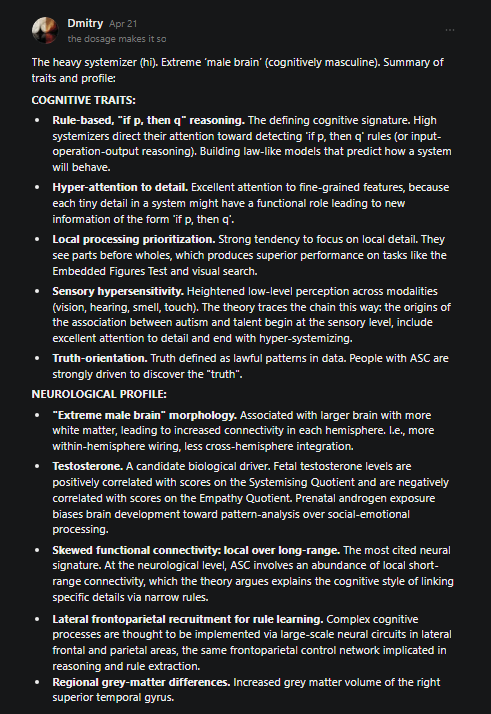
A comment from a reader, and my reply below.
COMMENT:
"These determinist essays are extremely misguided, but the claim is so extreme it draws people into it, like cutting off a head in a Tarantino film.
By its own logic, “biofoundationalism” (a reactionary version of the more serious claim of determinism) can be ignored. By correct logic, it should be ignored as it is wrong.
Whenever I read something like this or deterministic philosophy there is a basic antithesis: so, by your own logic, your essay argues no change as things are biologically or physically determined. By your own logic, there is no need for this essay, since there is no choice. I can ignore your essay entirely it won’t change anything. ———- by the logic of Darwin’s human selection on the other hand, human choice is subject to particularity and change, not simply programmed, but differing from natural selection which relates intergenerationally to survival and reproduction. It is obvious that “choosing determinism” is a mechanism of human selection which relates to other motives —- however, by its own logic, which is wrong by the way, there is no purpose of choice, as there is no choice in the first place. By its own logic, it can be ignored. By correct logic, it should be ignored as it is wrong."
----
RESPONSE:
The is a solid example of what philosophically inclined guys deploy in attempt to dismiss Biofoundationalism.
A relevant quote from Temperamental Residue:
> “The stories aren't necessarily wrong; they're just not first. They’re downstream. And downstream forces can, in time, reshape the river. When narratives get embodied in law, ritual, education, and habit, they become material forces, acting back upon the conditions that produced them. But that cycle still has an origin, recursion doesn’t erase sequence, and language did not summon the speaker into existence.”
Just say, “I don’t like this, so I’m not going to engage it; I prefer the narrative overlay,” next time. It’s more honest. Then you won’t have to play pseudo-logic games. None of that was logic; it was anger directed at a strawman you constructed by completely mischaracterizing the essay and series. You can thereby dismiss mountains of evidence and detail because the conclusions discomfort you, and thus, cannot be true.
You are confusing determinism with fatalism, and causal determination with causal irrelevance. That a choice has causes does not mean the choice has no consequences; it means the chooser, the choice, and its consequences all belong to the same causal chain.
You do have choices! You have bounded choices. However you simply do not choose the temperament doing the choosing from some immaculate balcony outside biology.
More importantly, you have the choice to stop treating your natural dyadic counterpart as a defective version of yourself. You can encounter The Other as a contrasting complement, carrying necessary values that you underweight. Or… continue with the prevailing storytelling approach, in which political disagreement shows the other person is evil, stupid, brainwashed, ethically deficient, or has tragically failed to read all the Good and Right books.
Look around. The political landscape has produced ideological rabies: two moral temperaments converting difference into depravity, each convinced the other half of the population is malicious or mentally defective. People attack one another as enemies because they mistake their own moral emphasis for morality itself.
And somehow this is being presented as healthier than what I’m doing! LOL. Political discourse is overwhelmingly a noxious clownshow of vicious moralizing attacks, yet when I lower the temperature and say, “Hey buddy, you didn’t author the machinery generating your convictions” then I’m ‘nihilistic’ or receive some other puffy philosophy-word dismissal amounting to “hey, this bums me out, so I’d rather not”.
A biological framework that tells you your opponent completes what you lack is plainly less toxic than one declaring him perpetually wrong, evil, and must be defeated, silenced, or purified out of the polity. The latter is our present arrangement.
Biofoundationalism is rooted in neurology, physical law, and demands you HUMBLE YOURSELF to recognize forces beyond your control are guiding your “firmly held” beliefs.
It encourages you to treat The Other as complement rather than enemy. That is not only more scientifically grounded than partisan self-worship; it’s vastly healthier. Yet people trot out “determinism”, “fatalism”, and “nihilism” as magic-word dismissals, as though Biofoundationalism were some kind of info hazard. Say the magical words and… poof… you have apparently made some kind of point through decree.
Biofoundationalism does the opposite. It strips out the moral melodrama. It says these competing dispositions are recurrent, adaptive, environmentally responsive, and complementary at scale. The opposing pole is not a tumor to excise, but a counterweight you resent because it obstructs your preferred excess.
We all could do with more sterile reality and less flamboyant, feverish political storytelling. Consider it good for you to eat a bit of humble pie and learn what’s going on under the hood.
-----
> “If biological reality is true, then I will call it determinism and/or nihilism and then dub it wrong by decree”
This is a TL;DR of many of the objections I’ve received over ~4 years of working on Biofoundationalism in public. This escape hatch doesn’t work anymore. Engage with the substance. Identify a causal claim, mechanism, or piece of evidence you believe is wrong, and I’ll examine it. But visceral dislike with philosophy words sprinkled on top doesn’t cut it.
Or, you can keep doing the whole toxic partisan tribalism thing. Surely that is more “logical” and healthier for everyone.
-----
A quote from Power Acts, Beauty Is:
> “Biofoundationalism is a framework recognizing natural law and its human elements. It reads society like a biologist reads an ecosystem: not through judgmental eyes of good/evil or right/wrong, but of symbiosis and competition. Growth and decay. Adaptation and extinction. It maps environments and trade-offs; it doesn’t decree virtues.
This contrasts with the partisan ideologue’s story, which selectively compiles factoids to craft top-down narratives advancing ethical beliefs wearing political drag. A framework doesn’t assert moral superiority, whereas a political story does by its nature. Biofoundationalism does not take sides or moralize.
We have more in common with political allies than we think. And more to be grateful for regarding political adversaries than led to believe. We’re counterweights in a shared mechanism. Opposing notes in the same chord.
A symphony cannot be all one note. A polity cannot be all one moral foundation.
A dyad decays without its counterpart. Political opposition you resent is the tension that improves you. The adversary you hate is the complement that completes you. Our contrasting temperaments are part of a human collective, evolved to produce a more resilient whole.”
Dmitry is about to upend the astrology market with his Biodeductionalism Seminars