

This is Part II of The Moral Genotype. It covers how disgust shapes our moral instincts and political expressions. The insula passionately speaks first; the mouth speaks second. All living things have immune systems, guiding life in ways we don’t fully appreciate.
I hope this disrupts how you see The Other and why certain behaviors persist. Maybe this information will anger you, perhaps it will disgust you: you’ll learn the difference between these two emotions should you get through this essay.
I listened to this modified song while writing. This track is what originally played during the first drafts of the Biofoundationalism series over three years ago. There’s also a video included at the end of this essay.
Disgust is a useful political diagnostic for good reason: the body is very bad at pretending.

Outline
I. Layers of Existence
Different disciplines observing the same creature
II. Methodological Note: Tails, Outliers, & Female Welders
Is every human science an elaborate fraud?
III. Disgust: What It Is & Isn’t
Everyone gets grossed out. The degree and impact tell us something.
IV. Neurology of Disgust vs Anger
Does it move toward the thing or away from the thing?
V. The Three Domains of Disgust
Pathogen. Sexual. Moral.
VI. Measuring Disgust, Predicting Politics
Disgust sensitivity isn’t monolithic.
VII. Homosexuality, Disease, Incest, & Sexual Abuse
Embodied disgust reactions point to something real
VIII. Sex Differences: Male & Female Baselines
Comparisons must be made apples-to-apples.
IX. The Four Boundaries
Pathogens shape a nation’s politics
X. Moral Disgust: Anger Saying “Gross”
Being offended is not the same as being disgusted
XI. Heritability & Distributions
Individuals produce the variation. The ecology selects the distribution.
XII. Moral Genotypes, Political Phenotypes
Nature doesn’t do coincidences at scale. Consolidated evidence of political biology.
XIII. Dyads, Collectives, & Body Before Ideology
Conservative and liberal beliefs are different decision criteria under uncertainty.

Note:
Section VII. Homosexuality, Disease, Incest, & Sexual Abuse contains potentially upsetting information on pedophilia, parasitic activity, and child sexual assault. In addition to the sources cited throughout, this essay incorporates material from two companion research documents:
The Moral Genotype II: Homosexuality, Disease, Incest, & Child Sexual Abuse
The Moral Genotype II: Parasites, Behavioral Changes, & Sexual Transmission
I. Layers of Existence
Biofoundationalism recognizes a simple reality: nothing about us is independent of our bodies. Nothing about our bodies is independent of their environment. And no environment we survive in is independent of physics and thermodynamics.
These nest. Physics constrains biology, biology constrains psychology, and psychology constrains everything we call politics, culture, and society.
The base layer is physics. These are The Rules.
They’re the constraints no organism negotiates. Gravity exists without our recognition. Thermodynamics expresses itself as metabolism and grants no narrative exemption. Life must acquire energy, maintain gradients, repair damage, reproduce, and persist under finite material conditions. Some refer to this as “natural law”.
Above that layer is biology.
What living matter builds under constraint. The metabolic and genetic machinery through which organisms perceive, move, coordinate, mate, learn, and adapt. Environments impose costs; organisms iterate and propagate within them… or don't. What survives is what we call "life".
Psychology sits above this.
Psychology is biology expressed through temperament, instinct, and behavior. How we interpret, remember, desire, fear, imitate, value, and act. The discipline observes and systematizes these patterned tendencies.
From there, other disciplines exist at varying psychological resolutions:
Economics: psychology applied to scarce resources and consumption
Anthropology: psychology applied cross-culturally
Education: psychology applied to learning and development
Politics: psychology applied to civilizational coordination
Sociology: psychology aggregated across groups
All of these human sciences study the same creature subject to the same constraints, differing only in which patterns and circumstances they prioritize.
Psychology doesn't hover above the nervous system. Politics doesn't occur outside bodies. Culture is not mist floating apart from the animal it describes. Institutions, norms, customs, and incentives are secondary forces: emergent properties of organisms with inherited architectures, physiological limits, and nonrandom dispositions.
These fields of study rest upon the same empirical premise: humans exhibit behavioral regularities. Traits cluster. Temperaments recur. Environments exert persistent effects on inhabitants. Certain conditions predict certain responses, and they’re not randomly distributed. This is the premise beneath every human science.
Recurring behaviors therefore demand recurring causes. If actions are stable enough to observe, measure, and anticipate, something stable must be emitting it.
You cannot recognize these disciplines while denying that the human is primarily a biological organism. For consistent behaviors to be observed, generalized, and systematized (which is what all of these disciplines do!) something in the organism must be producing them. This demands confrontation with the layer where they reside: biological substrate.
What we call 'social constructs' are mislabeled biological expressions. What we call culture is the aggregate of such expressions: repeated behaviors emitted by organisms with innate, recurring structure. Psychology, economics, politics, and sociology tacitly acknowledge this.
Assertions otherwise rely on a Blank Slate, faith-based belief: an infinitely plastic soul dropped into the body, operating independently of its limits, heredity, and physiology. If that were true, everyone’s behaviors would be utterly unpredictable, all datapoints would be noise, and every human science would be an elaborate fraud.
If you’re willing to call every human discipline a dehumanizing scam because it studies man as a predictable biological agent, so be it. At least you’re being consistent. If not, you’ll enjoy this essay.
The alternative to biological primacy isn’t Blank Slate fantasy: “I am whatever my mind’s thoughts say I am.”
And rejecting Blank Slatism doesn’t mean rigid determinism: “I am whatever my body’s genes dictate I am.”
Biofoundationalism is the third position: "I am what my body builds, within the conditions it encounters."
This is the nature-nurture question, restated in the parlance of physics. Reality has a concrete grammar, threaded with irreducible noise: structure and stochasticity, order and chaos. Both are critical to existence, but it’s not a relationship of equals. There’s an asymmetry of prerequisites. Order comes first; chaos comes second. The reason for this isn’t cosmically mysterious: nothing could live otherwise.
Nurture exists solely on the back of nature’s programming. What We Say is millions of years downstream of What We Are. The body’s reality permits the mind’s dreams; the former demonstrably lives without the latter; the latter cannot live without the former.
Let’s examine a critical instrument allowing the body to maintain its internal order: disgust.
II. Methodological Note: Tails, Outliers, & Female Welders
“But not all are like that!”
“They’re more alike than different”
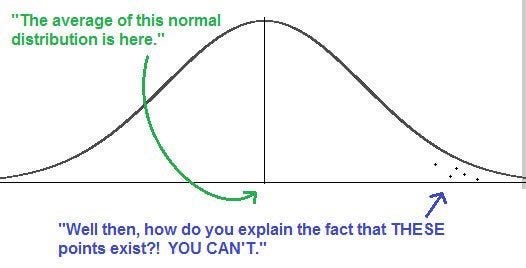
Biological regularities are distributional. Group tendencies aren’t absolutes. Pointing triumphantly at the tail of a chart demonstrates nothing except statistical illiteracy. A 6’2” woman, male kindergarten teacher, or female welder don’t erase sexual dimorphism and professional preferences.
Probabilistic, systematized analysis is what all sciences do.
Human traits don’t need to occur 100% of the time to reveal biological coding. Only physics and chemistry contain laws that always hold. Exceptions don’t refute rules and outliers don’t disprove aggregates. If you think they do, then you’re of the stance that every discipline besides physics is a scam, nothing is knowable, and I’m not sure why you went to school.
Small differences often produce major real-world disparities. And every pattern has peculiarities. That’s why it’s a pattern and not a physical law.
But for those who reason-by-feelings, one exception doesn’t modify the model; it detonates the very notion of modeling. Show it a distribution and it fixates on one dot in the tail. Show it a trait across societies and centuries and it remembers a bartender in Portland who was different.
In statistics, treating every datapoint as unique and novel resembles overfitting: it overindexes on anomalies and aberrations until the model explains the sample in front of it and nothing else. No predictive capacity. That is, quite literally, not how your brain works.
Oddities exist, the question is whether they change the slope. What follows is probabilistic throughout. This is known as systemization.
III. Disgust: What It Is and Isn’t
Disgust is one of the most politically powerful and most misunderstood traits. Over the years of developing Biofoundationalism publicly I’ve consistently encountered confusion about it. When I say conservatives exhibit stronger disgust responses, occasionally I’ll receive some version of “hey pal, liberals get grossed out too”.
Yes, liberals also possess stomachs and gag reflexes. But this misconstrues two different systems and the degree to which they're experienced. Disgust isn’t simply disapproval with an uglier adjective.
Everyone feels disgust. The useful questions are:
How readily does the response activate?
Which stimuli activate it, and how intensely?
How widely does it generalize?
How reliably does it predict judgment and political stances?
Disgust is not anger, offense, or disapproval. Anger and offense are cognitive-evaluative: they require appraisal. Disgust is a pre-rational reaction: revulsion, gagging, nausea.
It’s a physical avoidance state. Something is classified as infectious, corrosive, sexually costly, or otherwise unfit for incorporation or contact, and the organism rejects it. Disgust precedes language and reasoning, appearing early in development. Even newborns exhibit forms of it.
Disgust is one of the basic emotions identified across every studied human culture (Ekman’s universal six), including preliterate ones. This ancient somatic boundary-defense guides our interpretation of what's safe and what's contagion.
The behavioral immune system (BIS) is our prophylactic apparatus. A cluster of psychological mechanisms to protect from pathogens before the immune system has to do metabolically expensive work. Disgust is its emotional engine.
Thermodynamically: The BIS is an energy-conservation framework. Flinching and avoiding the contaminated thing costs fewer calories than fighting the infection it carries.
The BIS manifests the same thermodynamic logic that organizes every other biological system: minimize entropy, preserve bodily hierarchy.
Disease is harmful because it sows bodily entropy: attacking organ function, vitiating physiological processes. It spreads chaos within the organism. Every time you get sick, there’s a chaotic war going on inside you: disease is attempting to degrade the body (entropy), the immune system is attempting to preserve it (order). This is energetically costly.
Living things are dissipative structures; they persist by consuming energy to maintain structure and curtail internal entropy. Physics flows through all things.
Psychologically: BIS directives guide behaviors. Made legible to us via social filters.
Biologically: bodily processes maintain the organism’s structure. Anything imperiling its health informs the psychological layer.
Thermodynamically: determine energetic requirements and what the body must do to survive.
All of these are connected. The layer underneath dictates to the one above.
The BIS runs on a “better safe than sorry” principle; it overreacts, treating ambiguity as threats. This carnal software doesn’t restrict itself to microbiology. It also tags foreigners, sexual deviants, or norm violators as polluting.
Conservatives have a lower threshold for BIS activation.

IV. Neurology of Disgust vs Anger
When people conflate “that offends me” with “that disgusts me,” they’re confusing different primitives. True disgust is psychological perimeter defense that makes you want to recoil, gag, or wash. Anger doesn’t do this.
Critical distinctions
Offense is an evaluation (precedes anger): That violates a rule or value.
Anger prepares confrontation: That must be stopped or punished.
Fear elicits defense: That may harm me.
Contempt performs demotion: That is beneath me.
Disgust seeks separation: That is contaminating. Get it away.
Neurology of disgust
Disgust is visceral, frequently carrying parasympathetic signatures and vagal effects: decreased heart rate, changes in skin conductance (how well your skin conducts electricity, sweating affects this), and increased salivation.
Most parasympathetic responses are mediated through vagal pathways. The vagus nerve carries approximately 75% of all parasympathetic fibers.
Resistance to touch, eat, approach or remain near the stimulus.
Disgust makes you withdraw, not engage.
It has distinct facial expression: nose wrinkle, upper lip retraction, sometimes tongue protrusion, the “gape face”
These are involuntary. When someone’s levator labii fires, they’re disgusted whether they admit it or not.
These embodied responses arise without permission and provide a candid lens into the organism’s state.
The anterior insula (particularly the right anterior insula) is disgust’s key driver. This is where external sensory cues meet information about the body’s internal state.
The insula processes interoceptive signals: awareness of nausea, illness, fatigue, etc. It monitors your inner state.
Disgust is a gut feeling, literally. The insula receives signals and generates the sensation of “this is compromising, expel it”.
Disgust is produced by a distributed system integrating bodily sensation, learned association, attention, and memory. The amygdala plays a supporting role. The insula is its central node.
Impaired recognition and experience of disgust following brain injury: provides causal evidence of the insula’s role.
Insula damage can materially impair disgust processing and interoception, including the ability to recognize emotions in others. This doesn’t happen with amygdala damage for disgust (though it does impact fear).
Anger and disgust evoke different reactions. Anger mobilizes you toward the stimulus; disgust repels you away from it. They’re opposite autonomic programs.
Anger is a predominantly sympathetic program: increased heart rate, faster breathing, muscle tension, elevated blood pressure, increased sweating and skin conductance. The body preparing to close distance.
Of note: there are sympathetic markers associated with disgust like some salivary responses (signs of stress) and increased skin conductance. Neither emotion is a clean toggle of one branch. The ratio shifts; it doesn't flip. However, a dominant autonomic signature reliably separates the two: anger is sympathetic-led, disgust parasympathetic-led.
The cleanest distinction is operational. Anger precedes engagement (move toward the thing). Disgust precedes separation (move away from the thing).
V. The Three Domains of Disgust
The literature partitions disgust into three categories. I accept two of them.
1. Pathogen Disgust (ancestral, core)
Targets include spoiled food, feces, vomit, blood, wounds, pus, maggots/bugs, bodily fluids, corpses, visible infection, foul odors.
Function: prevent contact with substances that may introduce pathogens. The immune system’s behavioral front lines.
2. Sexual Disgust (ancestral)
Revulsion at sexual stimuli that represent fitness costs: incest, appearance of infection, poor mate quality, unwanted sex acts, or sex perceived as disease spreading or boundary-violating.
This makes some sexual advances feel not only undesirable but actively repellent.
This domain produces the largest partisan divergence.
3. Moral Disgust (modern, misclassification)
“Moral disgust” is cognitively evaluated. You encounter the violation, appraise it, then react.
Examples: betrayal, cruelty, cheating/stealing, oppression, loyalty violations.
It’s not remotely as visceral as worms in your sandwich.
Frankly I don’t think moral disgust warrants inclusion as a genuine disgust category. It’s not a pre-rational process.
Moral reactions lack the neurological indicators of authentic disgust; it’s closer to a metaphorical extension to the social/ethical domain.
In experimental comparisons, moral violations often resemble anger. I believe a category error is occurring. Much more on this later.
Anger characteristically organizes approach and confrontation; disgust characteristically organizes rejection and separation.
Moral transgressions elicit punishment and conflict effects that drive the respondent toward the object.
The toward/away heuristic is why I find moral disgust to be anger dressed in the language of revulsion.
Biofoundationalism’s core standard of evidence: Truth Is Found Through Motion. We know what something is by what it does, not what it says. When words and actions contradict, the embodied response is what’s true.
If you want to know which emotion someone is feeling, watch how they move.
VI. Measuring Disgust, Predicting Politics
Disgust sensitivity isn’t monolithic. Someone can be acutely pathogen-averse but sexually permissive; disaggregation allows us to isolate which kind has political implications. There are different ways to assess disgust, each probing different depths and domains.
1. Self-report
The Disgust Scale concentrates on core contamination and animal-reminder items (cues that we’re mortal biological organisms: death, gore, mutilation).
It gives scenarios like: “You see maggots on a piece of meat”, “You’re about to drink a glass of milk when you smell that it’s spoiled”, “You accidentally touch cremated ashes”, “You discover that a friend changes underwear only once a week”.
The Three Domain Disgust Scale contains 21 items divided among pathogen, sexual, and moral disgust. Subjects rate each item from zero (not disgusting) to six (extremely disgusting).
Sexual disgust uses scenarios like: “Hearing two strangers having sex”, “Finding out that someone you don’t like has sexual fantasies about you”, “Having sex with someone you just met”. Source.
Pathogen Disgust and Political Affiliation
Disgust Sensitivity, Political Conservatism, and Voting: found positive disgust-sensitivity and conservatism relationship across two large samples (31,045 people), holding after demographic controls and Big Five traits. Replicated across 121 countries.
Overall disgust sensitivity and conservatism: r = .22
Contamination disgust and conservatism: r = .27.
Across all regions had range of r = .17–.30
“Consistent with US results, in every region contamination disgust showed the strongest relationship with conservatism, ranging from r = .22 (United Kingdom) to r = .33 (Eastern Europe)”.
For context, the correlation between ibuprofen and pain relief is r ≈ .14. These are robust effects by any behavioral science standards.
The behavioral immune system and social conservatism: a meta-analysis of 24 studies found BIS positively related to conservatism, authoritarianism, social dominance orientation, religious fundamentalism, ethnocentrism, and collectivism.
r = .26 for BIS and social conservatism
r = .33 for authoritarianism
r = .38 for religious conservatism
These are meaningful population-level relationships. The association is most prominent for social/sexual topics (not policy stuff like taxes and regulation).
Disease avoidance and ethnocentrism: ethnocentric attitudes and ingroup attraction increased with perceived disease vulnerability and disgust sensitivity.
Self-report data establishes the relationship. The more definitive signal is found when you bypass the mouth and measure the body.
2. Physiological Evidence
Disgust Sensitivity and Neurophysiology of Left-Right Political Orientations: subjects had skin conductance and heart rate measured while viewing disgusting images. Those with stronger involuntary responses were more socially conservative, particularly opposing gay marriage and premarital sex.
A 1-standard-deviation increase in skin conductance predicted ~0.39 standard deviations greater opposition to gay marriage.
Among 16 binary political issues, gay marriage was the only one significantly associated with skin response.
More physiological studies will be shared throughout this essay
3. Neuroimaging (Brain Scan) Evidence
The most compelling test is whether the signal appears in the brain itself, where no conscious filtering intervenes.
Nonpolitical Images Evoke Neural Predictors of Political Ideology: researchers ran fMRI scans while subjects viewed repulsive, threatening, pleasant, and neutral images, then examined whether activity across the insula, basal ganglia, amygdala, and other regions predicted political characteristics.
Disgust images, especially animal-reminder, had neural markers predictive of political orientation, even when they didn’t match participants’ conscious ratings of the images.
Neural responses to disgusting images classified liberals and conservatives with a cross-validated area under the curve (AUC) of .757. Meaningful separation.
Animal-reminder (especially mutilated bodies) produced an AUC of .998 (!) Core contamination produced .548.
Context: 0.50 is chance and 1.00 is perfect classification.
An AUC of .998 means the model almost perfectly distinguished conservatives from liberals using brain activity alone. No survey, conversation, or self-report.
Sexual Disgust: The Main Differentiator
Sexual disgust substantially corresponds with conservative attitudes on gay marriage and deviant/promiscuous sexuality. The finding replicates across methods: implicit association, olfactory, skin conductance, and self-report.
Sexual Disgust Trumps Pathogen Disgust in Predicting Voter Behavior: Initially, both pathogen and sexual disgust correlated with social conservatism.
When pathogen and sexual topics were separated, sexual disgust remained a significant predictor, pathogen less so.
Each one-unit increase in sexual disgust corresponded to ~30% higher odds of voting Republican over Democrat.
Disgust Sensitivity Predicts Intuitive Disapproval of Gays: disgust sensitivity predicts both explicit and implicit (IAT) negative attitudes toward gay men.
Disgusting Smells Cause Decreased Liking of Gay Men: exposure to noxious odor decreased favorability toward gay men.
It had small effect on attitudes towards lesbians and none towards African Americans, the elderly, or other political issues.
Disgust Sensitivity and the Neurophysiology of Left-Right Political Orientations: those with stronger skin-conductance responses to disgusting images were especially more likely to oppose gay marriage.
Disgust, scrupulosity and conservative attitudes about sex: found core disgust associated with disapproval of homosexuality, even after accounting for contamination fear.
Sloppy discourse says “conservatives are more disgusted” as if they’re just vomiting more at life. The precise version: conservatism tracks threats of bodily degradation and contamination. Rather than “Ew, thing I dislike” it’s “Ew, potentially infectious”.
The next section expands on the critical category of sexual disgust and its relationship to disease and abuse.
VII. Homosexuality, Disease, Incest, & Sexual Abuse
High pathogen-disgust produces tighter group boundaries, stronger purity intuitions, and preference for the familiar. Circuitry that activates when smelling rot can also fire when encountering actions coded as contaminating.
Male homosexuality is a clarifying case because it separates conscious political narration from automatic somatic response.

What Do Two Men Kissing and a Bucket of Maggots Have in Common? Heterosexual Men’s Indistinguishable Responses: straight men produced a physiological saliva response (indicating stress and anxiety) to images of men kissing that was indistinguishable from reactions to universally repellent images like maggots.
It’s a feeling that arrives unbidden, a corporeal verdict, that later receives verbal scaffolding. Those who lack this embodied reaction assume it’s a learned bias: projecting their disposition onto others. These subconscious differences form the backbone of contentious partisan disagreements.
Note:
The elevated response held regardless of self-reported anti-gay stances. Meaning even the straight liberal guys had the same stress reaction. The response therefore isn’t politically predictive. If consistently replicated, it would represent a male sexual disgust universal.
This isn’t disgust regarding all gays. It’s specifically targeted at male homosexuality. This makes evolutionary sense in a pathogen-avoidance frame. The high-disgust male doesn’t flinch from all sex; the BIS is keyed to indications of infection risk and reproductive cost, not abstract notions of “homophobia” or being a prude.
These pathogen-avoidance instincts have a very real epidemiological provenance.
The BIS is calibrated to threats and their vectors, not ideological rhetoric or identities. Anal intercourse is a transmission vector with the highest STI conversion rate. The act concentrates risk. Gay men are the population with the highest-risk activities. The immune system doesn't moralize.
This topic is saturated with dogma that falsely labels aversions as “phobias” or “bigotry”, obscuring why these reactions persist and what they’re pointing at. To understand them, we must honestly examine the object eliciting the reaction.
Biofoundationalism looks to thermodynamics, biology, and environmental pressures to systemize scaled human coordination; it has no position for or against any data. If while reading this section your impulse is to sort findings into good or bad, you are in the wrong frame.
These excerpts are taken from the research document The Moral Genotype II: Homosexuality, Disease, Incest, & Child Sexual Abuse. All sources can be found within the document. For those listening to audio of this essay: there are pictures containing text that need to be read.
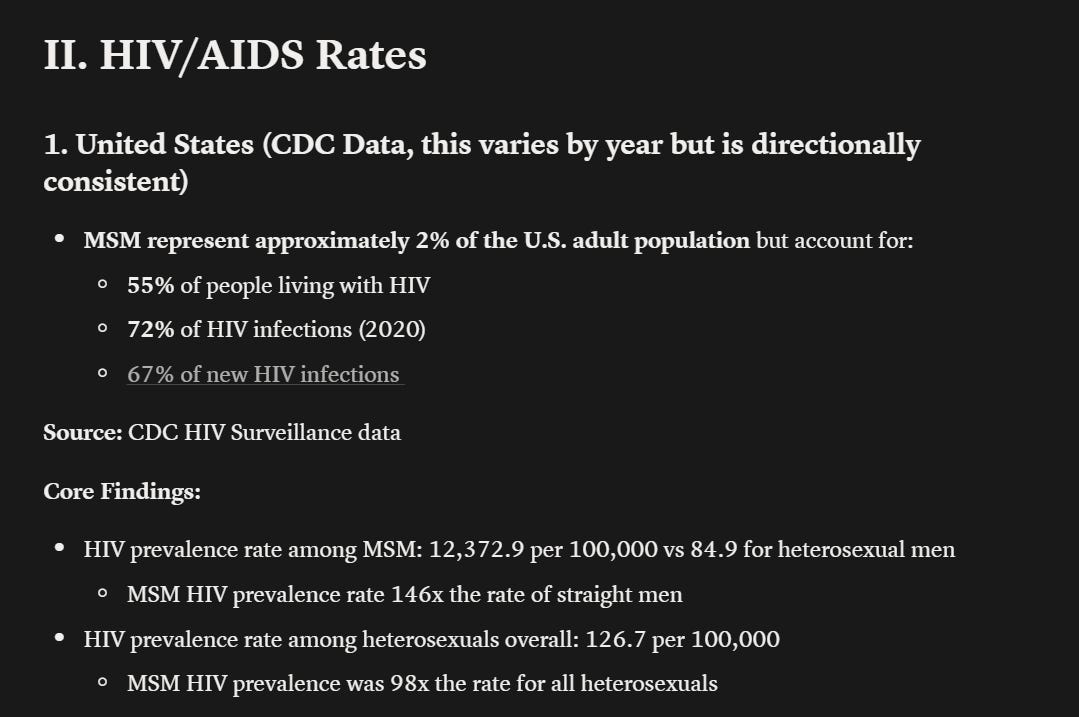
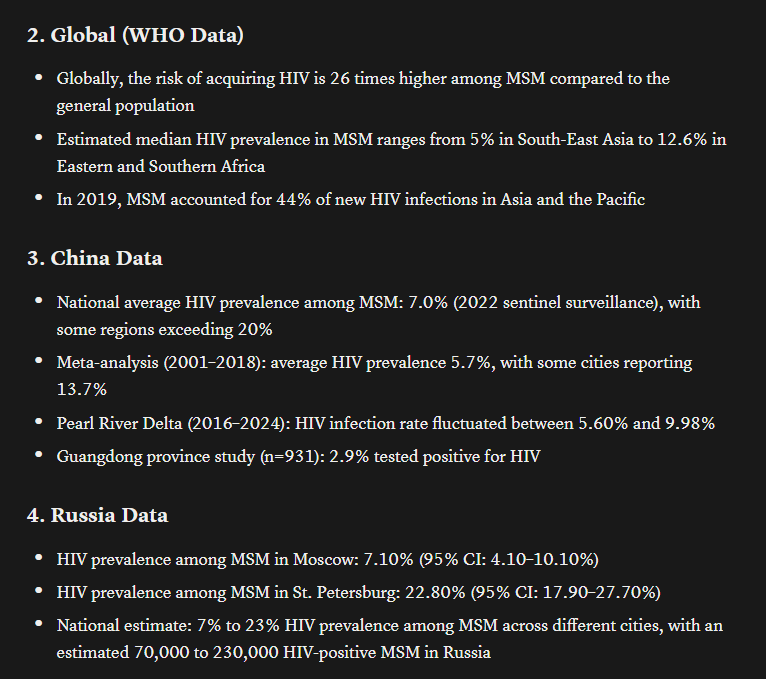
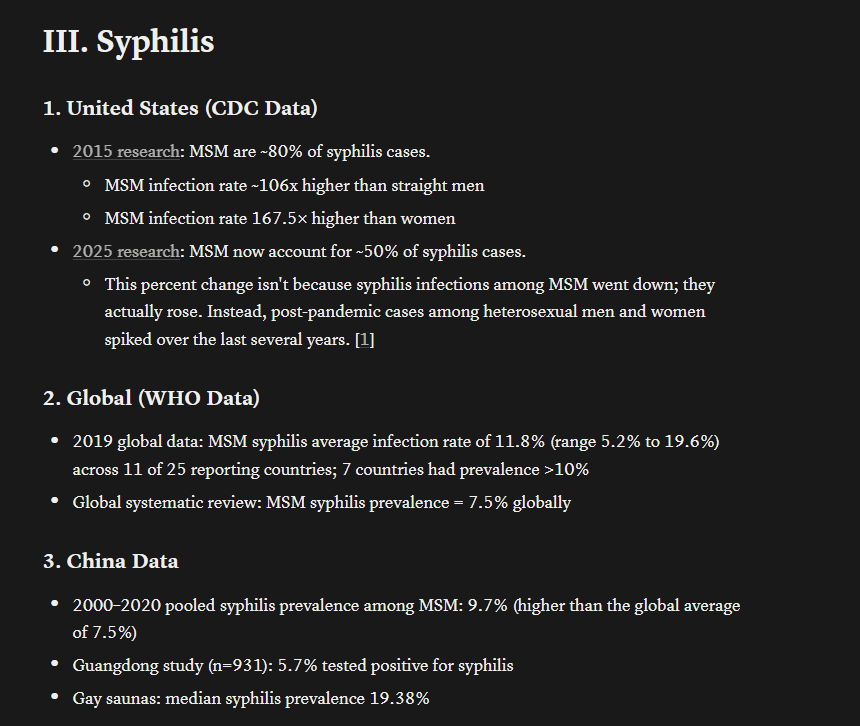
Keep in mind gay men make up ~2-4% of the US population (with similar rates in other nations), yet account for the following:
Disease
MSM = “men who have sex with men” (gay and bisexual)
HIV
The concentration is drastic.
Syphilis:
Gonorrhea:
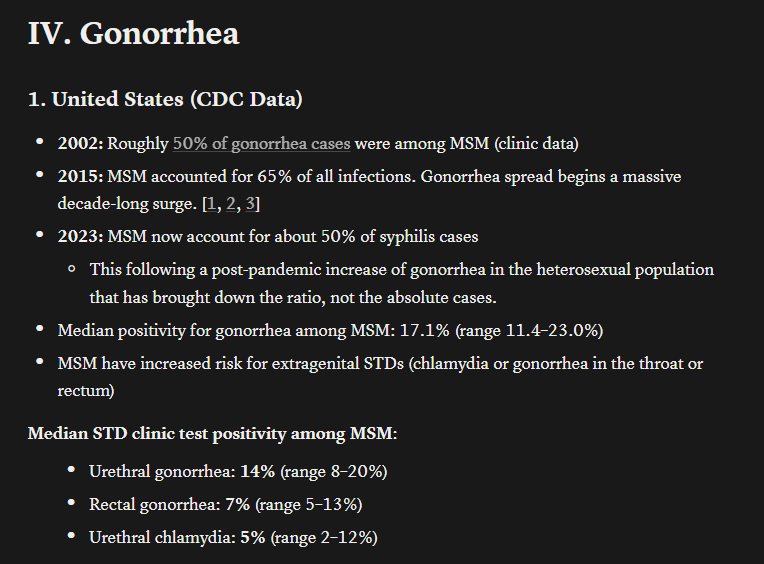
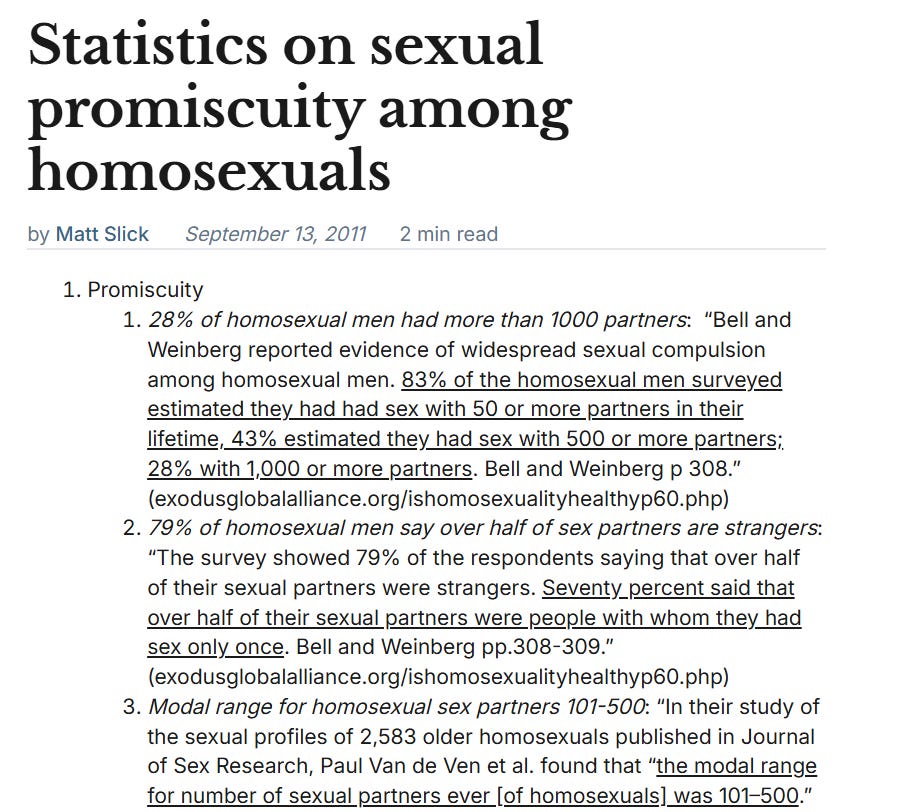
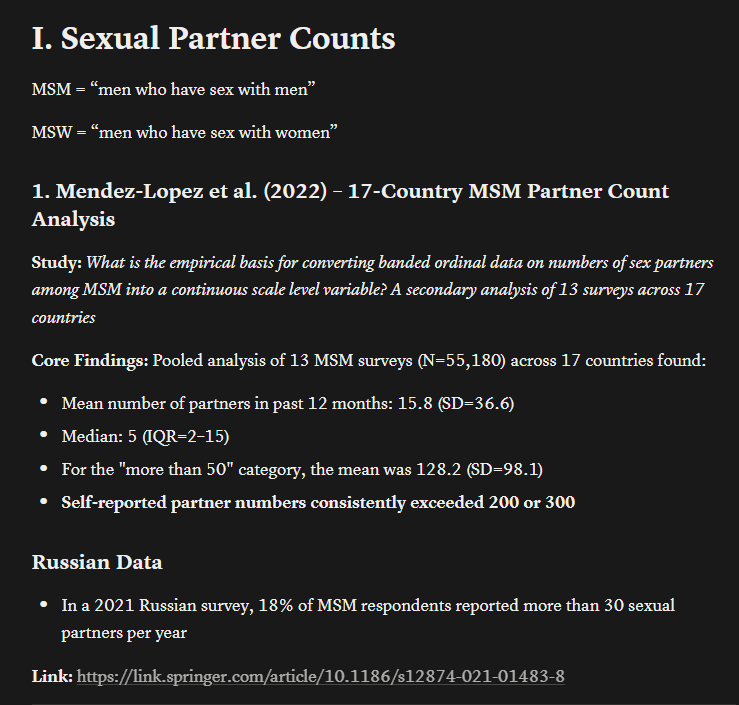
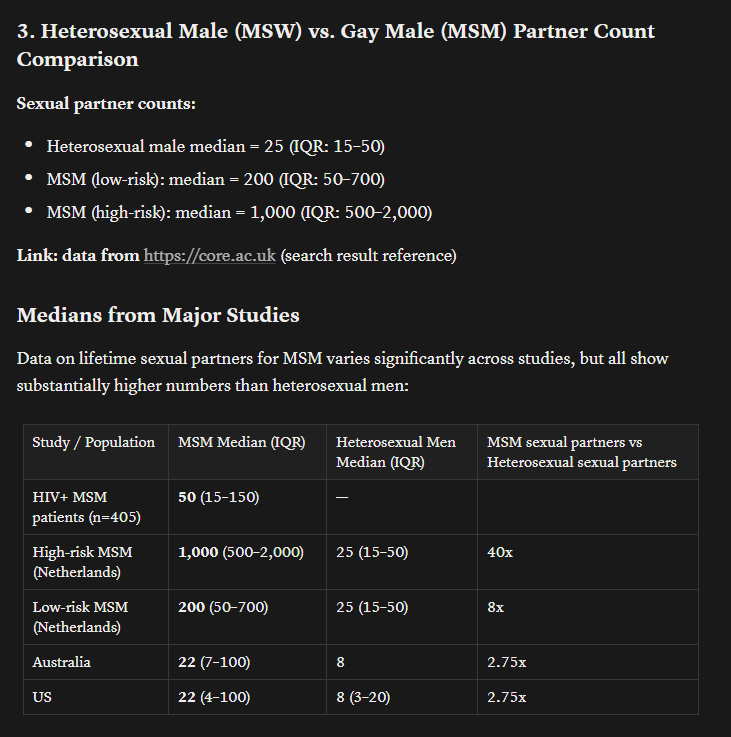
Sexual Partners and Promiscuity:
Disease requires transmission. MSM partner counts are vastly higher, providing a network for STD spread.
Incest:
The data on homosexual rates of child sexual abuse, pedophilia, and incest are the most aggressively suppressed, and their ramifications are the most actively destructive.
The BIS applies to more than just microbiology.
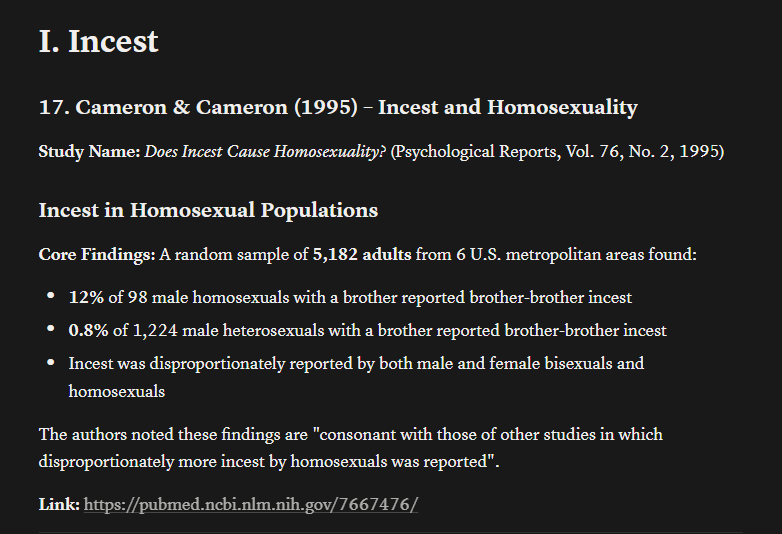
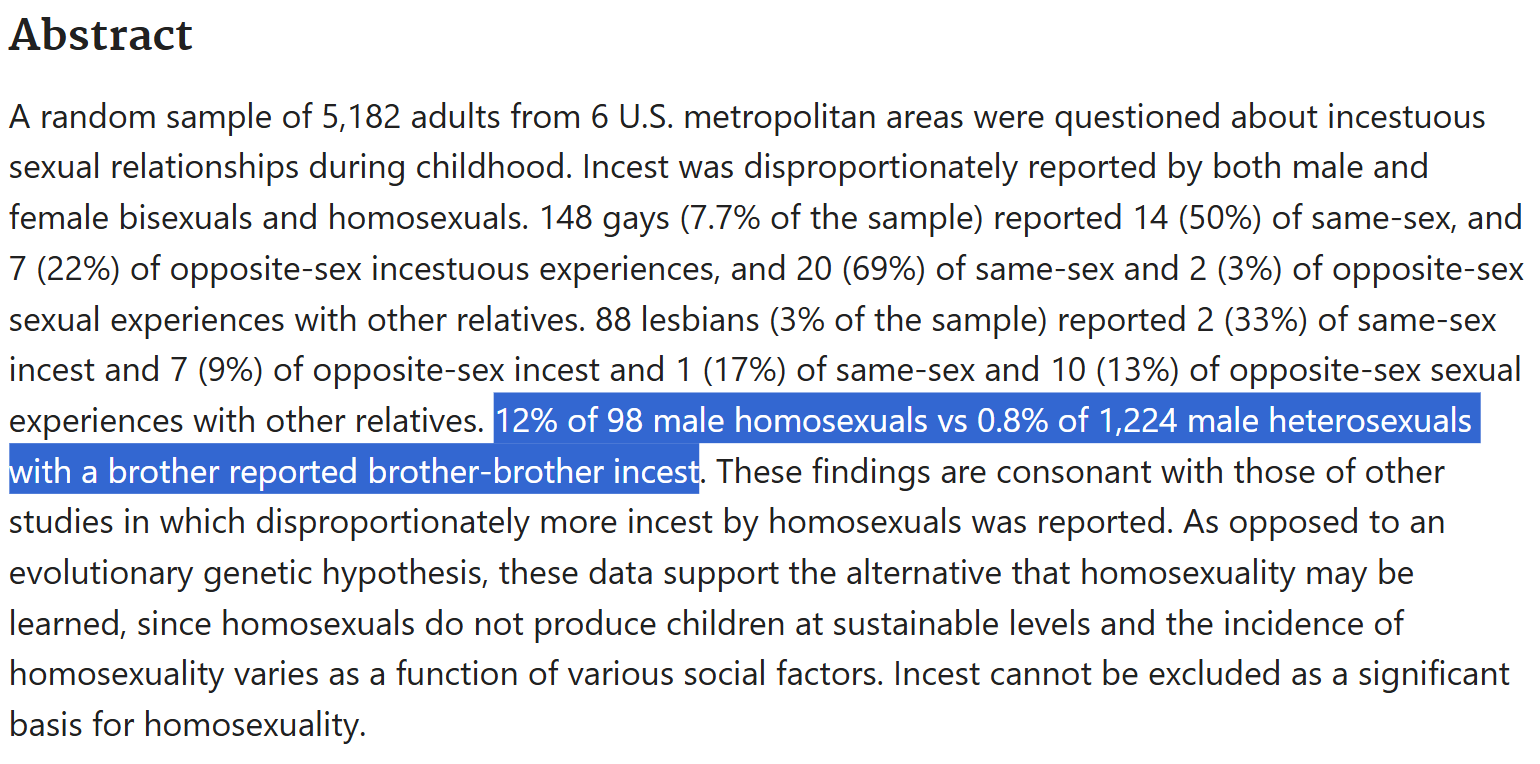
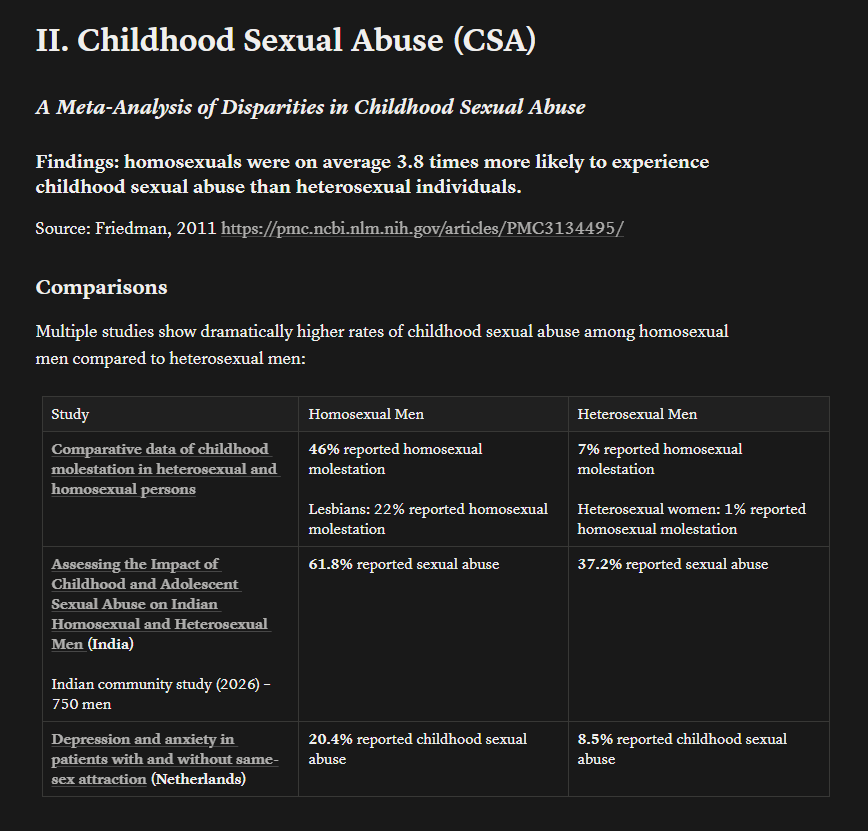
Childhood Sexual Abuse and Victimization:
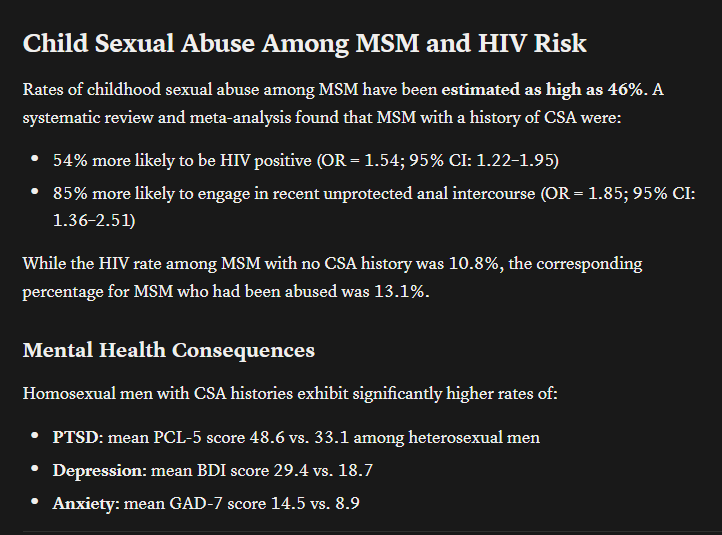
Gays are abused at dramatically higher rates in childhood. These disparities are substantial and replicated.
Note the mental health consequences:
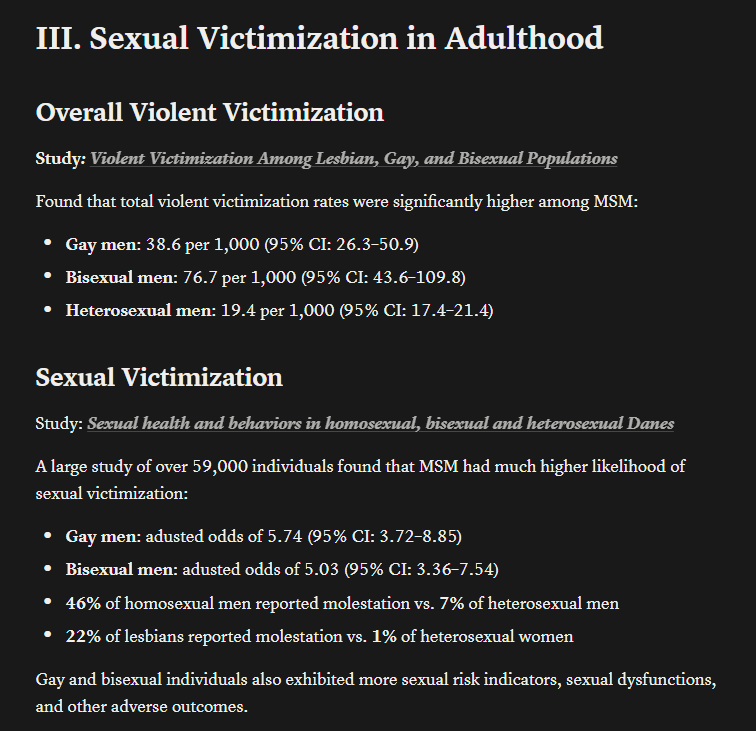
Pedophilia:
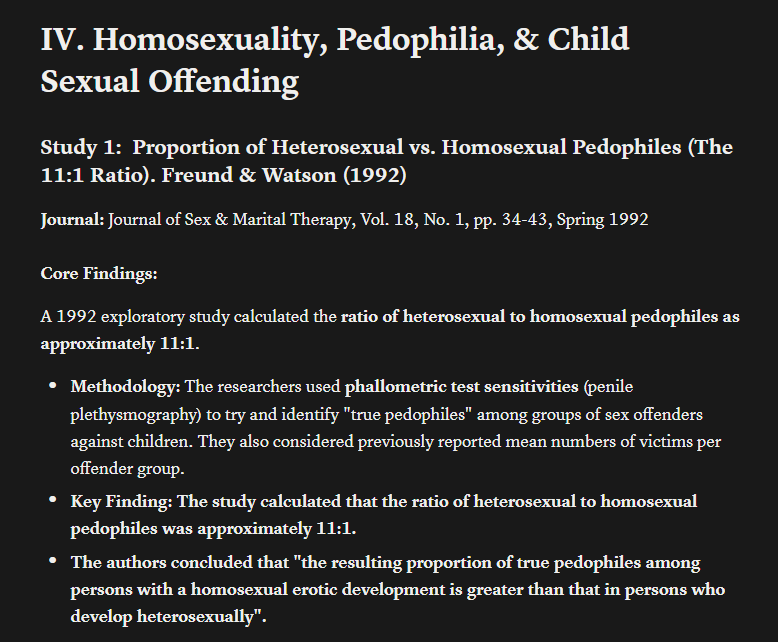
Note the ratios and the asymmetries:
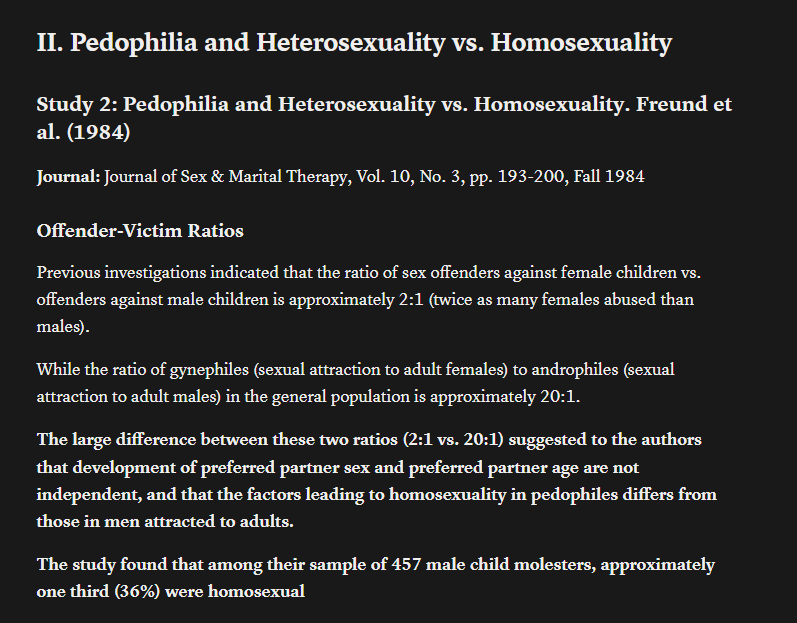
Birth order, homosexual development, and pedophilia:
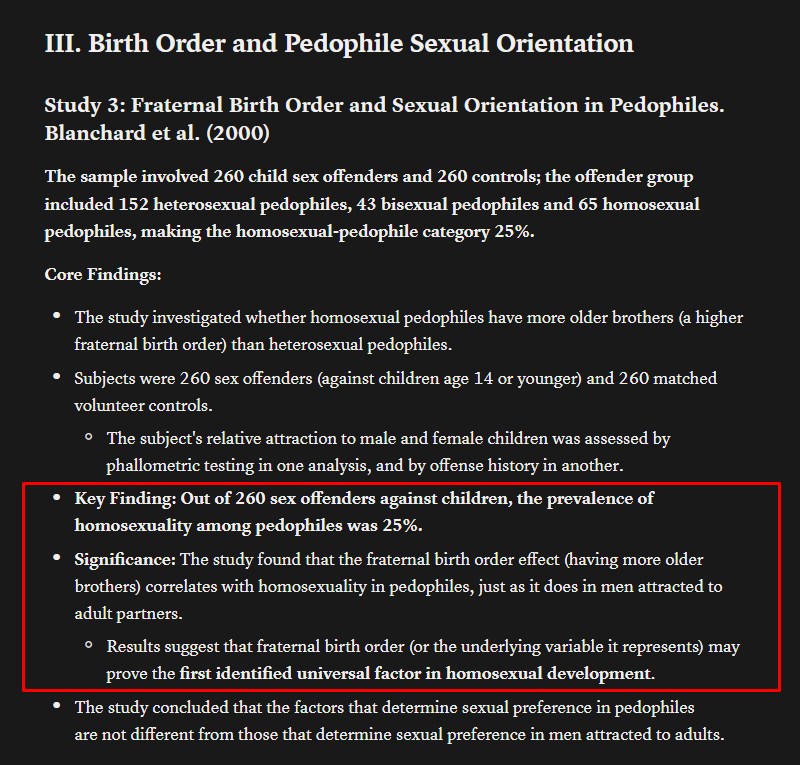
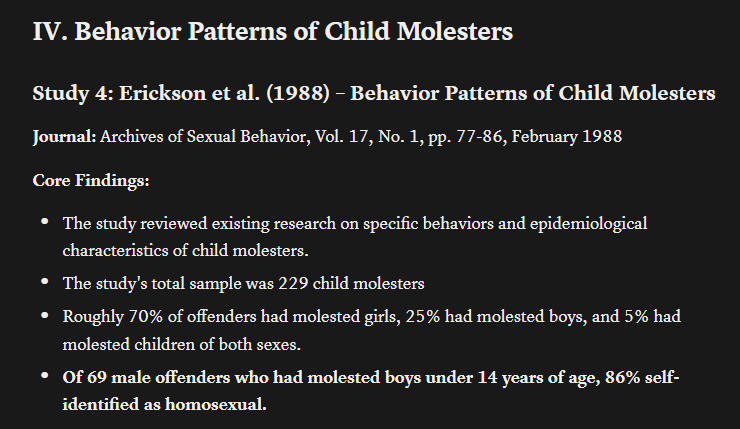
The BIS is invoking valid reactions to counteract pathogen spread, high abuse potential, and dysgenic activity. “Love is love” sloganeering doesn’t rebut this severe reality and its repercussions. Embodied disgust reactions cannot be ideologically scolded away, nor should they be.
Parasites and Behavioral Impacts
There’s concrete evidence that parasites manipulate host characteristics to facilitate their spread. A documented human case is Toxoplasma gondii effects on reaction times, testosterone, and other characteristics. There’s plenty more examples in the animal kingdom. This has implications for any abnormality that impedes reproduction and correlates with extreme-outlier behaviors, namely homosexuality.
Male homosexuality carries enormous fitness cost: gay men have roughly 80% fewer biological children than straight men. Its heritability is low (~25%). A purely genetic cause is infeasible: any allele producing homosexuality would be eliminated within a few generations under such intense negative selection. Something other than inheritance is sustaining it.
Within the second research document The Moral Genotype II: Parasites, Behavioral Changes, and Sexual Transmission you’ll find studies covering cognitive, behavioral, and physical effects associated with parasites, microbiomes, and disease.
These excerpts are taken from the second document, referencing the paper Infectious Causation of Disease: An Evolutionary Perspective. If this topic interests you, I recommend you read the research documents. The findings around gut microbiomes are particularly notable.
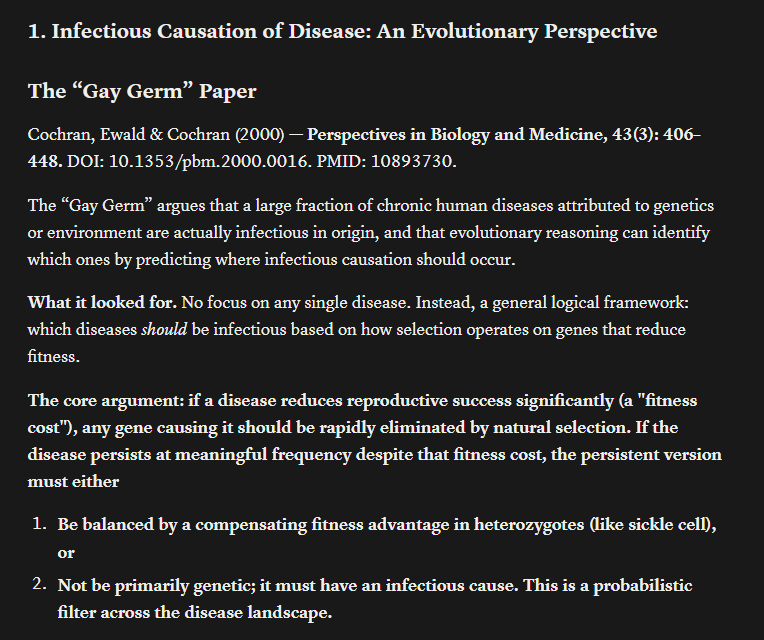
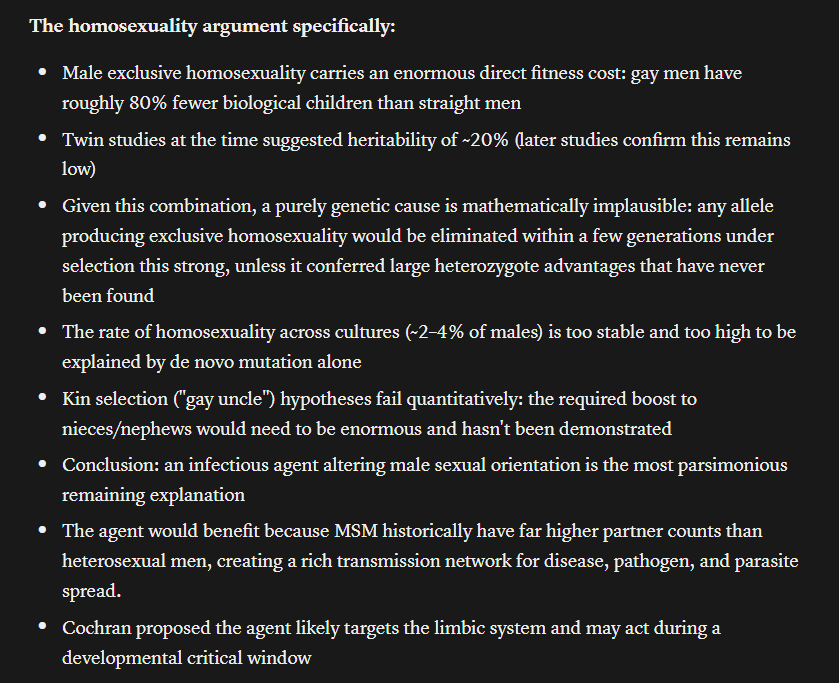
Political discourse obfuscates this biological basis beneath twenty thousand words of moralized storytelling. Denying that an orientation correlates with catastrophic rates of infection and exploitation because it’s emotionally inconvenient refutes nothing and makes it impossible to address.
The BIS evolved to detect precisely this kind of rampant harm. Pretending it lacks legitimate origins only results in more disinformation, more victims, and more suffering. This needs to be taken seriously.
VIII. Sex Differences: Male & Female Baselines
A bifurcation between men and women adds nuance to political affiliation. On average, men and women score similarly on disgust, save for one axis.
Sex differences and similarities in disgust sensitivity and Microbes, mating, and morality:
0 is ‘not disgusting’ and 6 is ‘extremely disgusting’:
Pathogen disgust: women 3.94, men 3.76
Moral disgust: women 3.81, men 3.53
Sexual disgust: women 4.03, men 2.19
The sexual-disgust gap is enormous: ~1.51 standard deviations higher for women.
This tracks vastly different risks of sex. Mating misjudgment costs a man minutes and a shot of protein. It can cost a woman nine months, and then some. This heightened vulnerability tracks well-documented higher rates of female neuroticism, which shares variance with disgust. Instincts push her toward “the ick” earlier and more often.
If disgust sensitivity predicts political orientation, and women score higher in a major category, they should vote further right than men. They do not. Women vote left/liberal at greater rates (research linked here and here).
I have a methodological solution that’s testable.
Biofoundational hypothesis:
I think a measurement error is occurring. Disgust provides a within-sex signal, not a between-sex one.
Elevated sexual disgust is an evolutionary default setting for women. Comparing her score to his is applying one unisex metric while ignoring different threat calibrations. Women don't have greater sexual sensitivity because they're more conservative; they have it because sex is costlier for them. The baseline is materially different. The political diagnostic isn't found in an absolute score, but the deviation from sex-specific mean and distribution.
Comparisons must be made apples-to-apples to yield predictive worth. If disgust studies pool male and female data without sex-indexing, they’ll systematically misclassify high-disgust women as conservative and low-disgust men as liberal, when both may simply be near their natural baseline.
A woman scoring 5 where the female average is 4 is expressing something different from a man scoring 5 where the male average is 2.1. She’s one unit above her baseline; he’s nearly three above his. Treating those as equivalent scores confuses altitude with irregularity.
This also reframes the response to male homosexuality discussed in the previous section. If disgust is a within-sex signal, then liberal and conservative straight men displaying similar physiological response is evidence that male sexual disgust has a floor high enough to universally produce that response.
Within-sex scores provide the benchmark; political prediction is found through deviations from it.

I looked up whether any studies do what I’m proposing. A fair number of the major disgust-politics studies control for sex, and some test whether the disgust/politics relationship differs between men and women. What I didn’t find was treating disgust as a deviation from a sex-specific baseline (referencing a sex-standardized score or percentile) and then using that relative position as the political predictor. I think this would be very valuable to implement.
IX. The Four Boundaries
Conservative sensitivities emphasize boundaries of body and nation: cleanliness, integrity, familiarity, and sanctity of form.
Four categories organize this. Three operate at individual scale. The fourth operates at civilizational scale and is extraordinarily important and formative in ways we don’t fully appreciate.
1. Sexual Boundary
The largest partisan divergence.
Male homosexuality reliably elicits disgust in conservatives.
BIS discrimination is anti-contagion, not anti-sex. An attractive woman in pornography is processed through approach/reward circuits (reproductive, low transmission threat). Two men kissing provokes avoidance/contamination (non-reproductive, high transmission threat).
Biofoundationalism hypothesis: I’d expect these would predict conservatism at the neurological level:
Public sex displays, fetishistic activity, paraphilic extremes, group sex, bestiality, radical deviation from sexual norms.
2. Pathogens
Rotting flesh, feces, bodily fluids, visible disease, open wounds, insects in food. Conservatives exhibit stronger responses to these.
Biofoundationalism hypothesis: these would predict conservatism at the neurological level:
Homeless encampments, open prostitution, street filth, bodily exposure, intravenous drug use.
3. Body Envelope
The violation of expected bodily form. Breaching that boundary registers as contamination and diminishes physical integrity.
Conservatives are more reactive to images that remind you’re a permeable biological organism.
Biofoundationalism hypothesis: these would produce politically predictive physiological responses:
Excessive tattoos or piercings, body modification, open surgery, transgender displays, graphic bodily violence, the deliberate blurring of male/female presentation and adult/child sexual content.
Any transformation of the body into something unnatural, unbounded, or mutilated.
The first three categories operate at individual/local scale. The fourth exists on collective scale. It has civilizational implications.
4. The Group Boundary
This shapes societal penchant for authoritarianism, collectivism, and ingroup/outgroup emphasis.
The Behavioral Immune System Shapes Political Intuitions, Opposition to Immigration: BIS applies to immediate and potential contagions. Generalizing from physical unfamiliarity to social unfamiliarity.
Social triggers: mass immigration, foreign enclaves, unfamiliar food/smells, no-go zones.
Outsiders evoke BIS tagging as threats via norm disturbances, especially those who look and smell different, or have unusual cultural practices around food and hygiene.
This isn’t “racism” in the way it’s typically moralized. The BIS extrapolates from “unfamiliar food might be toxic” to “unfamiliar people might carry disease”.
A group of cross-national studies found that historically higher pathogen prevalence is associated with greater collectivism, conformity, obedience, authoritarianism, restricted sexuality, and lower trait Openness and Extraversion.
Pathogen prevalence predicts cross-cultural variability in individualism/collectivism: data on disease spread strongly predicts collectivism vs individualism, controlling for wealth and other confounds.
Origins of cultural differences in conformity: high-pathogen-load regions historically develop more collectivist, outgroup-avoidant social norms.
Predicts cross-national differences in conformity at r = .49; valuing obedience over self-reliance at r = .48.
Pathogens and Politics: Evidence That Parasite Prevalence Predicts Authoritarianism: parasite and famine prevalence independently predicted country-level authoritarianism and valuing obedience.
Pathogens, personality, and culture: Disease prevalence predicts variability in sociosexuality, extraversion, and openness: higher disease negatively predicted levels of extraversion, openness to experience, and unrestricted sexuality.
These studies converge. National levels of collectivism, conformity, obedience, authoritarianism, and restricted sexuality track historical prevalence of infectious disease. These are incredible findings, durable across studies and continents.
Geographic distribution of personality traits and political organization are largely adaptations to pathogens. Cultural practices deemed “social constructs” ignore their biological roots directed at parasites.
This data corroborates a Biofoundationalist claim: culture isn’t a top-down arbitrary creation. It’s a bottom-up adaptation to ecology and agriculture. This research validates observations on temperamental distributions and governance found in the essay Temperamental Residue.
Causal sequence, psychological layer:
High pathogen load → intensified BIS selection → stricter ingroup boundaries, lower trait Openness → more conformity, authority-deference, sanctity-emphasis, and sexual conservatism.
Causal sequence, biological layer:
Parasite ecology → disgust calibration → temperamental distribution (genotype) → political-cultural expression (phenotype).
The BIS is the proximate mechanism; survival pressures are the distal one. Immunological, not ideological. Bottom up. The environment determines the expression.

X. Moral Disgust: Anger Saying “Gross”
Core disgust precedes moral judgement: “I feel revulsion. Thus it’s wrong”. Subconscious.
Moral disgust follows moral judgement: “I’ve concluded this is revolting. Thus it’s wrong”. Conscious.
Conservatives have genuine disgust mislabeled as bigotry. Liberals may have genuine disgust mislabeled as ideology. We’ll look to physiological hallmarks to tell us which is which.
Conservative disgust maps onto ancestral pathogen-avoidance and non-abstract threats; it has a lower activation threshold and wider generalization. Whereas liberal disgust is often moral. I disagree with this designation. Since it isn’t pre-rational nor subconscious, I believe this to be outrage under the banner of “gross”. Let’s review.
Liberal Moral Disgust
The Care/Harm moral foundation is the dominant liberal channel.
Acts involving harm or cruelty to those perceived as vulnerable.
Biases/slurs/bigotry against weaker classes (note: these are just words, symbolic hostility, not literal vectors for disease or bodily violation).
Moral-transgression experiments detect facial activity associated with disgust, but this also contains the impulse to confront/punish. This is a disgust/anger hybrid at best.
Ecological corruption: pollution, industrial waste, environmental degradation.
This strikes me as fair disgust application because it partly recruits actual pathogen concerns while extending it metaphorically.
Biofoundational hypothesis:
If studied, I'd expect acute ecological contamination to produce the closest thing to authentic disgust among liberal-coded triggers. Specifically for concrete contamination (a polluted river) rather than abstract contamination (carbon emissions, “hate speech”).
The further it’s removed from tangible pathogen cue, the more the response resembles outrage.
Under this expanded definition, conservatives have 'moral disgust' too, but I find the category misleading and there's already ample evidence for rightwing disgust. You can infer what induces conservative ethical angst via the Moral Foundations framework, developed by psychologist Jon Haidt:
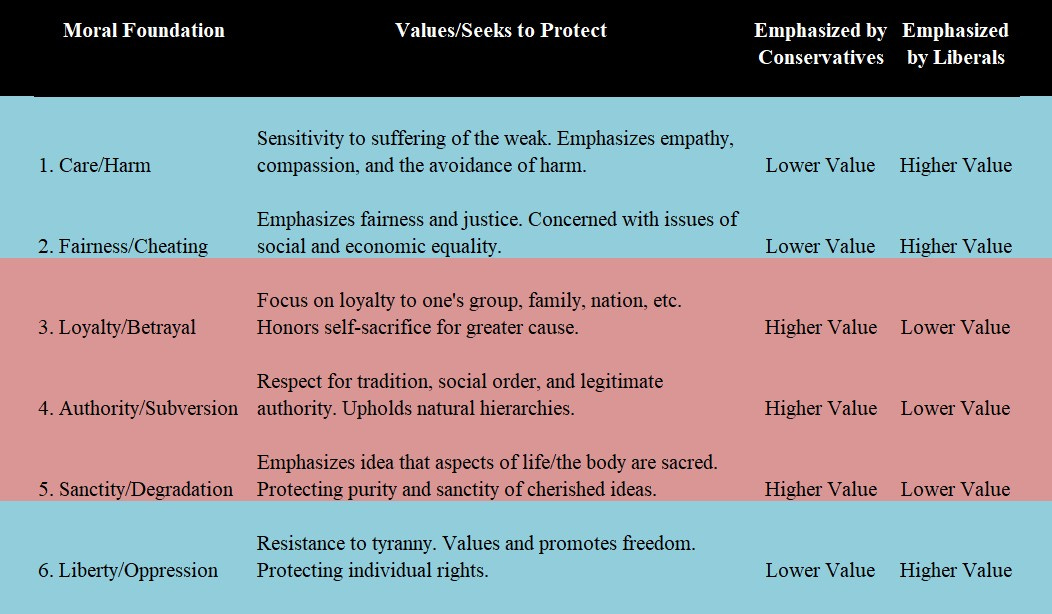
Evidence that moral disgust isn’t true disgust:
Autonomic correlates of physical and moral disgust: directly compared the two emotions.
Results: physical disgust produced mainly parasympathetic activation without heart rate change.
Moral disgust produced decreased vagal tone, increased heart rate, and autonomic imbalance. A mostly sympathetic process, matching standard anger responses.
Numerous studies reinforce how disgust and anger are fundamentally different autonomic indicators:
Sources: Autonomic Nervous System and Emotion; A mapping between three moral emotions (contempt, anger, disgust); Intersection of disgust and fear; Psychophysiological Correlates of Disgust; Aiming for the stomach and hitting the heart: Sources for disgust reactions
Being offended is not the same as being disgusted, even if narrated otherwise. This must be determined physiologically not semantically. What It Does > What It Says.
Standard disgust begins with embodied aversion and acquires moral language afterward. Moral disgust starts with righteous indignation that’s entangled with condemnation and rage.
Biofoundational comment: retire the term 'moral disgust'. It’s enough of a category error to warrant a different designation. Autonomic evidence reinforces this. The accurate label is moral outrage.
Anger characteristically closes distance; disgust characteristically creates it. Anger’s grammar entails specifying a wrong and a reason. Disgust brings no argument; reactions are its reasoning.
XI. Heritability & Distributions
Disgust sensitivity is heritable. Twin studies are the gold standard for partitioning genetic and environmental influence.
Quantitative genetics of disgust sensitivity: twin studies found significant genetic components to variation in disgust reactivity.
Genetic and Environmental Influences on Disgust Proneness: a large twin-and-sibling study found meaningful genetic basis.
The studies attribute genetics to roughly 35% of the variation; I think this materially understates it.
The Blank Slate prior is an active institutional ideological commitment. Every politically consequential behavioral-genetic study I've read is filled with hedges to undermine biological origins and inflate environmental attribution. Consistently diminishing ‘nature’ to sell the story of ‘nurture’. The incentives are apparent: a study that 'discovers' environmental influence gets published and promoted without objection. One that finds strong heritability gets an extra round of review and inundated with caveats. This bias is excessive.
Political orientation itself is heritable, ranging from 40-60%. Temperament is also heritable. I’ll review this in a separate chapter focused on personality traits and politics.
How Biofoundationalism conceptualizes heritability:
At individual resolution: disgust calibration is materially genetic. You inherit a threshold.
As we saw in The Group Boundary section: at population resolution, which thresholds predominate is a product of environmental selection pressures.
High-pathogen ecologies calibrate for high-BIS genotypes; low-pathogen ecologies, low-BIS genotypes.
Individual heritability produces the variation. Ecological selection creates the distribution.
Together they explain why disgust sensitivity predicts politics at the individual level and why collective political expressions (authoritarianism, conformity, etc.) tracks pathogen history at civilizational scale.

XII. Moral Genotypes, Political Phenotypes
Disgust isn’t the only biological channel that betrays partisanship. Political identity is inscribed in brain activity, brain structure, resting-states, risk assessments, and somatic responses. The organs confess before the mouth does.
Political voting patterns and temperaments recur consistently across societies and timelines. Nature doesn’t do coincidences at scale. Morality is a genotype; its political manifestation is its phenotype.
Here’s a recap of neurological evidence. These can be found in The Moral Genotype I and The Cathedral & The Ceiling, consolidated for reference:
Political affiliation predicted with 83% accuracy from brain activity alone.
Democrats show greater left insula activity during risky decisions. Republicans show greater right amygdala activity. Source.
Politics predicted with 72% accuracy from brain structure alone (just size of regions, no activity)
Liberals: larger anterior cingulate cortex. Conservatives: larger right amygdala. These results replicated.
Perhaps the most remarkable finding. Functional connectivity signatures of political ideology: brain connectivity classified ideology while participants sat quietly doing nothing.
The amygdala, inferior frontal gyrus, and hippocampus fire differently in liberals and conservatives at rest. No political stimulus, tasks, or prompts. Idle, and still broadcasting allegiance.
Three tasks had strong political links: empathy processing, episodic memory, and reward evaluation. This replicated.
Neuromodulation of group prejudice and religious belief: Provides causal evidence. Disabling the posterior medial frontal cortex (pMFC) made participants more ideologically liberal: softening threat sensitivity, reducing ingroup preference, and lowering belief in God/religion.
It’s causal (not association) because intervention altered ideology.
Political attitudes vary with physiological traits: individuals with lower physical reactions to sudden noises and threatening images supported liberal or pacifist policies.
Those with elevated somatic responses favored defense spending and capital punishment.
Conservatives perceive ambiguous faces as more threatening,16 respond to threatening stimuli with more aggression,1 and have greater blink startle and skin conductance to unexpected or threatening images.59
Each of these findings is independently significant. Together the pattern is unambiguous: moral dispositions are embedded in the body, then show up in the argument. When brain structure and resting states foretell ideology before a single word is spoken, the idea that reasoned debate produces beliefs becomes difficult to maintain.
Most political "debate" is theater that sorts rather than persuades. It helps the temperamentally similar find each other and coalesce. The meek libertarian, principled conservative, and compassionate liberal don't get "converted" by essays; they’re identified by them. You have more in common with political allies than you think.
You won’t reason people out of positions they didn't reason themselves into.

XIII. Dyads, Collectives, & Body Before Ideology
Political stances present themselves propositionally. They tell a top-down story:
Immigration is good for GDP or hurts median wages
Abortion is healthcare or murder
Gay marriage is victimless or degrades the sanctity of marriage
Criminality is improved through rehabilitation or consequences
But beneath narrative overlays is an organism with bottom-up coding assessing what it’s encountered:
Disgust: That’s contaminating. Remove it.
Anger: That’s an offense. Punish it.
Threat: That’s dangerous. Fortify the boundary.
Contempt: That’s beneath us. Demote and ridicule it.
Sympathy: That’s suffering. Protect it.
Curiosity: That's novel. Approach it.
Familiarity: That's ours. Maintain it.
Disgust is the body’s most primitive political stance; its original boundary enforcement, operating millions of years before the first word, letter, law, or constitution existed. Partisan argument about who belongs, what’s permissible, and what’s contaminating is a linguistic cherry atop an embodied cake that still eats just fine without it.
The instinct reacts first; the argument arrives afterward, wearing a wig of reasoning. Political doctrine is the phenotype. Morality is the genotype. The environment determines the expression. This is the basis of gene-environment interaction: applied to the one animal that fancies itself exempt from it.
The BIS scales fractally from individual to civilization.
At micro scale: don’t eat the rotten meat.
At middle scale: don’t sleep with the risky partner.
At macro scale: don't let the unfamiliar practice, person, or custom breach the boundary.
We evolved within collectives.
Our moral orientations weren’t individually selected for self-serving correctness but for group-level resilience. This necessitates variation. Competing moral blueprints are a feature, not a bug, forming a stronger whole. We’re complementary organs cultivated within a collective body. None of us evolved in isolation picking berries by ourselves! Not even the libertarians!
Our values, priorities, principles, and motivations evolved to be in productive conflict. Dyadic, symbiotic moral polarities act as an inhale and exhale for civilizational breathing. Explore/Exploit. Risk/Reward. Obligations/Options. Consequence/Compassion. Conflict/Consensus. Verification/Trust. Honor/Dignity. Masculine/Feminine. Conservative/Liberal. Order/Chaos.
These are all dyads: each side defined in relation to the other. Political debate negotiates these ratios through policy filters. You need elements of each. The pathology is found in imbalance.
Conservative and liberal beliefs are different decision criteria under uncertainty:
Each is optimized for different failure modes. The environment determines which failure is costlier. The politics and priorities of a nation in prosperity are very different than in poverty. The same policy that’s prudent in one setting becomes reckless in another.
One constitution prioritizes avoiding false negatives: “I’d rather exclude ten safe things than admit one dangerous thing”.
The other prioritizes avoiding false positives: “I’d rather accept the risk of a dangerous thing than wrongly exclude ten harmless things”.
The low-disgust liberal temperament discovers, trades, experiments, admits, mingles, and explores. But can become porous. Chaos.
The high-disgust conservative temperament preserves, filters, fortifies, excludes, and sanitizes. But can become rigid. Order.
This is Explore/Exploit, Risk/Reward, Verification/Trust, and Honor/Dignity expressed through immunology and morality. And they're all derivatives of the tension between entropy and structure, order and chaos. Never forget that physics flows through all things.
A civilization incapable of boundaries becomes vulnerable to disease, crime, exploitation, disorder, corruption, formlessness: an ocean. A civilization governed entirely by boundaries becomes distrusting, punitive, incurious, stagnant, hostile, ossified: a prison.
One civilization dies of infection; another dies of sterility. One disposition detects breaches, another permits exploration. One asks what must be kept out. The other asks what might be allowed in.
“Somewhere between order’s prison and chaos’ ocean stands a house with a pool. Structure enough to shelter, freedom enough to live. Orderly enough for safety, chaotic enough to swim. This is where civilizations try to live.”
The vote follows the temperament. The temperament emerges from biological substrate. The substrate obeys thermodynamic law. There’s no point in this sequence where an unembodied spirit intervenes to override the body it inhabits. The insula fires, mouth opens, and argument arrives… believing itself the cause of what it’s merely describing.
These aren’t limits on life but preconditions for it. Gifts allowing us to exist and thrive. What we call values are ancient bodily grammars that let human collectives survive long enough to invent the word “values”. Biology precedes ideology.
All living things have immune systems. Countries do too. A nation is a living thing by virtue of being composed entirely of living things.
Sound on.
A lot of work goes into these essays. If you enjoy them, please give them a like, subscribe, share, and comment.
You can show your appreciation by becoming a paid subscriber, or donating here: 0x9C828E8EeCe7a339bBe90A44bB096b20a4F1BE2B
Biofoundationalism Corpus: Chapters and Application
This is the current Biofoundationalism corpus. Numbered parts are core chapters. Subgroup essays fall under Applied Biofoundationalism: examples, extensions, and applications of the biological and thermodynamic frameworks developed in the chapters.
Each piece can be read independently, though it’s best understood when read in sequence.
Very, very good. This articulates the observable. I have a sense we(society writ large)suspect the above is true, Inuit it, and see it, but reject it. Words are awfully pretty and self satisfying after all.
Again, please continue. Each essay read ends up being a quality education and a useful map.
All interesting, but could be much shorter and still make all the points.